
Add us as your preferred source on Google to see more of our content in Search.
 Add to Preferred Sources
The European Union (EU) has committed an additional EUR 18 million to its partnership with the International Organization for Migration (IOM) known as the EU-IOM Joint Initiative for Migrant Protection and Reintegration in the Horn of Africa (EU-IOM Joint Initiative).
The funding brings to EUR 43 million the EU’s total commitment to the EU-IOM initiative in the region, which aims to save lives and improve assistance for migrants along migration routes originating from the Horn of Africa.
In the Horn of Africa, the EU-IOM Joint Initiative – running from March 2017 to March 2021 – is mainly focused on Ethiopia, Djibouti, Somalia and Sudan. Three of those countries – Ethiopia, Somalia and Sudan – combined to account for the largest migrant movement on the continent.
Backed by the EU Emergency Trust Fund for Africa, it covers and was set up in 2016 in close cooperation with a total of 26 African countries in the Sahel and Lake Chad, the Horn of Africa and North Africa regions. The programme facilitates safer, more informed and better-governed migration for both migrants and their community through the development of rights-based and development-focused procedures and processes on protection and sustainable reintegration.
Moreover, the initiative allows migrants who decide to return to their countries of origin to do so in a safe and dignified way. It provides reintegration support to enable returning migrants to restart their lives in their countries and communities of origin through an integrated approach, which may include individual assistance as well as community-based support and structural interventions.
Much of the work in the Horn of Africa takes place in Ethiopia, which has a population of over 100 million. The main migration routes in the Horn of Africa are the Northern and Western route to Libya, Egypt, and Europe; the Eastern route to the Middle East and beyond; and the Southern route to South Africa.
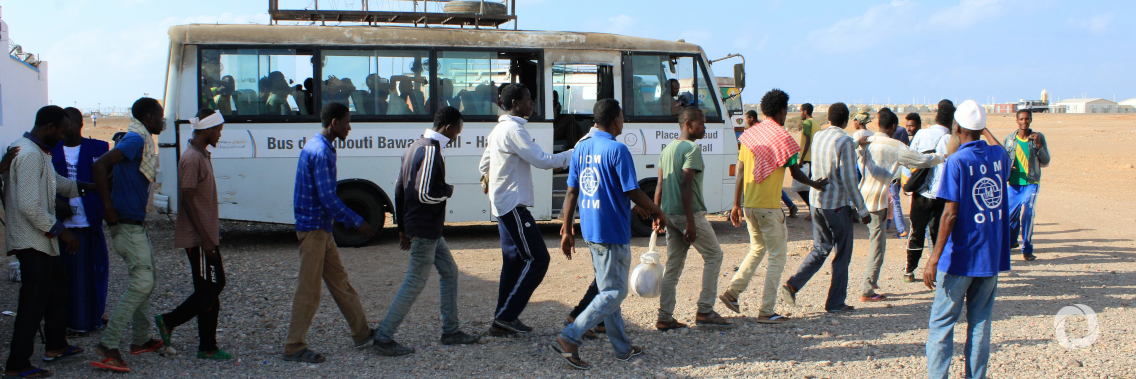
From April 2018, the bulk of the 3,804 migrants that the EU-IOM Joint Initiative in the Horn of Africa assisted to return to their countries of origin were Ethiopians on the Eastern Route through Djibouti to Yemen and the Gulf countries.
To date, the programme has made substantial achievements establishing mechanisms for returnees to benefit from sustainable economic, social and psychosocial reintegration support.
Original source: IOM
Published on 24 May 2019