
People in North Korea trapped in vicious cycle of deprivation, corruption and repression – UN human rights report
Add us as your preferred source on Google to see more of our content in Search.
 Add to Preferred Sources
People in the Democratic People’s Republic of Korea (DPRK) are trapped in a vicious cycle, in which the failure of the State to provide for life’s basic necessities forces them to turn to rudimentary markets where they face a host of human rights violations in an uncertain legal environment, according to a new UN human rights report.
The report, published by the UN Human Rights Office, highlights how the public distribution system in the DPRK has been broken for over two decades and how, as people seek to eke out a living in a legally precarious parallel economy, they are exposed to arbitrary arrest, detention, and extortion.
Based on 214 first-hand accounts of escapees gathered by UN Human Rights staff in South Korea in 2017 and 2018, the report describes how the most fundamental rights of ordinary people in the DPRK are widely violated because of economic mismanagement and endemic corruption.
“The rights to food, health, shelter, work, freedom of movement and liberty are universal and inalienable, but in North Korea, they depend primarily on the ability of individuals to bribe State officials,” said UN High Commissioner for Human Rights, Michelle Bachelet.
Since the economic collapse of the 1990s, people have been unable to survive through a State-led model of centralized economic planning and distribution, which includes State-assigned jobs and the dispensation of food, clothes and other rations. As a result, working in the informal sector has become an essential means of survival – or else.
However, when people try to engage in rudimentary market activity, they face arrest and detention, including for traveling within the country, for which a permit is required.
This situation invariably leads to a series of further serious human rights violations, due to the absence of rule of law and due process guarantees. People often experience inhumane and degrading treatment in detention and are sometimes subjected to torture during interrogation and disciplinary procedures.
The UN Human Rights Chief called for far-reaching changes: “Our report is a stark illustration of how important it is that the Government tackles the country’s profound human rights problems. Only then can the endemic system of corruption which pervades all aspects of life be effectively dismantled,” she said.
The report stresses how the State has not fulfilled its obligations under international human rights law to realize the right of its citizens to an adequate standard of living. It has neither sought to modify a failed public system nor helped to establish a functional and legal private sector to alleviate the economic destitution facing much of the population.
According to UN entities operating in the DPRK, in 2019 around 10.9 million people (over 43 percent of the total population) are undernourished and suffer from food insecurity. Almost 10 million people do not have access to safe drinking water and 16 percent of the population does not have access to basic sanitation facilities, increasing the risk of disease and malnutrition. People living in northeastern and rural provinces suffer most from the lack of basic services, and the 2018 Global Hunger Index classified the level of hunger in the country as “serious” and “bordering on alarming.”
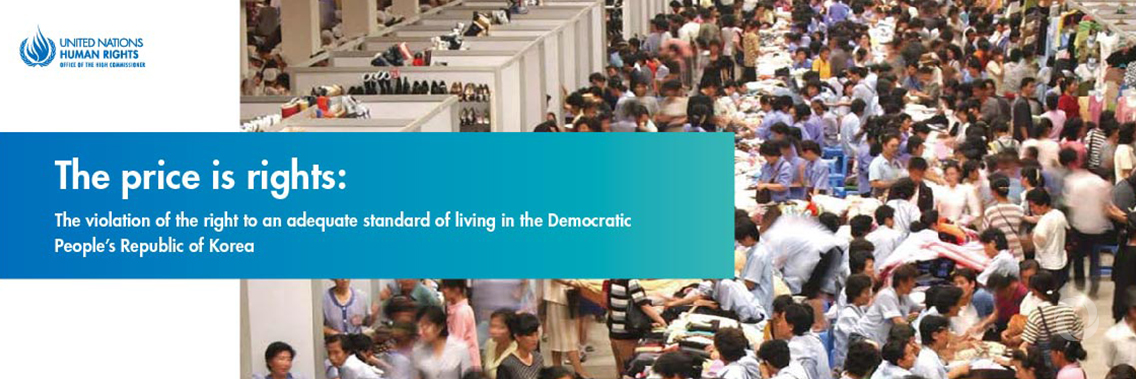
Read and download the report: The price is rights: the violation of the right to an adequate standard of living in the Democratic People’s Republic of Korea
Original source: OHCHR
Published on 28 May 2019