
Add us as your preferred source on Google to see more of our content in Search.
 Add to Preferred Sources
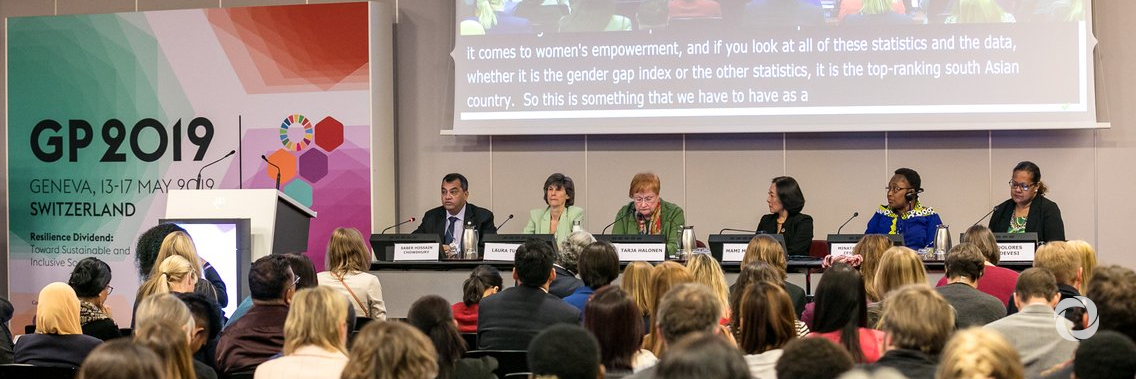
The need for women’s leadership and gender-responsive Disaster Risk Reduction (DRR) and resilience-building were at the centre of the sessions recently organized by UN Women in the context of the World Reconstruction Conference 4 (WRC4), on 13-14 May, and the 2019 Global Platform for Disaster Risk Reduction (GP), on 15-17 May, in Geneva.
Due to the gendered dimensions of disaster risk, women and girls face greater vulnerability and exposure to disasters. Women’s actual and potential contributions to DRR, including their leadership as first responders and their central role in community resilience, continue to be largely untapped assets in DRR, resilience, recovery and reconstruction strategies. Evidence has proven that harnessing women’s leadership, experience and knowledge into these efforts yields more effective initiatives. The events brought together representatives of United Nations Member States, international organizations, private sector actors, academia and civil society to advance this agenda.
As stated in the outcome documents of the 2019 Global Platform for Disaster Risk Reduction and the World Reconstruction Conference 4, participants agreed on the need to foster the promotion of women’s leadership in DRR and resilience, the importance of reflecting women’s voices at all stages of development and implementation, and highlighted the imperative of collection of data that is sex, age, and disability disaggregated.
During the session on Inequality of Risk and Women’s Leadership in Recovery at the World Reconstruction Conference 4, Dolores Devesi, the country director of Oxfam Solomon Islands, highlighted that letting women make decisions brings more inclusiveness, and local women’s organizations are often the most knowledgeable of the specific needs and capacities of affected people in the communities.
Ms. Devesi reminded the audience that “unless the barriers of inequality are broken down, women’s advancement and leadership will not go far. It is not about numbers, but also attitudes and behaviors.”
Original source: UN Women
Published on 31 May 2019