
Add us as your preferred source on Google to see more of our content in Search.
 Add to Preferred Sources
Africa is a negligible emitter of greenhouse gases, yet the continent is particularly vulnerable to climate change, the primary driver of vulnerability being the prevailing low levels of socioeconomic development.
The rains used to be predictable and it was easy for local communities and farmers to plan according to the seasons. But times have changed, and livelihoods are increasingly being affected by the reality of climate change.
The implementation of the EU-UNEP Africa Low Emissions Development Strategies (Africa LEDS) Project has demonstrated, through action on the ground and investment support tools, that strategic implementation of Nationally Determined Contribution (NDC) priorities – aligned to key socioeconomic sectors – can maximise climate and socioeconomic benefits simultaneously.
The EU-UNEP Africa LEDS Project, funded by the European Union, supported seven partner countries to establish structures at policy and operational levels, to inform implementation investment decisions on NDCs, shifting focus from traditional approaches that focus on climate benefits alone.
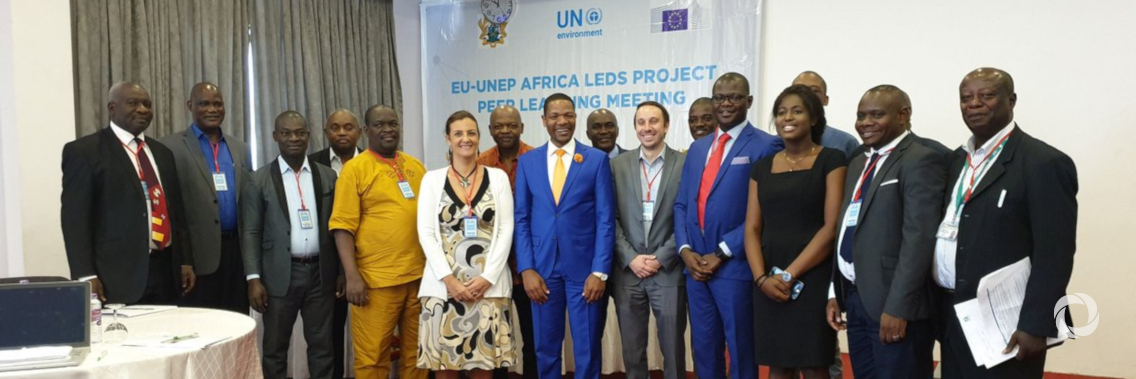
At a peer-learning meeting in Accra, Ghana, the partner countries showcased project interventions aimed at unlocking socioeconomic opportunities through Low Emissions Development Actions.
Cameroon showed that greening the entire cassava value chain using nature-based approaches of agro-forestry at the farm level, clean energy for processing and ICT for linkage to markets can create multiple income opportunities while reducing the environmental burden.
In Cote d’Ivoire, a practical demonstration of the conversion of agricultural waste in rice fields into biofertilizer and fuel briquettes proved that communities can shift from high-emitting, conventional approaches to more sustainable approaches and unlock socioeconomic co-benefits.
Kenya made significant progress in modeling clean cooking solutions – the modeling results showed that a possible saving of 2.9 million tons of charcoal could be achieved in 2030; in monetary terms, this is the equivalent of a 165 billion Kenya Shilling-saving by 2030.
The EU-UNEP Africa LEDS Project has highlighted numerous lessons which will drive Africa’s NDCs and low emissions.
Original source: UN Environment
Published on 07 June 2019