
Add us as your preferred source on Google to see more of our content in Search.
 Add to Preferred Sources
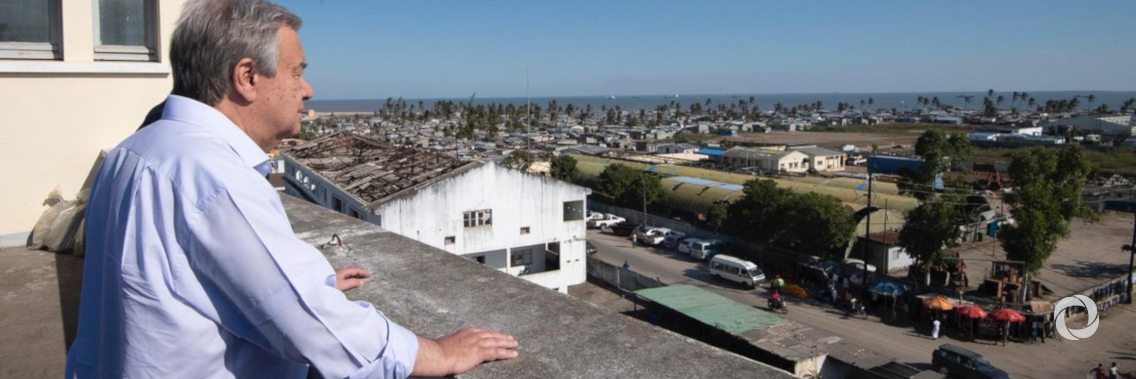
Determined children learning in classes without roofs, resilient women farming without tools or much land, and grateful people who survived a cyclone that destroyed their livelihoods; on his final day in Mozambique, UN chief António Guterres witnessed first-hand the inner strength and resilience of the storm-ravaged country’s people.
When Mr. Guterres asked a class of students: “How many of you have had your homes destroyed by the cyclone?”, almost every little hand was raised in the crowded classroom, which was baking under the hot sun because much of the roof ripped off by winds of 195-kilometer per hours when the cyclone hit.
The school, Escola 25 de Junho, is in Mozambique’s second-largest city, Beira, where 90 per cent of all infrastructure was damaged during Idai on March 14 and 15. Every day now, as people struggle to recover and rebuild, the school hosts close to five thousand children, divided into three shifts, in classes of up to 90 students.
Among the five pavilions in the school, only one structure had not been damaged by the cyclone and remained solid. It opened in February this year, just before the disaster. It was built according to UN-Habitat’s technical guidance by a programme of the Government of Mozambique as an example of how buildings could be made resistant to extreme climate events.
“That’s a great example of a culture of resilience, of how things can resist when they are built the right way”, Mr. Guterres observed.
Across Mozambique, the same UN-Habitat good practices has influenced the construction of three thousand resilient classrooms, funded by several development partners, such as UNICEF, World Bank, and ECHO, among others.
A half-hour drive from Beira, Mr. Guterres visited the Mandruzi Camp, where 480 families have been temporarily resettled. They have been given plots of land by the government, but still live in tents provided by the UN refugee agency, UNHCR, the International Organization for Migration (IOM), and other humanitarian partners.
The Secretary-General lauded the resilience and determination of the Mozambican people.
“I was already impressed with what I saw. What I saw was the great courage and determination of those people. I saw people already sowing and planting. They still don’t have a house, but they are already sowing, they are already planting. They already want to build their future.”
The UN Secretary-General leaves Mozambique with the resilience, determination, and independence of the people forever imprinted on heart.
Original source: UN News
Published on 12 July 2019