
Add us as your preferred source on Google to see more of our content in Search.
 Add to Preferred Sources
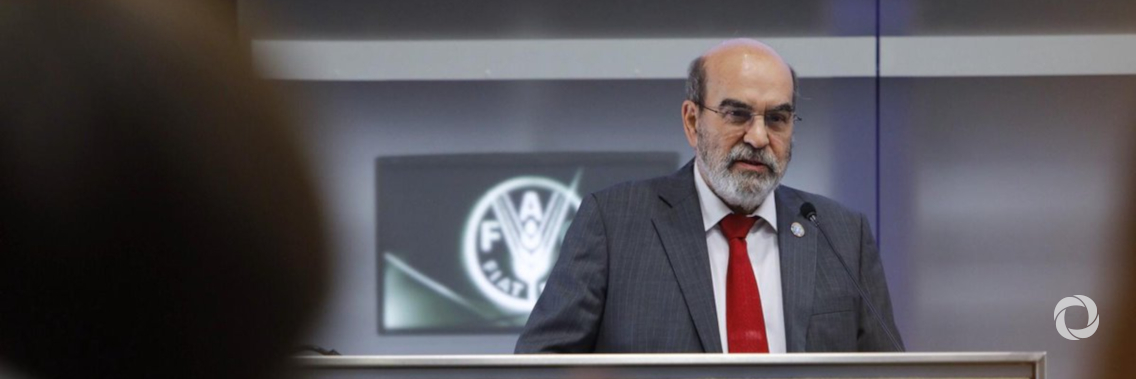
FAO Director-General José Graziano da Silva made his strongest appeal yet for tougher measures to combat the global obesity pandemic, urging the use of concrete fiscal and legal policies to promote healthier diets.
“It’s unbelievable, but it’s difficult to find and buy healthy food in our cities today,” Graziano da Silva said, adding that there are numerous policy tools to improve the accessibility and affordability of healthier diets.
He made his remarks while receiving the Nutrition Inspiration Award from the two winners of the 2018 World Food Prize, who recognized his lifelong “ambition not only to reduce malnutrition but eradicate it.”
The prize from GAIN, the Global Alliance for Improved Nutrition, is given to an individual who has made an outstanding contribution to improving global nutrition. The award was bestowed to the FAO Director-General at an event held at UN agency’s headquarters in Rome.
Graziano da Silva “has a personal, national and global track record in fighting hunger and he has inspired countless others to follow his lead,” said Lawrence Haddad, Executive Director of GAIN, which since its launch in 2002 has worked with partners, stakeholder and policymakers to support making healthier food choices more affordable, more available and more desirable.
The citation noted Graziano da Silva’s “unwavering commitment” and achievements as Special Minister for Food Security in Brazil and later in two terms leading the Food and Agriculture Organization of the United Nations, where he pioneered partnerships and dialogue between the public and private sectors.
Unhealthy diets and malnutrition are responsible for almost one of every three deaths, and non-communicable diseases, driven largely by poor diets, cost the world more than $7 trillion each year, Ghebreyesus said.
The award was given in the context of a panel discussion focusing on FAO’s recent work in the fight against hunger and the future challenges posed by the increasing world population, rapid urbanization and changing diets, especially in low- and middle-income countries.
FAO in recent years has pushed nutrition higher up the global agenda, holding a major international conference on nutrition that led to the Rome Declaration on Nutrition and advocating for the UN Decade of Action on Nutrition (2016-2025).
Graziano da Silva has in his eight years at FAO systematically noted that the world produces enough food to feed everyone, but this has not led to the end of hunger, and that more complex nutrition problems – such as obesity and diet-driven diseases – loom today.
Today he said that local and national governments have tools to improve food systems, citing Mexico’s sugar tax as an example, noting that pricing and subsidy policies can be tweaked and that cities can promote local circuits so that not only “hot dogs and burgers” are available. “The invisible hand of the market has a lot of hands behind it, ” he added.
Original source: FAO
Published on 26 July 2019