
Urgent action needed to reform gender discriminatory nationality laws causing childhood statelessness
Add us as your preferred source on Google to see more of our content in Search.
 Add to Preferred Sources
UNHCR, the UN Refugee Agency, UNICEF, and the Global Campaign for Equal Nationality Rights are calling for urgent action to reform gender-discriminatory nationality laws that remain a root cause of global childhood statelessness.
A new report released by the three organizations highlights that 25 countries still retain laws that deny women the right to pass their nationality to their children on an equal basis with men, while three countries also have laws that deny men the right to pass their nationality to children born outside of legal marriage.
“These discriminatory laws can leave children stateless, excluding them from nationality, limiting their access to basic rights such as education and healthcare and exposing them to life-long discrimination. Being left stateless can also put children at risk of violence, abuse and trafficking, and place them and their families at risk of arrest and detention,” said Grainne O’Hara, UNHCR’s Director of International Protection.
Though gender-discriminatory nationality laws were historically the norm in many countries, over 85 percent of countries worldwide have enacted reforms to ensure nationality laws uphold women and men’s equal right to confer nationality on their children, including most recently Madagascar and Sierra Leone.
The UNHCR-UNICEF led Coalition on Every Child’s Right to a Nationality and its partners, including the Global Campaign for Equal Nationality Rights, have been supporting efforts to end gender discrimination in nationality laws to ensure that every child has a right to a nationality.
The Convention on the Elimination of All Forms of Discrimination against Women upholds the equal rights of mothers and fathers to pass nationality to their children and the Convention on the Rights of the Child, to which virtually all countries are bound, requires that all children enjoy the right to acquire a nationality at birth and that this is without discrimination on the basis of the parent’s sex.
“No child chooses to be stateless – it is something beyond their control and most often their parents’. The consequences for children can be devastating – leaving them feeling excluded and isolated and unable to claim their rights. Ending gender discrimination in nationality laws is critical to end childhood statelessness and ensure every child can fulfill their ambitions and dreams for the future,” said Cornelius Williams, Associate Director of Child Protection, UNICEF.
Worldwide, statelessness affects millions of people. Some 3.9 million stateless people appear in the reporting of 78 countries but the true number is likely to be significantly higher.
UNHCR is mid-way through its #IBelong campaign to eradicate statelessness globally by 2024 and will hold a high-level meeting in October in Geneva to assess the achievements to date, including on actions to reform gender-discriminatory nationality laws, and to encourage concrete pledges by States and others on this and other statelessness issues.
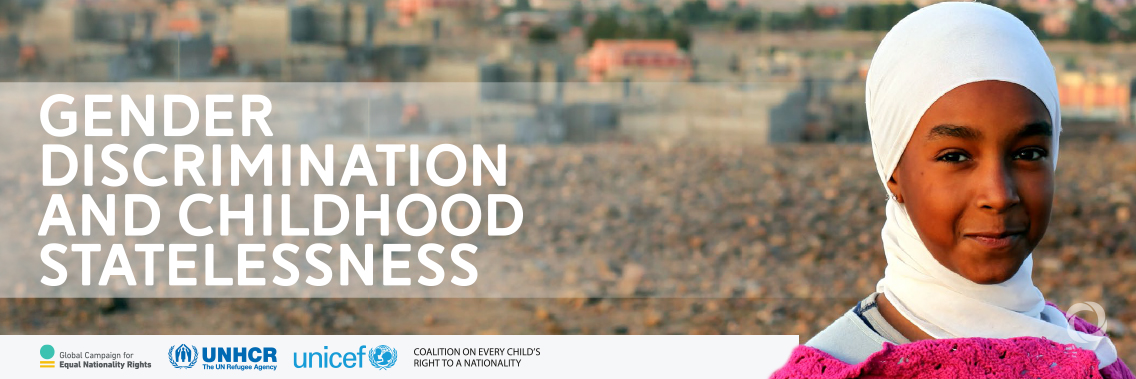
Read and download the full report: Gender Discrimination and Childhood Statelessness.
Original source: UNHCR
Published on 22 August 2019