
Add us as your preferred source on Google to see more of our content in Search.
 Add to Preferred Sources
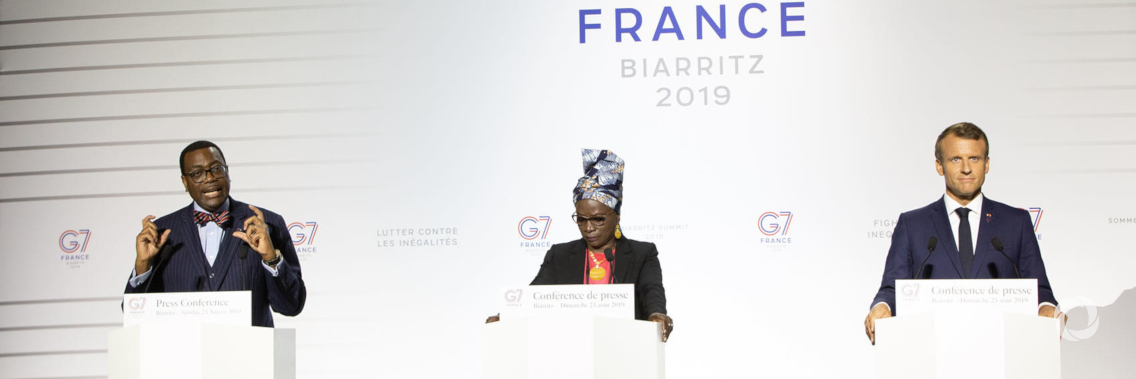
French President Emmanuel Macron and G7 leaders approved a package totaling $251 million in support of the African Development Bank’s AFAWA initiative to support women entrepreneurs in Africa.
“I am particularly proud, as the current G7 president, that the programme we are supporting today, the AFAWA initiative, comes from an African organisation, the African Development Bank, which works with African guarantee funds and a network of African banks,” Macron stated at a press conference at the G7 Summit in Biarritz, France.
The risk-sharing mechanism used by AFAWA (Affirmative Finance Action for Women in Africa ) is a practical approach to international commitments. It is a direct response to the demand by women to ease access to financing, specifically on the need to establish a financing mechanism for women’s economic empowerment, adopted during a summit of African heads of state in 2015 and assigned to the African Development Bank for implementation.
The Bank’s president Akinwumi Adesina applauded the “extraordinary support of all the G7 heads of state and government, which will provide incredible momentum” to the AFAWA programme.
“This is a great day for African women,” Adesina said. “Investing in women entrepreneurs in Africa is important because women are not only Africa’s future, they are Africa’s present”.
“Currently, women operate over 40% of SMEs in Africa, but there is a financing gap of $42 billion between male and female entrepreneurs. This gap must be closed, and quickly,” he added.
AFAWA aims to raise up to $5 billion for African women entrepreneurs and the African Development Bank will provide $1 billion financing.
The AFAWA initiative, backed by the G7 nations, is based on three fundamental principles. The first is to improve women’s access to financing through innovative and adapted financial instruments, including guarantee mechanisms to support women entrepreneurs.
In cooperation with strategic partners, the second principle is to provide capacity-building services to women entrepreneurs, including access to mentoring and training courses in entrepreneurship.
The third principle is improving the legal and regulatory environment, eliminating obstacles that specifically affect women by engaging in policy dialogue with governments, central banks, and other institutions.
Original source: AfDB
Published on 25 August 2019