
Add us as your preferred source on Google to see more of our content in Search.
 Add to Preferred Sources
Germany has reinforced its commitment to Syrian refugees and vulnerable Jordanians with a contribution of €56 million (JOD43.7 million) to the United Nations World Food Programme (WFP).
The funds will help WFP maintain its support to some 880,000 people every month during the difficult winter period.
Germany’s Federal Foreign Office is providing the bulk of the new contribution (€51 million), with the remainder (€5 million) coming from the Federal Ministry for Economic Cooperation and Development (BMZ).
Germany is the second-largest bilateral donor to Jordan, providing more than half a billion euros of annual support. It’s also the largest single donor to WFP in Jordan.
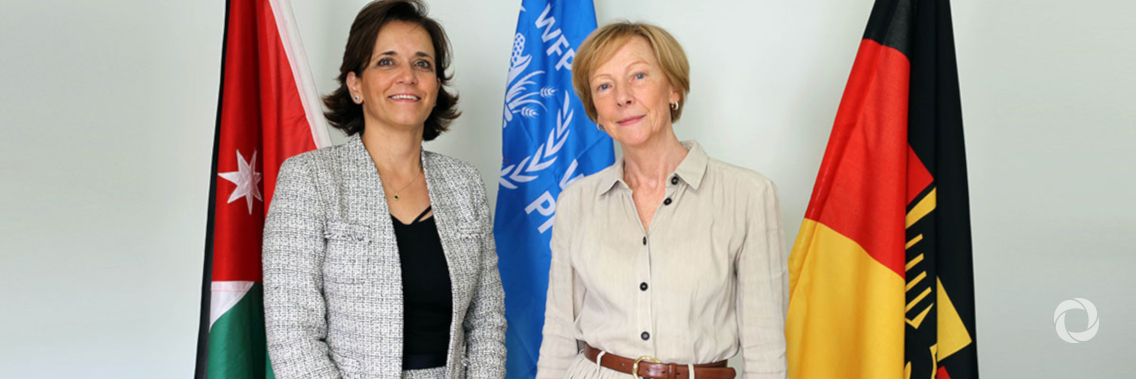
“Since 2012, the German Government has been supporting the Government of Jordan in dealing with the enormous challenges related to the influx of Syrian refugees,” said Germany’s Ambassador to Jordan, H.E. Birgitta Siefker-Eberle. “WFP is an important partner in this endeavour and our contribution reflects the value we place on WFP’s work.”
The funds will enable WFP to continue providing monthly cash-based transfers to some 500,000 refugees, including all those living in the Zaatari and Azraq camps. They will also support WFP’s school feeding programme, in partnership with the Ministry of Education, and its livelihoods and resilience projects.
“This grant will allow WFP to continue to support Syrian refugees as well as vulnerable members of host communities,” said WFP Representative and Country Director in Jordan Sarah Gordon-Gibson. “We’re extremely grateful for Germany’s long-standing support.”
WFP provides a healthy snack to some 330,000 school children in more than 1,500 schools across the country. It also provides a daily meal to children in formal education in the refugee camps as well as to around 58,000 children – both Jordanian and other nationalities – in some of the poorest parts of the country. School meals are prepared in a network of 17 WFP kitchens, offering training and employment opportunities for around 700 people – mostly women – in refugee and local Jordanian communities.
In conjunction with the Ministry of Agriculture and Irrigation, WFP carries out forestry rehabilitation and development projects involving tree planting, pruning, weeding and irrigation – projects that provide work and training in selected communities whilst also improving the environment.
Original source: WFP
Published on 18 September 2019