
Add us as your preferred source on Google to see more of our content in Search.
 Add to Preferred Sources
The World Meteorological Organization welcomed a landmark global report by the Intergovernmental Panel on Climate Change that underscores the urgency of timely, ambitious and coordinated action to address unprecedented and enduring changes in the ocean and cryosphere.
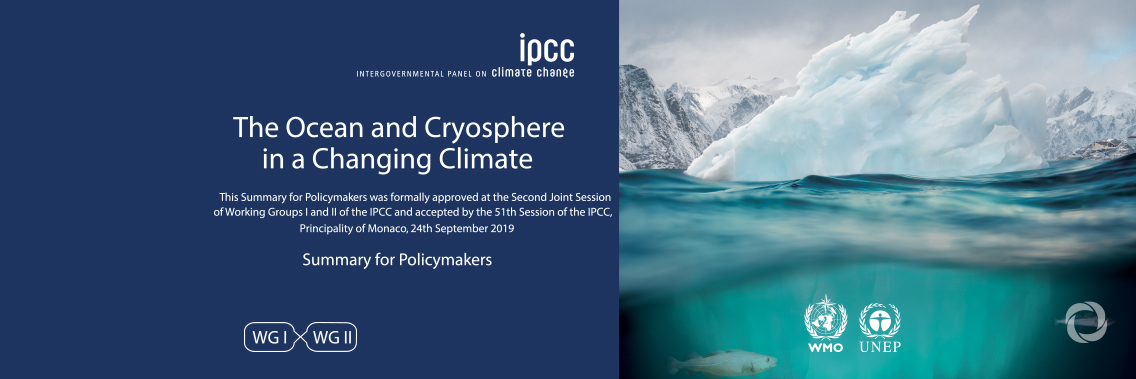
The IPCC Special Report on the Ocean and Cryosphere in a Changing Climate was approved on 24 September by the 195 IPCC member governments, gathered in Monaco. It spotlights the benefits of ambitious and effective adaptation for sustainable development and, conversely, the escalating costs and risks of delayed action.
“Water in its liquid or frozen state covers most of our Earth. The interplay between the ocean, cryosphere and greenhouse gas emissions influences climate and weather worldwide. Understanding this helps us to lessen the impacts of extreme events,” said WMO Deputy Secretary-General Elena Manaenkova, who attended the approval session.
The word “cryosphere” – from the Greek kryos, meaning cold or ice – describes the frozen components of the Earth system, including snow, glaciers, ice sheets and ice shelves, icebergs and sea ice, ice on lakes and rivers as well as permafrost and seasonally frozen ground. Hand in hand with the ocean, it plays a critical role for life on the planet.
According to a separate report released by WMO, the global average temperature has increased by 1.1°C since the pre-industrial period, and by 0.2°C compared to 2011-2015.
The IPCC report points to overwhelming evidence that global warming, which is stoked by past and current greenhouse gas emissions, is resulting in profound consequences for ecosystems and people. The ocean is warmer, more acidic and less productive. Melting glaciers and ice sheets are causing sea level rise, and coastal extreme events are becoming more severe.
Urgently reducing greenhouse gas emissions limits the scale of ocean and cryosphere changes. Ecosystems and the livelihoods that depend on them can be preserved.
“The open sea, the Arctic, the Antarctic and the high mountains may seem far away to many people,” said Hoesung Lee, Chair of the IPCC. “But we depend on them and are influenced by them directly and indirectly in many ways – for weather and climate, for food and water, for energy, trade, transport, recreation and tourism, for health and wellbeing, for culture and identity.”
A total of 670 million people in high mountain regions and 680 million people in low-lying coastal zones depend directly on the ocean and cryosphere systems. Four million people live permanently in the Arctic region, and small island developing states are home to 65 million people.
“If we reduce emissions sharply, consequences for people and their livelihoods will still be challenging, but potentially more manageable for those who are most vulnerable,” Mr. Lee said. “We increase our ability to build resilience and there will be more benefits for sustainable development.”
Knowledge assessed in the report outlines climate-related risks and challenges that people around the world are exposed to today and that future generations will face. It presents options to adapt to changes that can no longer be avoided, manage related risks and build resilience for a sustainable future. The assessment shows that adaptation depends on the capacity of individuals and communities and the resources available to them.
The IPCC report is a key scientific input for world leaders gathering in forthcoming climate and environment negotiations, such as the UN Framework Convention on Climate Change Conference, known for short as COP25, in Chile in December.
It provides new evidence for the benefits of limiting global warming to the lowest possible level – in line with the goal that governments set themselves in the 2015 Paris Agreement on climate change, of keeping warming below 2.0°C or, better still, 1.5°C.
“The world’s ocean and cryosphere have been ‘taking the heat’ from climate change for decades, and consequences for nature and humanity are sweeping and severe,” said Ko Barrett, Vice-Chair of the IPCC. “The rapid changes to the ocean and the frozen parts of our planet are forcing people from coastal cities to remote Arctic communities to fundamentally alter their ways of life,” she added.
“By understanding the causes of these changes and the resulting impacts, and by evaluating options that are available, we can strengthen our ability to adapt,” she said.
Read and download the IPCC Special Report on the Ocean and Cryosphere in a Changing Climate.
Original source: WMO
Published on 25 September 2019