
Add us as your preferred source on Google to see more of our content in Search.
 Add to Preferred Sources
FAO, UNDP renew partnership to better deliver on the 2030 Agenda, ADB to help improve water supply and SAP and UNICEF partner to give young people job skills training. Here is what you missed from last week’s headlines in the international development sector:
Informing society for a sustainable ocean: the Global Ocean Observing System launches 2030 Strategy
The agreement renews a long-standing formal collaboration between the two UN agencies and was signed in New York by FAO Director-General Qu Dongyu and UNDP Administrator Achim Steiner on the sidelines of the 74th UN General Assembly.
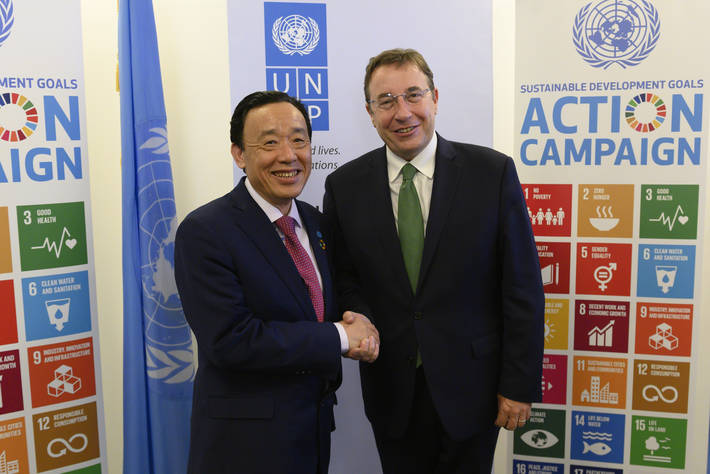
The MoU outlines a plan to undertake concerted and coordinated programmes to further the agencies’ common objective of supporting countries to achieve the 2030 Agenda.
“This marks the beginning of a new era in our long-standing relationship between FAO and UNDP as we build stronger ties in our work to assist countries achieve the Sustainable Development Goals,” FAO Director-General Qu Dongyu said.
“We welcome this new chapter in our partnership with FAO and we look forward to exploring ways through which we can work together to assist the most vulnerable people around the world to achieve the Sustainable Development Goals, particularly in the areas of agriculture, food security, nutrition, and livelihoods,” said UNDP Administrator Achim Steiner.
ADB to help improve water supply, sanitation in the Solomon Islands
The Asian Development Bank (ADB) has approved a $28 million loan and a $9 million grant for the Urban Water Supply and Sanitation Sector Project, which will provide better access to safe water and improve sanitation in urban areas of Solomon Islands.
The project will adopt a sector approach for developing sustainable, inclusive, and climate-resilient water supply and improved sanitation in the greater Honiara area and five other towns, namely Auki, Gizo, Noro, Munda, and Tulagi.
Following the government’s Water and Sanitation Sector Plan, the project will increase people’s access to piped water supply and sanitation services, especially among poor households; reduce reliance on well water and rainwater harvest, and ensure more efficient water usage.
Apart from ADB, the European Union (EU) with a $20.35 million grant, the World Bank with a $15 million loan, the Government of Solomon Islands with $11.47 million, and the Solomon Water with $9 million will contribute financing to the $92.82 million project, which will enhance hygiene awareness, promote water conservation, and improve fecal sludge management in the country’s urban areas.
SAP and UNICEF partner to give young people job skills training
SAP and UNICEF announced a new global partnership to provide quality education, life skills and job skills training to young people in disadvantaged communities, preparing them for decent work and active citizenship.
Announced at an event taking place at the 74th session of the United Nations General Assembly in New York, the three-year partnership will bring together businesses, governments and non-governmental organizations to build sustainable education models. The partnership will focus on workforce inclusion initiatives to help young people thrive, and provide organisations with a prepared workforce.
The partnership will look to develop a standardized national curriculum, workforce readiness programmes, and in-depth research to better inform and connect the private sector with future talent.
Here’s what else has happened
EBRD and Green Climate Fund: The EBRD, in partnership with the Green Climate Fund (GCF), is stepping up its efforts to support renewables in Kazakhstan with a loan of up to US$ 6.4 million to finance a new 10 MW solar plant in the Zhanakorgan District in southern Kazakhstan.
The plant will generate over 14.8 GWh of electricity per year and will help to reduce CO2 emissions by close to 13,000 tonnes per year.
Germany again a top supporter of WFP in Iraq: The German Government has provided the United Nations World Food Programme (WFP) in Iraq with €17.5 million to address the food needs of Syrian refugees and to support returnees and vulnerable communities.
UN General Assembly: Leaders gathering for the United Nations General Assembly from 17-30 September 2019 in New York have made a strong plea for enhanced South-South cooperation to strengthen food security during a session co-hosted by the African Development Bank.
African Development Bank: African Development Bank President Akinwumi Adesina pledged to boost funding commitments by $12.5bn to help countries adapt to the effects of climate change between 2020 and 2025.
“This is where the rubber meets the road,” Adesina told members of the Global Commission on Adaptation. “Because many of the countries are facing extreme weather patterns, and they can’t wait anymore, we’ve decided to launch the Africa disaster risk facility to ensure these countries get the resources they need to insure themselves against catastrophic risk events.”
Reports
New IRENA report explores the potential of green hydrogen
Hydrogen from renewables can help tackle various critical energy challenges. It could particularly offer ways to decarbonise a range of sectors where it is proving difficult to meaningfully reduce CO2 emissions, a new report by the International Renewable Energy Agency (IRENA) on Hydrogen: a renewable energy perspective finds.
Read and download the IRENA’s report Hydrogen: a renewable energy perspective.
Multilateral agencies launch a joint plan to boost global health goals
Developed over 18 months, Stronger Collaboration, Better Health: Global Action Plan for Healthy Lives and Well-being for All outlines how a dozen multilateral health, development and humanitarian agencies will collaborate to be more efficient and provide more streamlined support to countries to deliver universal health coverage and achieve the health-related SDG targets.
“The plan is called, ‘Stronger Collaboration, Better Health’ for a reason,” said Dr. Tedros Adhanom Ghebreyesus, Director-General of WHO. “Although collaboration is the path, the impact is the destination. The release of this plan is the beginning, not the end, of that path.”
Read and download Stronger Collaboration, Better Health: Global Action Plan for Healthy Lives and Well-being for All.
From “lost decade” of climate action, hope emerges
The UN Environment Programme (UNEP) released a look back at ten years of its Emissions Gap Report—a hugely influential publication that compares where greenhouse gas emissions levels are headed to where they should be to avoid the worst impacts of climate change.
Read and download the Emissions Gap report 10-year summary.
Events
Coming up at AidEx Brussels 2019
Belgium, Brussels
13 – 14 November
Now in its 9th year, AidEx is established as the leading platform for the international aid and development community to come together and improve the efficiency of aid.
World Climate Summit: The Investment COP
Santiago, Chile
8-9 December 2019
Launched in 2010, the World Climate Summit is recognised as the essential importance of the “bottom-up” perspective in solving climate change. Ten years later and growing from strength to strength, it is the must-attend event for leading stakeholders driving climate action and legislation. The Summit is a key platform for driving policies and projects as well as creating synergies with the public and private sector.
Global Vaccine Safety Summit
Geneva, Switzerland
2-3 December 2019
In the year that marks the 20th anniversary of the WHO’s Global Advisory Committee on Vaccine Safety (GACVS), the Global Vaccine Safety Summit will be an opportunity to take stock of GACVS accomplishments and look towards priorities for the next decade.
At the Summit, WHO will present the Global Vaccine Safety Blueprint 2.0 strategy 2021-2030 to key stakeholders and collect their input for the final version, due for publication in the new year.