
Add us as your preferred source on Google to see more of our content in Search.
 Add to Preferred Sources
As global development leaders convened at the Annual Meetings of the World Bank and IMF, messages related to inequality and climate change dominate global headlines and social media, fueled to a large degree by the global youth movement.
In recent years, the concerns and worldviews of young adults have been increasingly occupying center stage in global debates. And they should. The energy, dreams, and demands of the world’s youth (young adults aged 15-24) can be the drivers of massive political, societal and economic shifts. Some of the most important trends expected to shape our global reality during the 21st century—such as the opportunities and challenges of the rapidly increasing cohort of African Youth and the on-going explosion of Asia’s middle class—bring this fact into stark relief.
In collaboration with the International Fund for Agricultural Development (IFAD), World Data Lab has pioneered the development of a global poverty model. The data provides new insights into the landscape of poverty facing youth around the world.
Of the world’s 1.2 billion people aged between 15-24, 104 million—about 9 percent—live on less than $1.90 a day (at 2011 US$ PPP). That’s as much as the total population of Germany and Australia combined. Collectively they represent one-fifth of the world’s poorest people and though their absolute number is expected to fall by about 20 million by 2030, their share of total global extreme poor poverty will stay unchanged. This “structural” nature of youth poverty is driven in part by the relatively sparse opportunities available to harness their productivity, connectivity, and sense of agency. Notably, some 500 million youth live in rural, relatively undeveloped areas where employment opportunities are scarce.
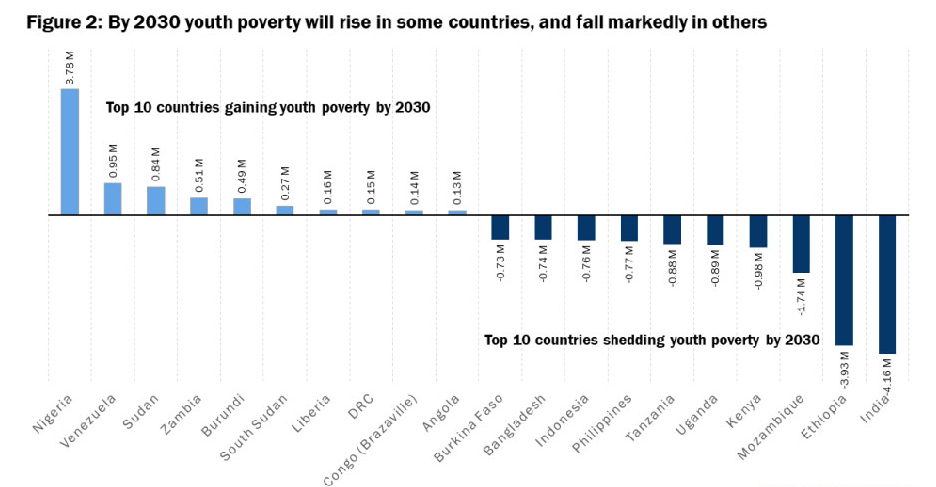
Africa’s 80 million youth living in extreme poverty represent more than three-quarters of the global total. The good news for Africa is that by 2030, their ranks are expected to decline—though only modestly to 73 million. Thanks to improving economic conditions, a handful of African countries are expected to massively reduce the number of poor youth by 2030.
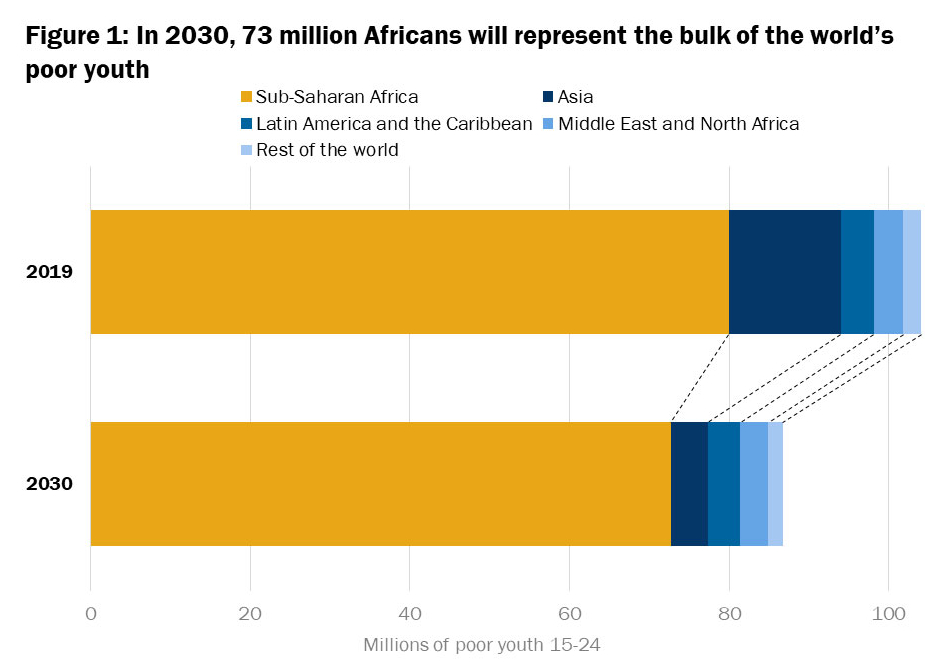
In Asia, the number of youth living in extreme poverty will decline sharply from 14 million to some 5 million people by 2030. India will account for roughly half of this total decline and Indonesia, Philippines, and Bangladesh will each shed some 800,000 poor youth from their total populations. While living in very different economic and political contexts, trends for poor youth in Latin America and the Middle East and North Africa are similar. Each region has one negative outlier—Venezuela and Yemen, respectively—that explains why each region will still have a population of some 4 million extremely poor young people.
The data presented above paint a depressing picture of what is likely to happen should current trends continue. In an effort to change this, some countries are creating opportunities for rural youth populations that aim to strike the right balance between broader interventions for all and youth-specific investments.
Original source: IFAD
Published on 21 October 2019