
Add us as your preferred source on Google to see more of our content in Search.
 Add to Preferred Sources
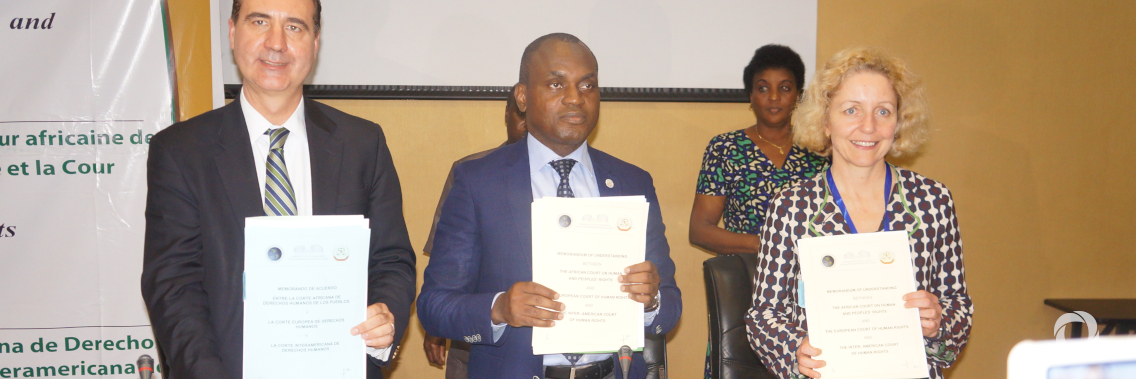
The African Court on Human and Peoples’ Rights, the European Court of Human Rights and the Inter-American Court of Human Rights have signed a Memorandum of Understanding (MoU ) which is aimed at what they term as “operationalize the International Human Rights Forum.”
The MoU was signed by Sylvain Ore, the president of the African court Human and people’s rights, Angelika Nussberger, the Vice President European Court of human rights, and Eduardo Ferrer Mac- Gregor Post, the President the Inter- American Court of Human Rights on October 29, 2019 during the recently concluded African judicial dialogue hosted at the Munyonyo Commonwealth resort. In the document, the three courts agree to encourage the Member States of their respective organizations, partners, civil society and citizens to contribute to and support the continued organization of the International Human Rights Forum and the programs and activities of the Forum.
“To organize the International Human Rights Forum biennially in private and public sessions on a rotational basis and involving other regional and global human rights stakeholders, where necessary, “ the MOU states, “To ensure that the decisions and resolutions reached the Forum are adhered to and implemented by allocating the necessary resources and appointing focal points for the required follow-up.”
The judges also agreed to undertake knowledge-sharing through digital platforms, on topical human rights issues, including on, migration, and violence against women, environmental hazards, climate change, bioethics, terrorism, mass data surveillance and on the working methods of the courts.
“To develop on-line learning courses on various aspects aimed at protecting human rights in their respective jurisdictions in particular, as well as globally. To publish annually an electronic/digital report on the leading judgments of the three courts with commentaries, where necessary, and taking into consideration the working languages of the respective courts,” the MoU which has now been christened as the Kampala declaration partly reads.
The foundation of signing the MoU was laid in 2018 when the San Jose declaration was signed. Therein the three courts affirmed that the respect for, and protection of human and peoples’ rights and access to justice of the people under their jurisdictions is a prerequisite for the enhancement of the rule of law and democracy and contributes to the attainment of national goals and objectives.
“Noting with commendation the existing cordial relationship that allows for institutional and jurisprudential dialogue, the sharing of information and best practices for their common benefit; the desire to strengthen that relationship through continued shared work and efforts between the three courts,” the MoU states.
Now the courts envisage that signing of the MoU will augment dialogue and sharing jurisprudence with national courts, as one of the mechanisms for ensuring reference by national courts to the regional courts’ judgments and contributing to the enforcement of these judgments in the long run.