
Add us as your preferred source on Google to see more of our content in Search.
 Add to Preferred Sources
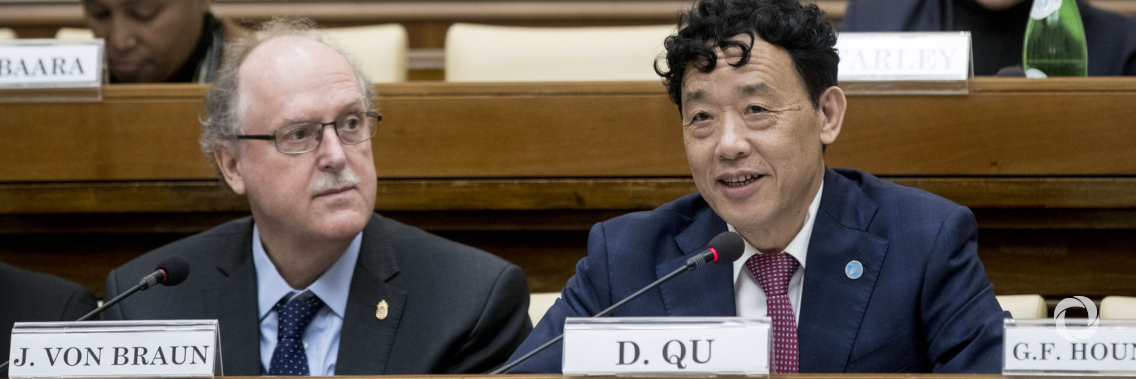
FAO Director-General Qu Dongyu said that raising awareness, greater innovation – including digital technologies – and investment were needed to reduce food waste and eliminate global hunger.
The Director-General gave the keynote speech to the Vatican’s Conference on Food Loss and Waste Reduction hosted by the Pontifical Academy of Sciences in Rome. Pope Francis has described food waste as scandalous and called for urgent economic and social initiatives to end hunger.
“We cannot end hunger and all forms of malnutrition if we do not address the inefficiencies and inequities in our food systems that lead to the high levels of food losses and waste,” Qu said.
The Director-General said around 14 percent of the world’s food production is either lost or wasted between the harvest and retail stage of the food chain, at a cost of $400 billion.
Food loss mainly occurs in developing countries where 821 million people still suffer from chronic malnutrition and also has an impact on climate change.
Qu said fruit and vegetable damage caused the loss of 75 billion cubic metres of water a year, while the loss of meat and animal products meant 715 million hectares of land were effectively used for nothing.
“We are now working on building capacities to obtain more and better data to understand where and how food losses and waste occur in the food supply chain and the determinants behind them,” Qu said, FAO is working with a broad spectrum of stakeholders and partners to tackle food waste, change practices and boost farmers’ incomes.
Qu underscored the importance of awareness-raising and education, being vital to tackling the problem of food loss and waste. He noted that this needs to start at the family-level and that educating children on the respect and appreciation of food was fundamental, leading to new healthy and sustainable consumption patterns.
The Director-General appealed to governments to work with the private sector, to not only reduce losses but finance research and innovation that will enhance efficiency.
“We need to be open to new ideas and new ways of doing business,” Qu said. “Innovative business models with the participation of the private sectors are required,” he added, pointing to make available rural infrastructure and the technology needed to support the training of smallholders.
Qu also underscored the importance of learning from successes achieved in other sectors – for example, harnessing the use of ICT and digital innovation for upscaling improved practices, supporting training and providing technical support to accelerate the process of change.
Original source: FAO
Published on 11 November 2019