

Add us as your preferred source on Google to see more of our content in Search.
 Add to Preferred Sources
Decarbonization of energy, 2020 Regional Climate Weeks and support business efforts to tackle climate change. Here is what you missed from last week’s headlines in the international development sector:
Latin America and the Caribbean could save US$ 621 billion by 2050 through the decarbonization of energy, transport sectors
Latin America and the Caribbean could achieve annual savings of US$ 621 billion by 2050 if the region’s energy and transport sectors reach net-zero emissions, according to new findings from the UN Environment Programme (UNEP) presented in Madrid at the UN Climate Change Conference COP25.
The findings are included in an advance executive summary of the Zero Carbon Latin America and the Caribbean 2019 Report, which will soon be published, and which highlights the opportunities, costs and benefits of coupled decarbonization of power generation and transportation. Both sectors account for two-thirds of the region’s fossil CO2 emissions and about 25 percent of its greenhouse gas emissions. A two-fold increase in these emissions is expected by mid-century if current policies continue unaltered.
Under current policies and conditions, the emissions from the energy sector are expected to increase 140 percent (up to 1.2 billion tons), considering the regional electricity demand will almost triple by 2050. Meeting these new requirements under a fossil fuel-based generation matrix would place the region further away from the 2°C pathway of the Paris Agreement, the report warns.
2020 Regional Climate Weeks announced at COP25
The dates and host cities have been announced for the suite of 2020 Regional Climate Weeks, which will include for the first time a Climate Week in the Middle East and North Africa (MENA) region, in addition to Climate Weeks in Africa, Latin America & the Caribbean and Asia.
Regional Climate Weeks bring together private- and public-sector representatives to share ideas and make connections in discussions, meetings and exhibitions on diverse themes related to climate action and sustainable development. They are meant to encourage and facilitate the implementation of ambitious Nationally Determined Contributions (NDCs) under the Paris Agreement and help deliver on the 2030 Sustainable Development Goals.
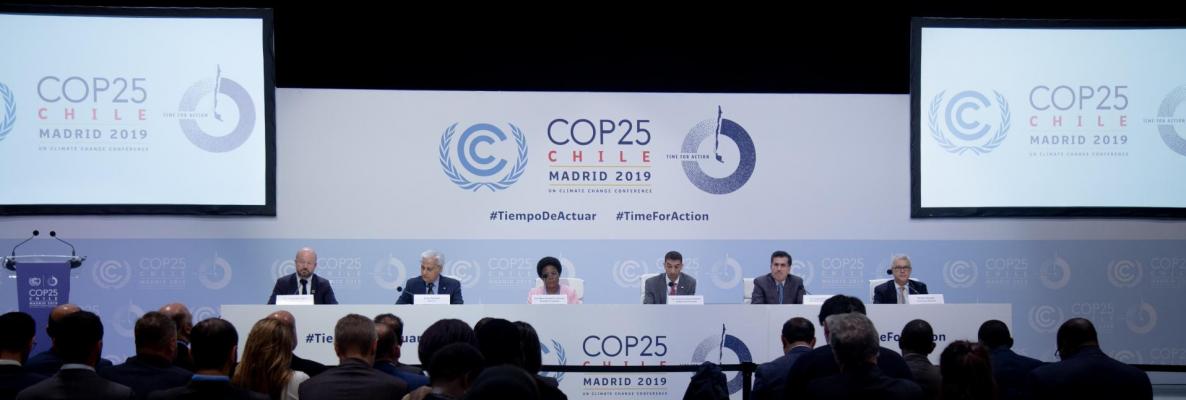
Representatives from the 2020 host countries announced the dates and host cities at the United Nations Climate Conference (COP25) in Madrid.
COP25: Support business efforts to tackle climate change, urges Guterres
The UN Secretary-General has called on business and civil society leaders to press Governments into articulating policies that support private-sector efforts to address climate change.
António Guterres issued the charge in a speech to the annual Caring for Climate Meeting, held during the on-going UN COP25 climate conference in Madrid.
“I’m meeting more and more business leaders that complain that they cannot do more because governments will not allow them to do so, because of the environment that is still created in the bureaucratic, administrative, tax regulatory and other frameworks that are under government control”, he said.
Caring for Climate mobilizes business leaders to implement and recommend solutions and policies to beat climate change.
Here’s what else has happened
Germany: The German Ministry of Environment, Nature Conservation and Nuclear Safety through its International Climate Initiative announced it is providing €20 million for a new programme co-led by FAO and the United Nations Development Programme (UNDP), to accelerate climate change action in developing countries’ agricultural and land-use sectors.
EIB: The European Investment Bank (EIB) approved EUR 8.1 billion of new financing for climate action, sustainable development, health, and education investment across Europe and around the world. This included support for large and small-scale renewable energy projects, for the development of electric vehicles, and for improving the energy efficiency of homes. EIB financing approved will also help to build water infrastructure and rural roads in developing countries impacted by a changing climate.
Colombia: On the eve of a critical year for environmental decision-making, Colombia, Germany and UN Environment Programme (UNEP) announced that Colombia will host World Environment Day 2020 in partnership with Germany and that it will focus on biodiversity.
Climate Ambition Alliance: In Madrid, President COP25, Minister Carolina Schmidt, presented a renewed alliance of countries and Non-State Actors who determined to follow the recommendations of science as regards climate change. Chile has led this alliance after a request of the Secretary-General of the United Nations, António Guterres, in the context of the 2019 Climate Summit.
Reports
Unprecedented humanitarian crisis in Mali revealed in new report
Escalating violence and insecurity in Mali have sparked an unprecedented humanitarian crisis, rendering 3.9 million people in need of assistance and protection – an increase of 700,000 since the beginning of the year, the UN said.
Citing a recent report from the NGO Refugees International, Deputy Spokesperson Farhan Haq told correspondents in New York that the number of internally displaced people has also jumped from around 80,000 to nearly 200,000 in one year with more than half being children and women.
Read and download the report: Mali’s Humanitarian Crisis.
Three million undernourished people in Asia-Pacific need to be lifted out of hunger every single month until the end of 2030 to achieve Sustainable Development Goal
Three million undernourished people in Asia and the Pacific must be lifted out of hunger each month from now on, if the region is to meet the SDG 2 Zero Hunger goal by the end of 2030, says a new report released by four United Nations agencies.
With nearly half-a-billion of the world’s undernourished people living in Asia-Pacific – and with the 2030 deadline for Zero Hunger just a decade away -the Food and Agriculture Organization of the United Nations (FAO), the United Nations Children’s Fund (UNICEF), World Food Programme (WFP) and the World Health Organization (WHO) are calling for urgent actions to address hunger and malnutrition in all its forms, and, for the first time in this region, to take decisive, informed and coordinated action to place nutrition at the heart of social protection programmes.
Read and download the report: Asia and the Pacific Regional Overview of Food Security and Nutrition 2019.
Events
EIB-UN-Habitat Africa Day 2020: Places for people
Dakar, Senegal
27 February 2020
Africa’s population is growing and urbanising at a very high rate, which brings increasing demands on services and infrastructure for the cities of today and of tomorrow. Two-thirds of the urban space that the continent will need by 2050 don’t exist today. They will only be built over the next 30 years. Sustainable urbanisation will be the key topic at Africa Day 2020, a conference hosted by the EIB and UN-Habitat.
World Biodiversity Forum
Davos, Switzerland
23-28 February 2020
First, of its kind, the World Biodiversity Forum will bring together leading researchers, early career researchers, practitioners, representatives from different sectors, decision-makers and societal actors to have a conversation on the kind of future we want (and/or do not want) for biodiversity.
Tenth Session of the World Urban Forum (WUF10)
Abu Dhabi, United Arab Emirates
8-13 February 2020
The World Urban Forum, which is convened by UN-Habitat, is the world’s most important conference on cities. As a non-legislative forum open to all, it provides the opportunity for thousands of participants involved in all aspects of urbanization to share practices and knowledge on how cities are built, planned and managed.