
Add us as your preferred source on Google to see more of our content in Search.
 Add to Preferred Sources
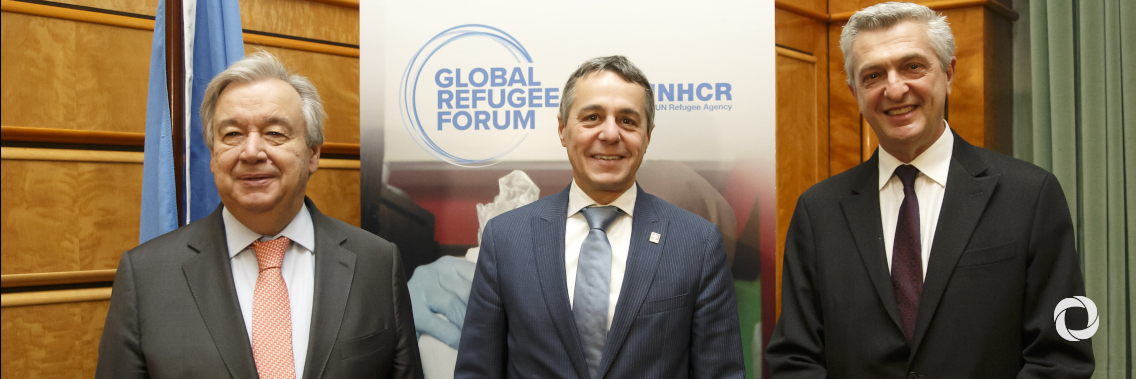
The international community must do far more to share responsibility for millions of refugees worldwide through “bold and concrete” pledges, the UN Secretary-General told a global gathering to transform the response to refugee situations at a time of record displacement.
“Gratitude is not enough at this time of turbulence … The international community must do far more to shoulder this responsibility together,” UN Secretary-General António Guterres told the opening session of the first-ever Global Refugee Forum.
“Now more than ever we need international cooperation and practical and effective responses… We need better answers for those who flee and better help for communities and countries that host them.”
The Forum is meeting in Geneva at a moment when 70.8 million people are forcibly displaced worldwide, including 25.9 million refugees. Some 3,000 people are taking part, including refugees, heads of state and government, UN leaders, international institutions, development organizations, business leaders and civil society representatives, among others.
UNHCR, the UN Refugee Agency, is co-hosting the Forum together with Switzerland, and it is being co-convened by Costa Rica, Ethiopia, Germany, Pakistan, and Turkey – some of the countries hosting the largest refugee populations globally.
Over three days, it aims to generate new approaches and long-term commitments from a variety of actors to help refugees and the communities in which they live.
“I urge you to be bold and concrete in the pledges you’ll make,” Guterres, who served as UN High Commissioner for Refugees from 2005 to 2015, told the gathering. “This is a moment for ambition, it is a moment to jettison a model of support that too often left refugees for decades with their lives on hold.”
Also addressing the Forum as co-host, UN High Commissioner for Refugees Filippo Grandi said poverty, inequality and the climate crisis are accelerating conflict and displacement, while “long-standing crises seem ever more intractable.”
At the same time, he said, a piecemeal and unbalanced approach to refugees means that countries with more resources push responsibility onto developing nations that are “less able to cope.”
“It’s time to reboot our responses,” Grandi said. “We need a sweeping vision, to inspire and engage people and institutions across society – a broad alliance of governments, the aid community, businesses, development institutions, civil society, faith groups, academia, sports and the arts, and refugees themselves,” he said. “We represent that very alliance – here, today”
The Global Compact on Refugees, affirmed by the UN General Assembly a year ago, paves the way for all to take responsibility and play a role, Grandi said, including all levels of government, the private sector, development agencies and financial institutions, civil society, faith groups, and refugees themselves.
Original source: UNHCR
Published on 17 December 2019