
Add us as your preferred source on Google to see more of our content in Search.
 Add to Preferred Sources
Minerals and metals play a central role in the global economy and will continue to provide the raw material we need for industrial processes and daily use.
Despite enormous efforts to decouple economies from resource use, the extraction of mineral resources has increased markedly in recent decades and, over the last decade, at a faster rate than economic growth. This trend is forecasted to steadily increase in the future, as we struggle to meet the mineral resource needs of a growing global population that is expected to reach 8.5 billion by 2030, 9.8 billion by 2050 and 11.2 billion by the end of the century.
Worldwide transitions towards clean energy and electric vehicles will also accelerate the trend, as renewable energy sources require larger amounts of metals than energy production from fossil fuels.
But the extraction of these much-needed metals and minerals comes at a high price, among those damage to wildlife and ecosystems.
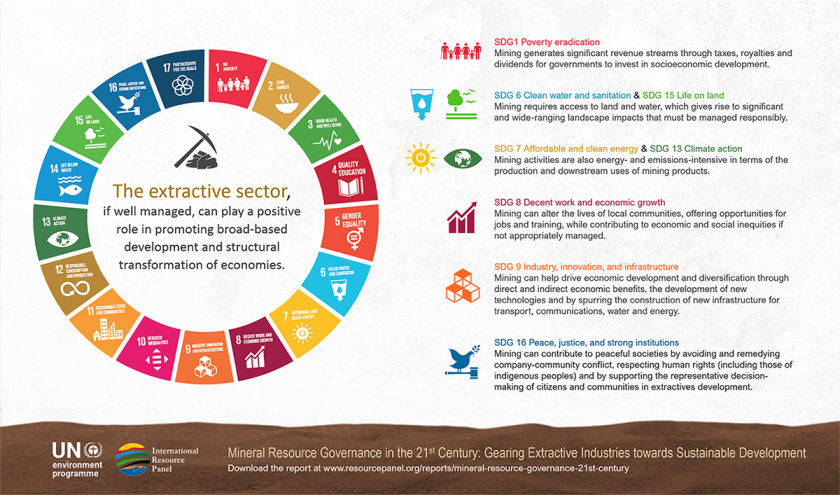
It doesn’t need to be so: the minerals and metals industry has, in fact, the potential to successfully support countries in achieving the Sustainable Development Goals. They can, for example, promote social cohesion, inclusiveness and economic progress among low-income countries and the most vulnerable groups of the population.
In its latest report, launched in February 2020, titled Mineral Resource Governance in the 21st Century: Gearing Extractive Industries Towards Sustainable Development, the International Resource Panel provides suggestions on how to improve the economic performance of the extractive sector while ensuring that it complies with the highest social and environmental standards at national and international levels.
The report provides guidance on how the extractive sector can establish a modern governance structure which addresses resource security and efficiency—an area of particular interest to developed nations—and satisfies the demand for continuous structural transformation, economic development and diversification in resource-exporting, developing countries.
The International Resource Panel strongly believes that effective work at national level with broad and inclusive involvement of all stakeholders including “host and home” country governments, the international community, mining companies and civil society organizations should lead to the adoption of a strategic development plan. The plan must contain targeted actions for the Sustainable Development Goals and define performance standards.
Original source: UN Environment
Published on 19 February 2020