
Add us as your preferred source on Google to see more of our content in Search.
 Add to Preferred Sources
Some 6.5 million people in South Sudan – more than half of the population – could be in acute food insecurity at the height of this hunger season (May-July), three United Nations agencies warned.
The situation is particularly worrying in the areas hardest hit by the 2019 floods, where food security has deteriorated significantly since last June according to the Integrated Food Security Phase Classification (IPC) report released by the Government of South Sudan, the Food and Agriculture Organization of the United Nations (FAO), the United Nations Children’s Fund (UNICEF) and the World Food Programme (WFP).
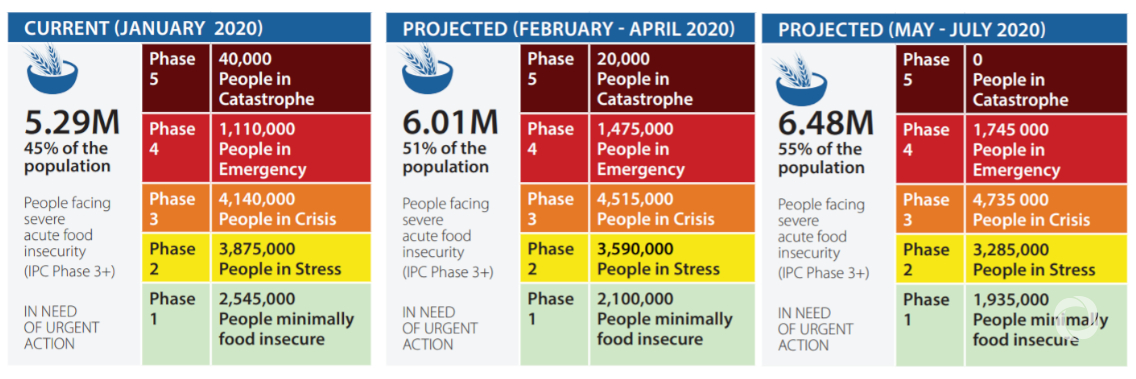
Particularly at risk are 20,000 people who from February through April will be suffering from the most extreme levels of hunger (“catastrophe” level of food insecurity or IPC 5) in Akobo, Duk and Ayod counties that were hit by heavy rains last year, and need urgent and sustained humanitarian support.
Hunger is projected to get progressively worse between now and July, mainly in Jonglei, Upper Nile, Warrap and Northern Bar el-Ghazal, with over 1.7 million people facing an “emergency” level of food insecurity (IPC Phase 4) due to the impacts of devastating floods and low levels of food production. Thirty-three counties will reach an “emergency” level of food insecurity during the hunger season, up from 15 in January
Overall, in January, 5.3 million South Sudanese were already struggling to feed themselves or were in “crisis” or worse (IPC Phase 3 and above) levels of food insecurity.
“Despite some seasonal improvements in food production, the number of hungry people remains dangerously high and keeps rising. On top of that, we are now faced with Desert Locust swarms that could make this even worse. It is important that we maintain and scale up our support to the people of South Sudan so they can resume or improve their livelihoods and food production, and boost the government’s capacity to respond to the locust outbreak,” said Meshack Malo, FAO Representative in South Sudan.
Hunger is expected to deepen as of February due mainly to depleted food stocks and high food prices. Overall, the cumulative effects of flooding and related population displacement, localized insecurity, economic crisis, low crop production and prolonged years of asset depletion continue to keep people hungry.
The report also notes that the country’s relative peace and stability have led to some improvements in the overall food security situation, with the upcoming lean season expected to be slightly less severe compared to last year’s, when 6.9 million people were in “crisis” or worse food insecurity.
For example, since the signing of the Revitalised Peace Agreement in September 2018, cereal production has increased by 10 percent, and a more stable environment allowed some of the farmers to resume their livelihoods, which combined with favorable rains has led to increased food production.
The report also estimates that 1.3 million children will suffer from acute malnutrition in 2020.
“Over the years and with support from donors we have become good at treating malnutrition. With support from UNICEF and its partners, 92 percent of all children suffering from severe acute malnutrition received assistance and more than nine out of ten recovered. Yet, these children shouldn’t be malnourished in the first place. Access to enough food, the right food, water, sanitation, hygiene, and health services are human rights and key to preventing malnutrition. There is a need for a paradigm shift with a multisectoral approach to malnutrition, ensuring we get just as good at prevention as we are at treatment,” said Mohamed Ag Ayoya, the UNICEF Representative in South Sudan.
Responding to the crisis
This year, FAO aims to increase food production and protect livelihoods by distributing seeds, farming tools, fishing and vegetable kits, and providing cash assistance to people most in need. FAO is also carrying out livestock vaccination and treatment to protect over 3 million animals from diseases and malnutrition. FAO appeals for $75 million for its 2020 response programme.
For 2020 UNICEF appeals for $253 million to treat more malnourished children and intensify prevention efforts through intersectoral interventions in areas of nutrition, water, sanitation and hygiene, health and communication for development.
In 2020, WFP plans to assist some 5 million people, providing life-saving food to the most vulnerable, food assistance to communities to build or rehabilitate their assets, school meals and special nutritious products to prevent and treat malnutrition among children and pregnant or nursing women. WFP urgently needs $208 million over the next six months to meet immediate needs and boost people’s resilience. WFP plans to pre-position 190,000 metric tons of food in over 60 warehouses before the onset of the rains in May to save lives and reduce costs, making expensive airdrops unnecessary when many areas become unreachable by road.
Read and download the Integrated Food Security Phase Classification (IPC) report.
Original source: FAO
Published on 20 February 2020