

Add us as your preferred source on Google to see more of our content in Search.
 Add to Preferred Sources
In 2018, Official Development Assistance from the 30 members of the OECD’s Development Assistance Committee (DAC) totaled US$153.3 billion, as calculated using the “grant-equivalent” methodology. On February 7th, 2020, the OECD released details of the final data on development aid flows in 2018 by donor and sector. DevelopmentAid has prepared a brief overview of the flows to various sectors and the dynamics as compared to previous years.
Who cares about the environment?
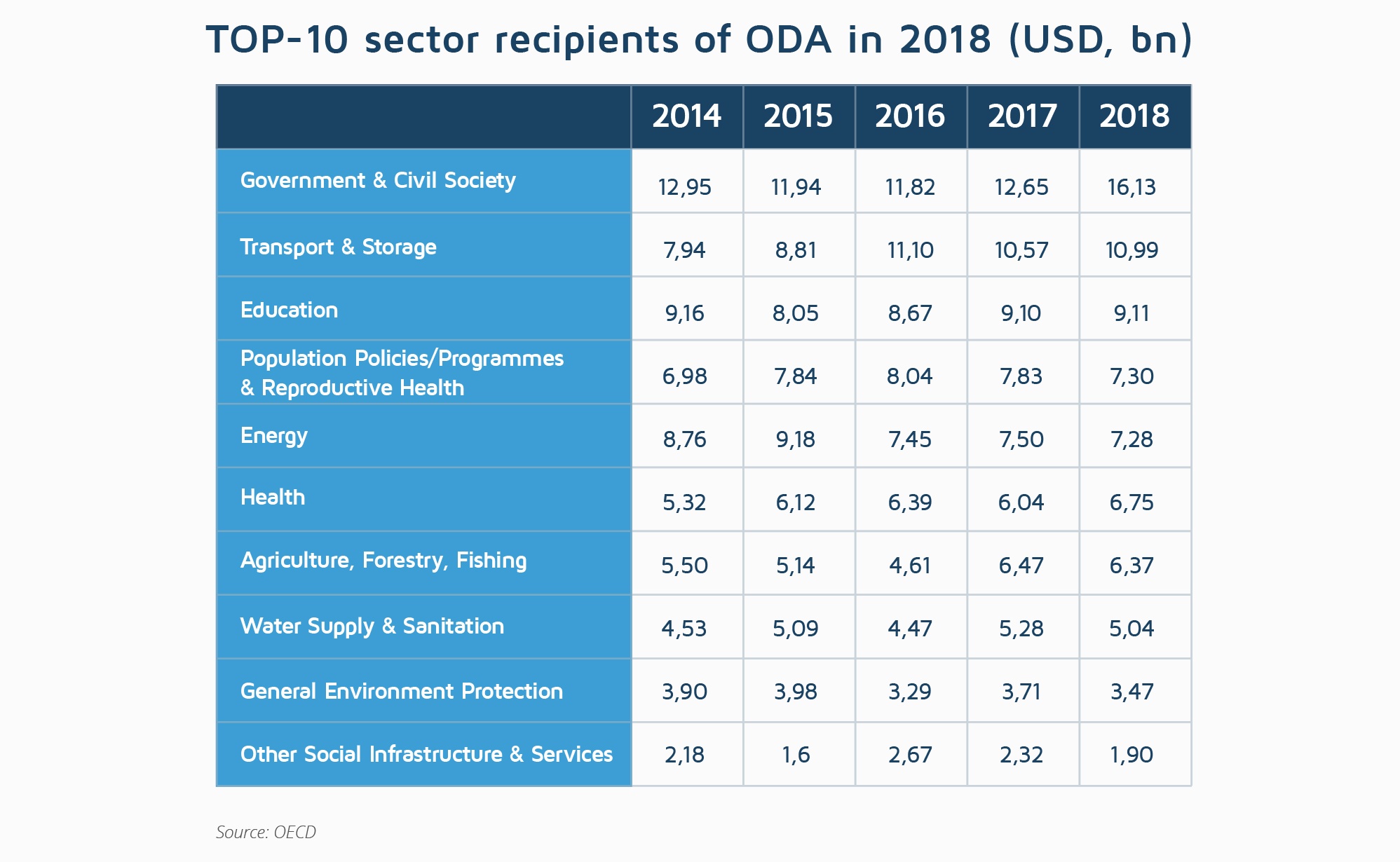
With almost US$3.5 billion of aid committed in 2018, General Environment Protection is one of the sectors that is least financed by the international community. In fact, the aid flow to this sector decreased by almost 7% in 2018 compared to 2017, confirming the continual fall in the amount of aid since 2010 when a record US$5.2 bn was recorded. Since the official data for 2018 released by the OECD does not yet include the environment marker, through which a more exhaustive analysis could be performed of donors’ efforts to halt climate change, it is rather difficult to assess the total amount of money committed to tackle the climate issue under the umbrella of General Environment Protection.
Economic infrastructure development
Although the commitments to the Economic Infrastructure and Service grouping of sectors remained at the same level of US$21.9 bn. in 2018, when compared to 2017, some of the trends within the sector’s categories are worth highlighting. Thus, the aid flows for the development of communications doubled in 2018, reaching almost US$350 m while the banking and financial services sector dropped by 17% to US$1.8 bn. The same decreasing trend is characteristic of the energy sector where the volume of commitments dropped by 3%, totaling US$7.2 bn in 2018.
Accountable leaders and strong societies – an on-trend sector
Looking at the last decade, in 2018 the Government & Civil society sector received its highest amount. Over US$16 bn was committed by DAC countries for developing smarter governments and stronger civil societies across the world. The 2018 figure was 27% higher than the 2017 value of US$12.6 bn. This growth involved Finland, France, Germany, the Netherlands, Spain, Sweden, Switzerland, the United Kingdom and the United States which altogether increased ODA commitments by almost US$ 3 bn.
Development aid for Global Health
Total ODA commitments for the Health sector increased by 11% in 2018 reaching US$6.7 bn. This achievement is due to almost US$800 m in additional aid for the General Health sub-sector. At the same time, the aid designated for the basic health services decreased by almost US$100 m.
The biggest donors by volume of aid in 2018 were the United States (US$34.2 bn), Germany (US$25 bn), United Kingdom (US$19.4 bn), Japan (US$ 14.2 bn) and France (US$12.1 bn).
Become a DevelopmentAid member today and gain access to business intelligence data on all the available funding opportunities and grant notices in the International Development sector.
Learn more about ODA distribution in 2018 by recipient country and discover which regions benefited from the most development aid from our recently published review. Subscribe to the DevelopmentAid newsletter to receive the latest news from the Development Sector.