
Add us as your preferred source on Google to see more of our content in Search.
 Add to Preferred Sources
From developed to developing countries, no nation is immune from financial “gaps and vulnerabilities”, the President of the UN General Assembly said.
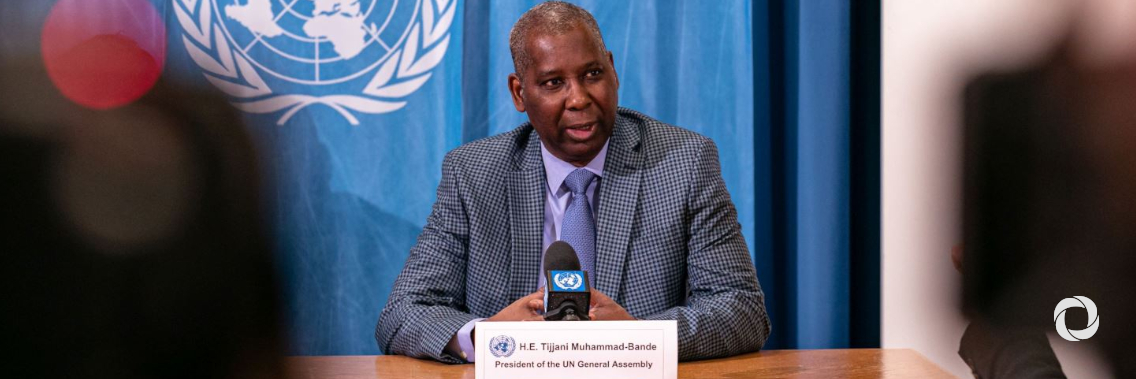
Speaking at the High-level Panel on International Financial Accountability, Transparency and Integrity (FACTI) for Achieving the 2030 Agenda, Tijjani Muhammad-Bande warned that gaps, or the illegal siphoning off of government revenues, “have real consequences in all countries”.
The informal interactive dialogue, which was jointly convened by the General Assembly and Economic and Social Council (ECOSOC) Presidents, aims to implement the vision of the 2030 Agenda to make global economic and financial systems fair and equitable.
While acknowledging the work of international bodies to promote cleaner, more transparent financing as part of implementing the Sustainable Development Goals (SDGs), Mr. Muhammad-Bande noted that many questions have arisen surrounding the gaps and vulnerabilities.
“By some estimates, the equivalent of 10 percent of world GDP [gross domestic product] is held in off-shore financial assets”, he observed, adding that “corporate profit-shifting is collectively costing governments between $500 billion and $600 billion a year in lost corporate income tax revenue, and globally corruption is significantly draining our budgets”.
He reminded those assembled of their pledge “to leave no one behind” and spelled out that if this activity continues, “least developed countries will be unable to deliver adequate health care and education to their populations and fail to achieve our collective Sustainable Development Goals”.
“We have entered the Decade of Action and Delivery, and our focus must now be firmly fixed on implementing the ambitious and transformational blueprint of the 2030 Agenda for Sustainable Development. Our aim is to contribute to efforts which will enable the global economic and financial systems to work better for everyone, everywhere,” Mr. Muhammad-Bande stressed.
Original source: UN News
Published on 02 March 2020