

Add us as your preferred source on Google to see more of our content in Search.
 Add to Preferred Sources
Recent Black Summer bush fires in Australia have brought significant damage to the country’s economy. The event pinpointed the need to take a closer look at the financial risks associated with climate change. In 2019, Australia’s main financial regulators made a call to action, citing climate change as a central concern for the economy and the financial stability of the country. This article will take a look at the current considerations of Australia’s institutions regarding climate change and the steps that are being taken in order to contain the financial risks associated with it.
Developing climate change informed economic models
Australia is set to create new economic models which would be informed by climate change risks. Australia’s Reserve Bank (RBA) has made its first detailed commentary regarding the climate change and economy. RBA’s deputy governor, Guy Debelle, warned that climate change associated consequences “are likely to have first-order economic effects”. The deputy emphasized that, in contrast to the temporary effects related to climate experienced in the past, current climate change is an ongoing trend that is here to stay. Debelle said that the RBA is currently in discussions with businesses, institutions and climate modelers in order to translate information into “frameworks that inform our monetary policy decision-making”.
In a Financial Stability Review publication, the RBA classified the risks into three categories: physical, transitional and liability. RBA stated that, while climate change is not yet a direct threat, investors and businesses should take into account and manage the risks associated with it.

A 2017 report by the Task Force on Climate-Related Financial Disclosures (TCFD) found that the following entities are likely to be affected by climate-related risk:
- Financial sector entities – banks, insurance groups, asset owners (investment entities) and asset managers
- Non-financial sector entities – energy, transportation, material and buildings and agriculture, foods and forest products
A climate change financial risks guide for businesses
In 2019, the Australian Prudential Regulation Authority (APRA), which supervises entities with more than $6 trillion in assets, released the results of its first climate risk survey. Thirty-eight large banks, insurers and superannuation trustees were surveyed to assess their views and practices on managing the financial risks of climate change to their businesses. The survey highlighted that many large entities are aware of the risks and are actively taking active steps to increase their understanding of them. Reputational damage, flooding, regulatory changes and cyclones were characterized as the top climate-related financial risks by survey respondents. However, the survey results also pointed to the need to address climate data deficit and to quantify the likely impact of climate change. In response to the survey, APRA will, by the end of 2020, develop a climate change financial risk prudential practice guide. This guide, in accordance with the TFCD recommendations, will cover aspects of governance, strategy, risk management, metrics and public disclosure of climate related financial risks.
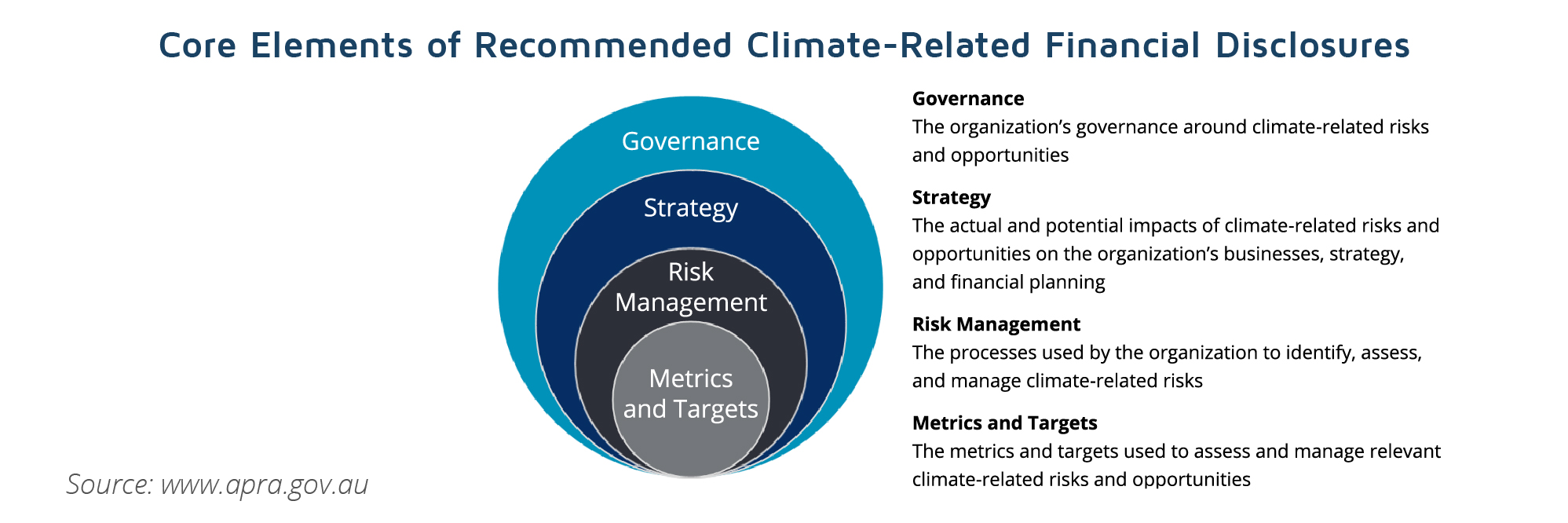
Assessment of financial risks of climate change, formally subject to Australian law
Moreover, as of August 2019, under Australian law climate change is now formally included as a risk that entities (financial institutions, businesses, etc.) should consider when assessing their operational and financial reviews and, when relevant, disclose the information. This regulatory update of Australian law follows the TCFD framework adopted by more than 800 international leading organizations and it is considered to be a benchmark standard. The Task Force on Climate-Related Financial Disclosures (TCFD) was set up by the Financial Stability Board (FSB) to create climate-related financial risk disclosures for use by businesses, banks and investors in providing information to stakeholders.
Assessment of the financial risk of climate change is an increasing trend worldwide, not in Australia alone. The Bank for International Settlements, the global financial institution which is owned by the 60 largest central banks, such as the Reserve Bank of Australia, has published a report explaining the financial instability climate change can cause. The report claims that current risk assessment and climate change models cannot accurately predict climate-related risks and the “potentially extremely financially disruptive events that could be behind the next systemic financial crisis.” It also states that ultimately, it might be up to the central banks to “intervene as climate rescuers of last resort” and, for example, buy a large set of carbon-intensive assets and/or assets stricken by physical impact.
DevelopmentAid brings relevant information for individuals working in the development sector. If you want to stay up to date with the latest information, become a member and sign up to our newsletter.