
Add us as your preferred source on Google to see more of our content in Search.
 Add to Preferred Sources
UNHCR, the UN Refugee Agency is warning that the latest rounds of violence in eastern parts of the Democratic Republic of the Congo (DRC) displacing thousands of people could unleash terrible consequences for the country as it grapples to initiate a new fight against the deadly coronavirus.
More than five million people have been uprooted by conflict within the DRC’s borders, the single-largest internally displaced population in Africa. The country also hosts over half a million refugees, fleeing unrest and persecution in the neighbouring countries.
Recent attacks in North Kivu and Ituri provinces are reported to have displaced more than 35,000 people in recent weeks including some 25,000 in villages south of Lubero territory.
In the meantime, security has deteriorated in the Djugu Territory in Ituri province, where a growing number of attacks by unknown assailants have displaced over 12,000 persons so far this month.
These attacks hamper humanitarian access, hinder assistance to desperate displaced people, and disrupt vital coordination on COVID-19 prevention and sensitization.
Ongoing violence and insecurity in other parts of the country could also make it harder for the displaced to access public health facilities. Many areas and sites hosting displaced people are also overcrowded, making it difficult to implement physical and social distancing.
As confirmed cases of COVID-19 continue to rise in DRC with 287 confirmed cases and 23 deaths, mainly in the capital Kinshasa, UNHCR is working closely with other UN and humanitarian partners to prevent the spread of the disease among refugees and the internally displaced. At the same time, we continue our activities to protect and assist refugees and internally displaced people.
As to date, no cases of COVID-19 infection have been reported among refugees and asylum seekers in the DRC. UNHCR is redoubling its efforts to implement prevention and response measures in refugee camps and sites.
Insecurity in the East had forced UNHCR partners to withdraw staff from displacement sites in Drodro and Bule in the Ituri province at the end of March, leaving displaced people without effective support. UNHCR and its partners have facilitated the establishment of 14 humanitarian committees to temporarily provide remote management, until the security situation improves.
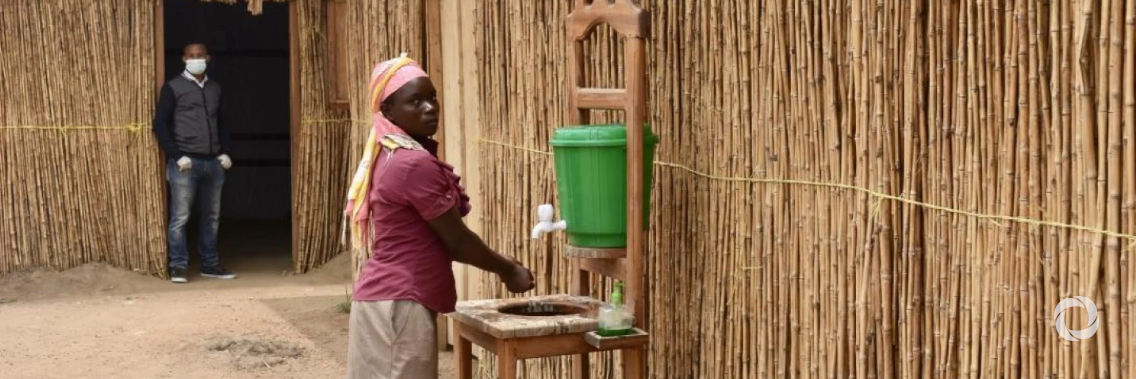
UNHCR is strengthening its regular health and sanitization activities in camps, sites and transit centres where possible. The present prevention COVID-19 measures include temperature screening at entry points of camps, sites and transit centres, and have installed some 365 hand-washing stations, and carried out an initial distribution of more than 23,000 soap bars.
UNHCR is also conducting mass awareness-raising activities on health measures being implemented by the Government and on guidance on preventive measures to lower the risk of infection.
Refugees and displaced persons often express fears about the virus, mainly as a result of misinformation. While physical distancing can be challenging in overcrowded camps or settlements, the advice to regularly wash hands is globally keenly followed.
Across DRC, UNHCR is also supporting the national healthcare system to scale-up its response. We are for instance setting up three isolation centres in the Kasai province where patients with COVID-19 symptoms will be referred to for treatment, hence limiting the burden on public hospitals and health structures.
UNHCR continues its advocacy for equal access to refugees and displaced people in the national health systems being put in place to fight COVID-19.
Original source: UNHCR
Published on 17 April 2020