
Add us as your preferred source on Google to see more of our content in Search.
 Add to Preferred Sources
The United Nations Development Programme (UNDP) released two new data dashboards that highlight the huge disparities in countries’ abilities to cope with and recover from the COVID-19 crisis.
The pandemic is more than a global health emergency. It is a systemic human development crisis, already affecting the economic and social dimensions of development in unprecedented ways. Policies to reduce vulnerabilities and build capacities to tackle crises, both in the short and long term, are vital if individuals and societies are to better weather and recover from shocks like this.
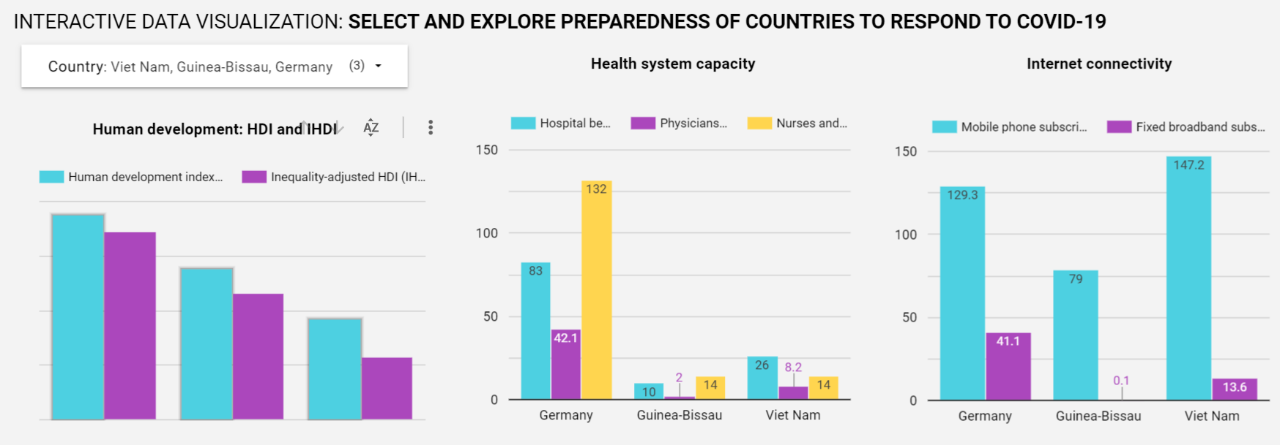
UNDP’s Dashboard 1 on Preparedness presents indicators for 189 countries – including the level of development, inequalities, the capacity of a healthcare system, and internet connectivity– to assess how well a nation can respond to the multiple impacts of a crisis like COVID-19.
While every society is vulnerable to crises, their abilities to respond differ significantly around the world.
For example, the most developed countries – those in the very high human development category- have on average 55 hospital beds, over 30 physicians, and 81 nurses per 10,000 people, compared to 7 hospital beds, 2.5 physicians, and 6 nurses in the least developed country.
And with widespread lockdowns, the digital divide has become more significant than ever. 6.5 billion people around the globe – 85.5 percent of the global population – still don’t have access to reliable broadband internet, which limits their ability to work and continue their education.
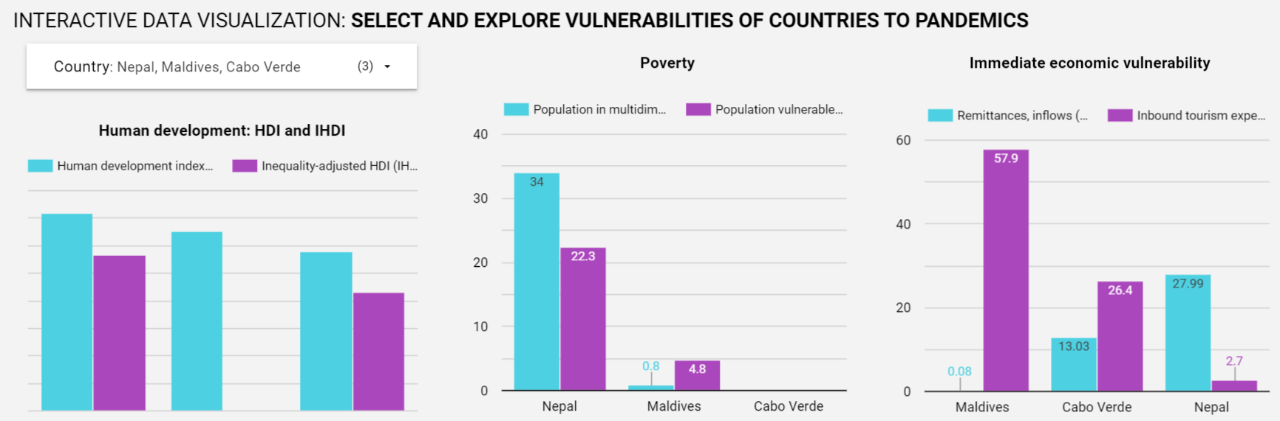
Preparedness is one thing. But, once a crisis hits, how vulnerable are countries to the fallout? UNDP’s Dashboard 2 on Vulnerabilities presents indicators that reflect countries’ susceptibility to the effects of this crisis.
Those already living in poverty are, particularly at risk. Despite recent progress in poverty reduction, about one in four people still live in multidimensional poverty or are vulnerable to it, and more than 40 percent of the global population does not have any social protection.
The COVID-19 pandemic also reminds us that disruptions in one place are contagious, triggering problems elsewhere. For example, in some countries, like Kyrgyzstan, a significant part of their GDP comes from remittances. While places as diverse as Montenegro, Maldives and Cabo Verde, rely heavily on tourism (almost 60% of GDP in the Maldives for example), which is being hit very hard by travel bans and lockdown.
Read and download the: COVID-19 and Human Development: Exploring global preparedness and vulnerability.
Original source: UNDP
Published on 29 April 2020