
Add us as your preferred source on Google to see more of our content in Search.
 Add to Preferred Sources
Trade facilitation reforms are at the heart of countries’ responses to the economic slowdown, disruptions to global supply chains and shutdown of businesses due to COVID-19.
More than ever, countries have recognized the need to implement reforms to ease the flow of critical goods and services, such as medical supplies and key agricultural products, across borders, while managing the pandemic’s economic consequences.
A new UNCTAD study underscores the critical role of national trade facilitation committees (NTFCs), the primary trade facilitation coordination mechanism, in helping countries implement impactful trade reforms to fight the pandemic.
“National trade facilitation committees are the right platform to bring together public and private sectors not only to address current bottlenecks to trade caused by the pandemic, but also to prepare for recovery,” said Shamika N. Sirimanne, UNCTAD’s director of technology and logistics.
The committees help establish contacts, coordinate actions, advise in negotiations and lead in mobilizing resources for trade facilitation projects.
In the wake of the coronavirus pandemic, some NTFCs have coordinated the establishment of trade information portals to ease trade by simplifying and explaining procedures and processes as well as COVID-19 emergency measures.
In countries such as Rwanda and Uganda, they have coordinated the dissemination of information on procedures for importing and exporting vital medical and pharmaceutical products.
Besides, they have worked with local authorities to expedite customs clearance and release of goods essential to combatting the spread of the pandemic, such as masks, gels and disinfectants.
UNCTAD’s latest study on NTFCs expands on two previous ones conducted in 2015 and 2017, utilizing information from 52 countries with which the organization has partnered on trade facilitation measures over the years.
It spotlights how the committees are evolving fast to meet current challenges. The study reveals 12 major trends in the evolution of NTFCs around the world.
It shows how NTFCs evolve in aspects such as mandate, scope, institutional framework and composition, while adapting to new emerging needs.
NTFCs play an important role in the simplification of foreign trade procedures and in keeping costs of trade to a minimum. They coordinate trade facilitation reforms by opening and guiding discussions between public and private stakeholders, enabling swift and actionable responses to emerging challenges.
NTFCs have long existed in various forms, but they have only started gaining traction in leading trade facilitation efforts in recent years.
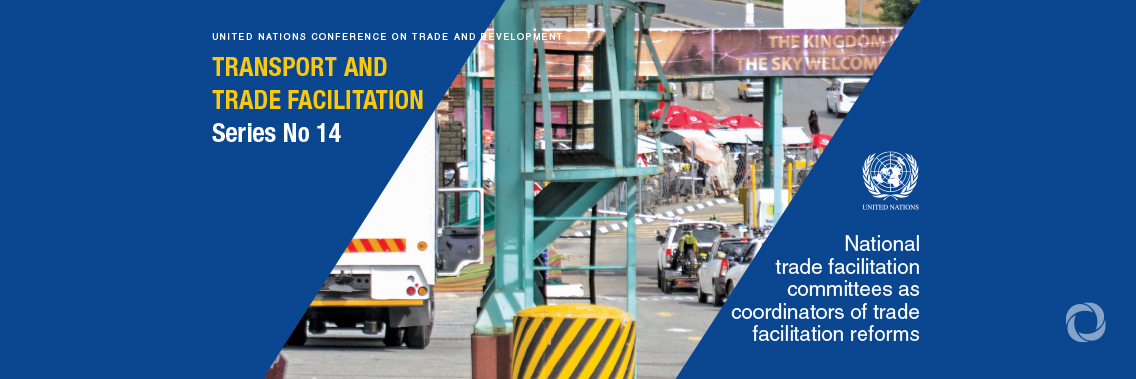
Read and download the UNCTAD study: Transport and Trade Facilitation.
Original source: UNCTAD
Published on 05 May 2020