

Add us as your preferred source on Google to see more of our content in Search.
 Add to Preferred Sources
International tourism, COVID-19 exacerbates poverty risks in the poorest countries and Bill and Melinda Gates Foundation’s announced a commitment at the Coronavirus Global Response Summit. Here is what you missed from last week’s headlines in the international development sector:
International tourism numbers could fall 60-80% in 2020
The COVID-19 pandemic has caused a 22% fall in international tourist arrivals during the first quarter of 2020, the latest data from the World Tourism Organization (UNWTO) shows.
According to the United Nations specialized agency, the crisis could lead to an annual decline of between 60% and 80% when compared with 2019 figures. This places millions of livelihoods at risk and threatens to roll back progress made in advancing the Sustainable Development Goals (SDGs).
UNWTO Secretary-General Zurab Pololikashvili said: “The world is facing an unprecedented health and economic crisis. Tourism has been hit hard, with millions of jobs at risk in one of the most labour-intensive sectors of the economy.”
Available data reported by destinations point to a 22% decline in arrivals in the first three months of the year, according to the latest UNWTO World Tourism Barometer. Arrivals in March dropped sharply by 57% following the start of a lockdown in many countries, as well as the widespread introduction of travel restrictions and the closure of airports and national borders. This translates into a loss of 67 million international arrivals and about US$80 billion in receipts (exports from tourism).
COVID-19 exacerbates poverty risks in the poorest countries
As the number of COVID-19 cases continues to rise in Africa and Southern Asia, and the global economy enters a synchronized recession unseen since the Second World War, the world’s poorest countries brace for yet another shock that threatens to deepen global inequalities and exacerbate an already challenging situation.
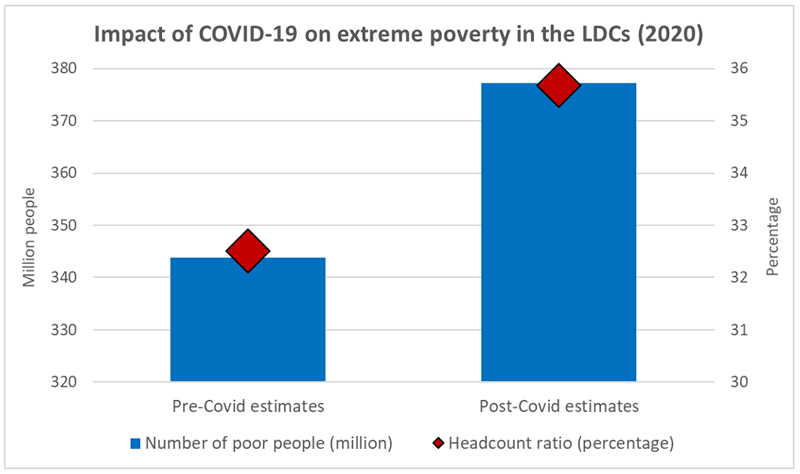
Public health and socio-economic concerns are deeply intertwined all over the world, but all the more so in contexts like the least developed countries (LDCs).
Indeed, even though two-thirds of people in LDCs live in rural areas, many of them reside in overcrowded urban settlements lacking basic services. They can hardly cope with strict social distancing, as well as broader economic shocks that directly affect their income.
Even prior to the emergence of the COVID-19 pandemic, respectable gross domestic product (GDP) growth rates in the 47 LDCs were only weakly translating into inclusive social outcomes.
Bill and Melinda Gates Foundation announced a commitment of $125 million at the Coronavirus Global Response Summit
At the Coronavirus Global Response Summit, the Bill & Melinda Gates Foundation announced a commitment of $125 million towards the international collective effort to develop and equitably distribute COVID-19 diagnostics, therapies, and vaccines.
This includes $50 million of new funding to Gavi, the Vaccine Alliance and $75 million of previously announced funding for therapeutics and diagnostics.
Commenting on the summit and the foundation’s commitment, Melinda Gates, co-chair of the Bill & Melinda Gates Foundation, said:
“In order to beat COVID-19, the world needs more than great science. It needs great humanity, the commitment to help people beat this virus no matter where they live. This effort will help us do that. With the collective resources and brainpower pledged today, we’ll finally be able to attack this virus in the way it is attacking us – globally. Our foundation is proud to support this critical work, and thanks the European Commission for convening the Global Response Conference.”
The summit mobilized new and existing commitments from governments, philanthropies, and the private sector for the international response to COVID-19. In addition, a number of donors made early pledges to Gavi, the Vaccine Alliance, to ensure it can continue to protect the world’s poorest children against vaccine-preventable diseases.
DevelopmentAid Editorials
Experts’ Opinions| Age discrimination and the impact on global development
Ageism – the stereotyping, prejudice, and discrimination against people based on their age – is pervasive and is experienced by both younger and older participants within the labor market. The number of age-related discrimination charges filed against employers with the EEOC (Equal Employment Opportunity Commission) by workers doubled between 1990 and 2019. We asked several experts to share their opinions on this topic. Check their answers below.
Associate Writer | 5 Essential steps to integrate gender-based violence in other programs
Day after day, we start realizing that humanitarian action is most effective when it focuses not only on meeting the immediate needs of those most affected but also on protecting the rights and long-term wellbeing of the most vulnerable at every stage.
Gender-based violence is among the highest protection challenges individuals, families, and communities face during humanitarian emergencies.
The IASC (Inter-Agency Standing Committee) developed many guidelines to provide some initial ideas to colleagues on how to tackle this throughout a project cycle. The guidelines are designed for those who are involved in the design and implementation of different sectoral programs not focused on GBV and provides some simple recommendations that any project can integrate into their plans ideally during the planning phase, but can also consider even after a project is up and running.
Here’s what else has happened
Switzerland: The United Nations World Food Programme (WFP) welcomed a contribution of CHF 1.8 million (US$ 1.9 million) from the Government of Switzerland that will help cover the basic food needs of thousands of Sahrawi refugee families and support WFP’s school feeding programme.
CABEI: The Central American Bank for Economic Integration (CABEI) approved financing for the Republic of Guatemala amounting to US$193.2 million. The resources are aimed at the Ministry of Public Health and Social Assistance, specifically for the Hospital Infrastructure and Equipment Investment Program.
CEB: The Council of Europe Development Bank (CEB) and IREN S.p.A. signed a Public Finance Facility (PFF) for an amount of €80 million, usable in several tranches, with a duration of up to 16 years, to partially finance IREN’s integrated water services plan in the provinces of Genoa and Parma. Approximately 1.1 million inhabitants across 75 municipalities are expected to benefit from an improved, efficient and secure water supply.
UNICEF: An estimated 116 million babies will be born under the shadow of the COVID-19 pandemic, UNICEF said. These babies are projected to be born up to 40 weeks after COVID-19 – currently straining health systems and medical supply chains all over the world – was recognized as a pandemic on March 11.
Reports
Increased foreign aid needed to save millions of lives
A rapid and massive increase in international assistance is needed to save millions of lives and bring the world together amid the COVID19 pandemic, said Oxfam.
Given the devastating health, social, and economic impacts around the world and especially in the world’s poorest countries, governments – including the US – must urgently and massively increase international aid funds.
In its new report “Whatever it Takes,” Oxfam called for this aid to prioritize prevention measures, health systems, social protection and food security. Oxfam also called attention to the need to reshape the future of aid to help build more equal and resilient societies, so that we are all better prepared for future crises.
Read and download the Oxfam report: “Whatever it Takes”.
Coronavirus and human rights: New UN report calls for disability-inclusive recovery
The COVID-19 pandemic is intensifying inequalities experienced by the world’s one billion people with disabilities, UN Secretary-General António Guterres said in launching a report that calls for a disability-inclusive recovery and response to the crisis.
Even under normal circumstances, people with disabilities are less likely to access education, healthcare, and income opportunities, or to participate in their communities, according to Mr. Guterres.
Read and download the Policy Brief: A Disability-Inclusive Response to COVID-19
Events
Domestic Resource Mobilization: Country Strategies to Enhance Health Funding in Normal Times and Times of Crisis
? May 14, 2020 ?9:00 am – 10:00 am EDT
Webinar
During this webinar, international health financing experts will discuss strategies being used by LMICs to raise more resources for health locally, and share country-level DRM experiences in normal times as well as times of health crisis.
Webinar| Fragility and Conflict
? May 13 May 2020 ? 3pm CET
Webinar
Join EIF’s Trade for Development News and experts for a series of online discussions on topics crucial to the impacts of COVID-19 on trade in least developed countries (LDCs). 48% of impoverished people today live in fragile and conflict-affected states, and the number is increasing. COVID-19 has the potential to make the situation even worse. What can countries and global institutions do to stem this tide and improve stability?
Sustainable Economies in the aftermath of COVID-19: A virtual Policy Dialogue on Economic and Social Survey of Asia and the Pacific 2020
? May 13, 2020 ? 11.30 AM – 1.00 PM
Virtual event
The Economic and Social Survey of Asia and the Pacific 2020: towards Sustainable Economies, the flagship publication of ESCAP, was launched recently at the UNESCAP headquarters in Bangkok.