
Add us as your preferred source on Google to see more of our content in Search.
 Add to Preferred Sources
Several countries in Asia and Europe, where the COVID-19 outbreak appears to have peaked, are gradually reopening their economies. Without a vaccine or effective treatment, policymakers will be balancing the benefits of resuming economic activity against the potential cost of another increase in infection rates. They face difficult choices, in part, because the costs of erring in either direction could be very large.
Given this, authorities are adopting a gradual and sequenced approach to reopening, along with the adoption of further prevention and containment measures. While some Asian countries have already moved down this path with some success, risks remain—and the risks for Europe may be even greater.
How Asia is restarting economic activity
As containment measures proved effective in curbing the epidemic, a few Asian countries are already well down the path to reopening.
In China, the number of reported new infections has stabilized at very low levels. Since mid-February, the government has been reopening the economy in a gradual, sequenced manner. It has prioritized essential sectors, specific industries, regions, and population groups based on continuous risk assessments. Meanwhile, it has also been leveraging digitalization, big data and technology to support contact tracing.
Crucially, the effort has been complemented by large-scale testing, including the start of randomized screening in select provinces, and systematic tracking via mobile phone apps to rapidly trace the contacts of any new positive cases. This has been accompanied by restrictions on movement and other control measures on infected people and their contacts. So far, the reopening in China has unfolded without a debilitating second wave of infections, but this may yet change as activity normalizes further.
Korea also encountered the virus early in the global wave and put in place a swift and well-organized containment effort. This was based on large-scale testing, mandatory isolation of detected and at-risk cases, and widespread use of digitalization and technology for contact tracing.
However, domestic mobility and business activity were never widely restricted in Korea. As a result, the resumption of economic activity is proceeding gradually, and more or less automatically as social distancing recedes. The authorities have transitioned to less stringent guidelines for “Daily Social Distancing,” which directs citizens to stay home when feeling ill, keep personal distance, wash hands frequently, wear face masks, and ventilate indoor spaces regularly.
Singapore also succeeded in containing the contagion early on following a strategy similar to Korea’s. But, in early April, it tightened containment measures in response to a new outbreak.
Europe’s gradual reopening
Several European countries have announced plans to gradually reopen their economies and some have already begun the process. The timing, sequencing, and pace of the planned exits differ across countries, reflecting differences in the progress of the epidemic but also national preferences.
For example, Denmark and Norway have started by reopening lower schools and services, while Spain has lifted restrictions in manufacturing and construction, as well as for some small businesses, including retail, with safety measures. Germany has lifted restrictions on retail shops and is gradually re-opening schools, with the relaxation subject to a break mechanism allowing for re-tightening if needed. Italy has reopened manufacturing and construction (under strict safety rules) and select small stores. France has just allowed the reopening of primary schools, shops, and industry, on a differentiated regional basis, as of May 11.
Sweden stands out with its distinctive approach, and its decision not to fully lock down activity. It is too early to tell whether this strategy will prove more effective.
All countries envisage using health and social distancing measures to mitigate the risk of a new wave of contagion, but they vary by type and intensity.
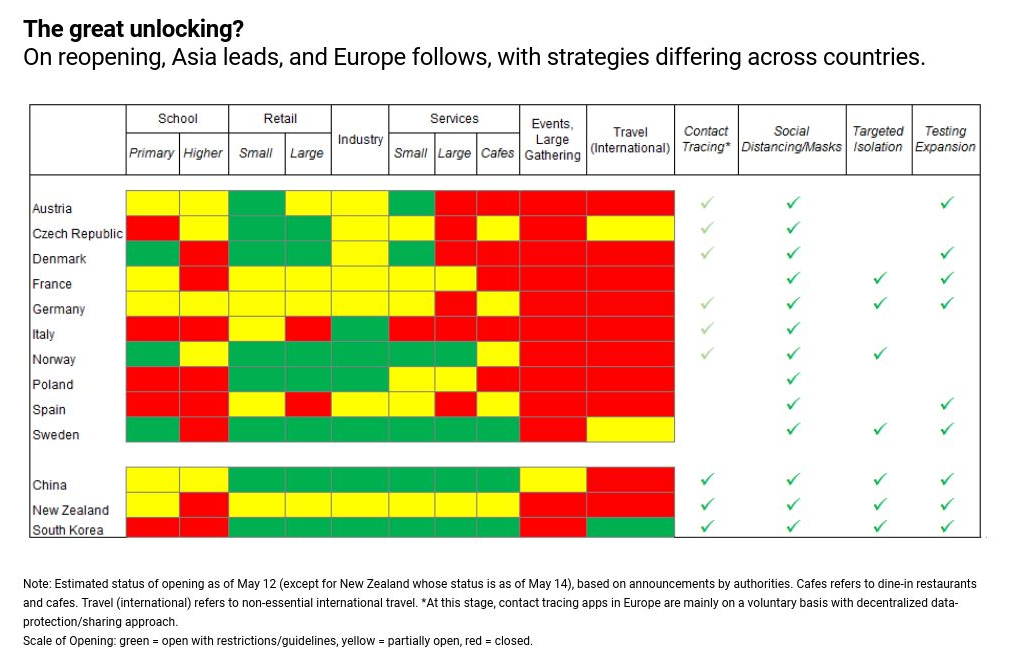
While reopening strategies differ, Europe appears to be reopening its economy earlier in the epidemic cycle than China. In addition, the capacity for large-scale testing, contact tracing, and case isolation in Europe may lag behind the best examples in Asia―partly reflecting stringent privacy rules. For instance, the European Commission recommends tracking apps, but only on a voluntary basis. Consequently, Europe appears to be more at risk than some Asian countries, including China, though no country can confidently declare victory against the virus.
In both Europe and Asia, lockdowns and other restrictions have imposed a significant economic and psychological cost on citizens, and their desire to roll back these measures and reopen economies is all too understandable. However, moving too early and before wide-reaching measures to quickly identify and contain new infections are in place would put the gains in fighting the spread of COVID-19 at stake and risks imposing new human and economic costs. In charting their path out of this unprecedented lockdown, the economies in Asia and Europe should proceed carefully and resist the urge to do too much too soon and risk a relapse.
Original source: IMF
Published on 12 May 2020