
Add us as your preferred source on Google to see more of our content in Search.
 Add to Preferred Sources
Women make up the bulk of mainly low-skilled workers in the tourism industry on small island developing states (SIDS). But are they being catered for and what should be done to protect them from the economic and social fallout from the coronavirus pandemic?
The impact of the COVID-19 pandemic on women working in the tourism industry in SIDS is disproportionate but so is the emerging policy response which lacks an explicit gender component.
Right now, tourism has ground to a halt globally and for many SIDS this is their only economic lifeline.
The United Nations World Tourism Organization (UNWTO) reported that during the first quarter of 2020 $80 billion were lost in export revenues from tourism and there were 67 million fewer arrivals as compared to the same period of last year.
Moreover, by April 2020 100% of worldwide destinations had put travel restrictions in place.
According to the UNWTO’s current scenarios, international tourist arrivals could decline between 58% and 78% in 2020, which would translate into a loss of up to $1trillion in international tourism receipts.
For SIDS, putting tourism-related activities to a standstill is expected to have devastating consequences. Tourism provides more than half of total export revenue in 20 SIDS and more than 30% in 29 SIDS.
Tourism also supports employment generation both directly through hotels, restaurants, travel agencies, aircrafts, cruises, resorts, and shopping outlets; and indirectly through its multiplier effects on restaurant suppliers, construction facilities, and handicraft producers, among others.
Economic contraction of tourism to SIDS is likely to hit women hardest
Under the economic pressures of the COVID-19 pandemic, enterprises are inclined to first lay off workers in low-skilled, casual, seasonal and informal jobs while keeping those in high-skilled or permanent positions.
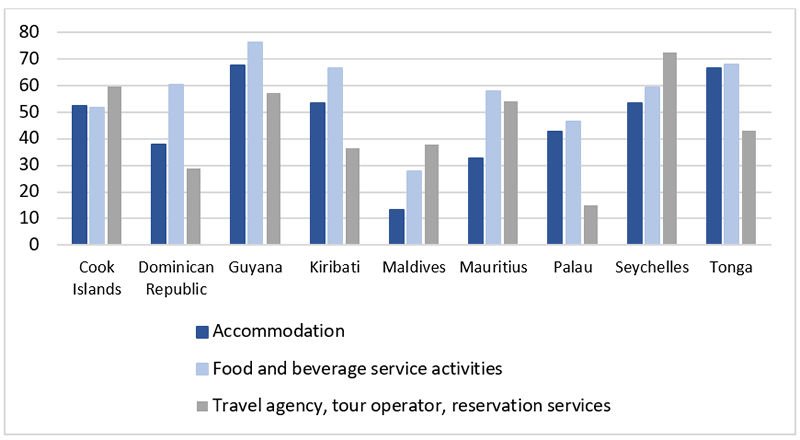
Given the highly female-intensive nature of employment in tourism, especially in low-skilled activities, women are likely to be hit the most by job losses in SIDS.
Female share of employment in selected tourism-related economic activities in SIDS (% share)
There are several immediate actions that can be taken to mitigate the negative impacts of the coronavirus pandemic on women in tourism on these small islands. Targeted policies must incorporate a gender perspective to address these gender gaps, examples of which include:
- Workers/employees. Policies are needed to prevent job losses in tourism for both men and women employees/workers. Such polices include incentive programmes for job retention through wage subsidies and/or social security and other fiscal payment reliefs. Income support schemes such as unemployment benefits need to be given or extended. They should cover the formal and informal sector where disadvantaged groups, including women, are highly represented.
- Own-account workers. Direct income support and cash transfers are necessary to overcome the loss of income-generating activities for own-account workers, a category that includes many women.
- Tourism enterprises/employers. There is also an immediate need to prevent closures and bankruptcies of tourism enterprises through monetary and fiscal policy measures. They include measures to ease the liquidity constraints of enterprises through sectoral funds, social security and fiscal payment exemptions or deferrals, fast and subsidized loans, relaxation of regulations and taxes on travel and tourism activities.
Original source: UNCTAD
Published on 13 May 2020