

Add us as your preferred source on Google to see more of our content in Search.
 Add to Preferred Sources
Coronavirus, automation and the future of work, world leaders unite in call for a people’s vaccine against COVID-19 and emerging from the great lockdown in Asia and Europe. Here is what you missed from last week’s headlines in the international development sector:
Coronavirus, automation and the future of work
According to Cedefop’s skills forecast, in the sectors with a medium-high and high impact of coronavirus on economic activity, around one-fifth to one-quarter of the new jobs expected to be created up to 2030 are at risk of automation. This amounts to around 1.4 million jobs at stake in the EU-27.
As societies are struggling to cope with the new reality following the coronavirus pandemic in terms of socialising, shopping or working, the question arises as to whether this new way of living is here to stay and whether technology will from now on be the preferred way of doing things.
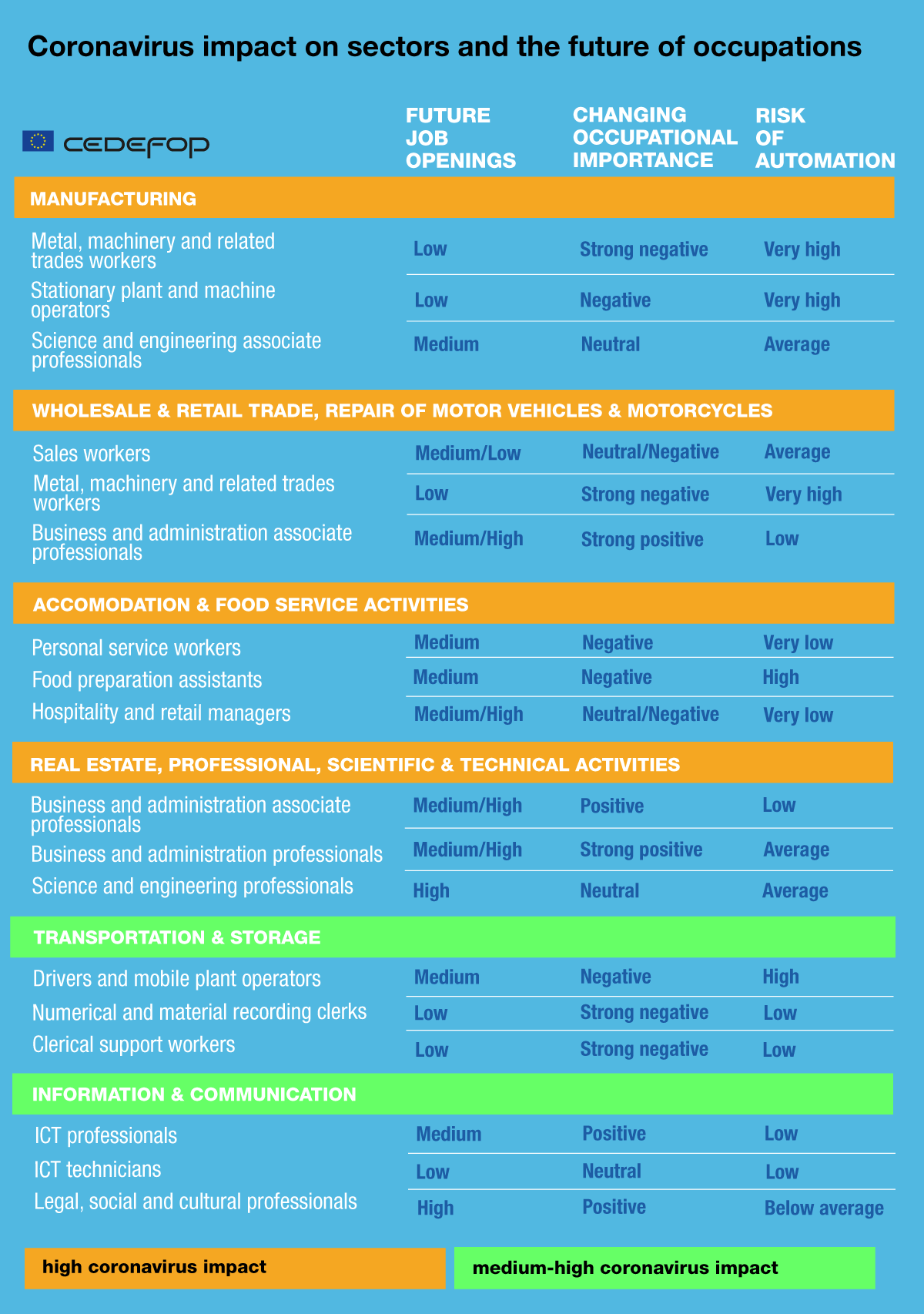
The ILO has used real-time economic and financial data to investigate the impact of the crisis on output by sectors of economic activity. Given that output is the major determinant of employment trends, it is possible to make a first assessment of how the pandemic may affect future skill needs and what the implications for occupations are. The dominant occupations in the sectors affected the most can be examined to gauge the impact of coronavirus on employment and the impact of automation and technology. Data from the 2020 Cedefop skills forecast, which is due to be published soon, along with the estimated risk of automation have been used for that purpose.
World leaders unite in call for a people’s vaccine against COVID-19
More than 140 world leaders and experts, including the President of South Africa and Chair of the African Union, Cyril Ramaphosa, the Prime Minister of Pakistan, Imran Khan, the President of the Republic of Senegal, Macky Sall and the President of the Republic of Ghana, Nana Addo Dankwa Akufo-Addo have signed an open letter calling on all governments to unite behind a people’s vaccine against COVID-19.
The letter, which marks the most ambitious position yet set out by world leaders on a COVID-19 vaccine, demands that all vaccines, treatments and tests be patent-free, mass-produced, distributed fairly and made available to all people, in all countries, free of charge.
Other signatories include the former President of Liberia, Ellen Johnson Sirleaf, the former Prime Minister of the United Kingdom, Gordon Brown, the former President of Mexico, Ernesto Zedillo, the former United Nations Development Programme Administrator and former Prime Minister of New Zealand, Helen Clark.
Emerging from the great lockdown in Asia and Europe
Several countries in Asia and Europe, where the COVID-19 outbreak appears to have peaked, are gradually reopening their economies. Without a vaccine or effective treatment, policymakers will be balancing the benefits of resuming economic activity against the potential cost of another increase in infection rates. They face difficult choices, in part, because the costs of erring in either direction could be very large.
How Asia is restarting economic activity
In China, the number of reported new infections has stabilized at very low levels. Since mid-February, the government has been reopening the economy in a gradual, sequenced manner. It has prioritized essential sectors, specific industries, regions, and population groups based on continuous risk assessments. Meanwhile, it has also been leveraging digitalization, big data and technology to support contact tracing.
Korea also encountered the virus early in the global wave and put in place a swift and well-organized containment effort. This was based on large-scale testing, mandatory isolation of detected and at-risk cases, and widespread use of digitalization and technology for contact tracing.
Singapore also succeeded in containing the contagion early on following a strategy similar to Korea’s. But, in early April, it tightened containment measures in response to a new outbreak.
Europe’s gradual reopening
For example, Denmark and Norway have started by reopening lower schools and services, while Spain has lifted restrictions in manufacturing and construction, as well as for some small businesses, including retail, with safety measures. Germany has lifted restrictions on retail shops and is gradually re-opening schools, with the relaxation subject to a break mechanism allowing for re-tightening if needed. Italy has reopened manufacturing and construction (under strict safety rules) and select small stores. France has just allowed the reopening of primary schools, shops, and industry, on a differentiated regional basis, as of May 11.
Sweden stands out with its distinctive approach, and its decision not to fully lock down activity. It is too early to tell whether this strategy will prove more effective.
All countries envisage using health and social distancing measures to mitigate the risk of a new wave of contagion, but they vary by type and intensity.
DevelopmentAid Editorials
Experts’ Opinions| The Role of nuclear Energy in Sustainable Development: Entry pathways
One of the UN Sustainable Development Goals is “Affordable and Clean Energy”. At present, people possess proven technologies that ensure adequate safety levels and safe radioactive waste disposal. We asked several experts to share their opinions regarding the role of nuclear energy in achieving sustainable development goals and what are the nuclear energy challenges.
Higher rates of global unemployment: Coronavirus puts the global economy on hold
Unemployment rates are skyrocketing as the impact of the coronavirus outbreak becomes more and more evident. The reality is much tougher than the devastating statistic of an increase of tens of millions of people becoming unemployed, many more than the number initially forecast. Recent job losses have added to the total of those 188 million people who were registered as unemployed in 2019. While this crisis has affected about 81% of the world’s workforce, only the United States has revealed that 30 million people have lost their jobs over the past six weeks. A halt to the dramatic decline in the number of jobs and aggregate hours of work will depend on governments’ capacities to boost their economies during the second half of the year.
Here’s what else has happened
IsDB: IsDB President Dr. Bandar Hajjar continued, for the 6th week in a row, his meetings with Governors for Member Countries (MCs) to discuss the Bank’s financial assistance to support their efforts to fight COVID19.
UN: The UN Human Rights High Commissioner warned of potential risks as more countries move to lift lockdown measures put in place to contain COVID-19 spread.
EIB and ICO: The European Investment Bank (EIB) and the Instituto de Crédito Oficial (ICO) are providing the self-employed, SMEs and mid-caps in Spain with up to EUR 1.5 billion to enable them to cope with the impact of the COVID-19 crisis. The first EUR 1 billion instalment of this financing package has been signed under an accelerated approval procedure introduced by the EIB in response to this emergency, enabling the funds to reach Spanish firms as quickly as possible.
IRENA: IRENA Permanent Representatives meet virtually to discuss the role of renewable energy in the global recovery from the COVID-19 pandemic. IRENA’s Director-General Francesco La Camera led the discussion by giving IRENA members an update on the Agency’s work, highlighting the relevance of IRENA’s recently published Global Renewables Outlook to the global response to COVID-19.
Reports
COVID-19 economic impact could reach $8.8 trillion globally — ADB report
The global economy could suffer between $5.8 trillion and $8.8 trillion in losses—equivalent to 6.4% to 9.7% of global gross domestic product (GDP)—as a result of the novel coronavirus disease (COVID-19) pandemic, says a new report released by the Asian Development Bank (ADB).
The report, Updated Assessment of the Potential Economic Impact of COVID-19, finds that economic losses in Asia and the Pacific could range from $1.7 trillion under a short containment scenario of 3 months to $2.5 trillion under a long containment scenario of 6 months, with the region accounting for about 30% of the overall decline in global output.
Read the Updated Assessment of the Potential Economic Impact of COVID-19.
Strengthened social protection systems will lessen the impact of crises such as COVID-19
The COVID-19 crisis has exposed devastating gaps in social protection coverage in developing countries, and recovery will only be sustained and future crises prevented if they can transform their ad hoc crisis response measures into comprehensive social protection systems, according to a new analysis from the International Labour Organization (ILO).
Two briefing papers released by the ILO warn that the current gaps in social protection could compromise recovery plans, expose millions to poverty, and affect global readiness to cope with similar crises in future.
Events
Virtual Conversation | WTISD 2020 “Connect 2030: ICTs for the Sustainable Development Goals”
? 18 May 2020 ? 14:00 to 15:30 (CET)
Virtual Event
This year’s WTISD event will address the importance of enhancing collaboration and cooperation among countries, the UN family and others to strengthen the role of ICTs as we embark on the ‘Decade of Action’ to deliver the Sustainable Development Goals (SDGs) and to advance the role of ICTs in the global response to COVID-19.
Course | Gender Issues in Humanitarian Action Pathway
In the first part of the pathway, you will be immersed in a humanitarian response scenario. You will work as a programme manager for the response and go through the main steps of humanitarian programming. While taking these steps you will be prompted to use a ‘gender lens’ to explore the full impacts and consequences of your decision-making.
Virtual Event | 73rd World Health Assembly (WHA73)
? 18 -19 May 2020
Virtual Event
The World Health Assembly is the decision-making body of WHO. It is attended by delegations from all WHO Member States and focuses on a specific health agenda prepared by the Executive Board.