
Add us as your preferred source on Google to see more of our content in Search.
 Add to Preferred Sources
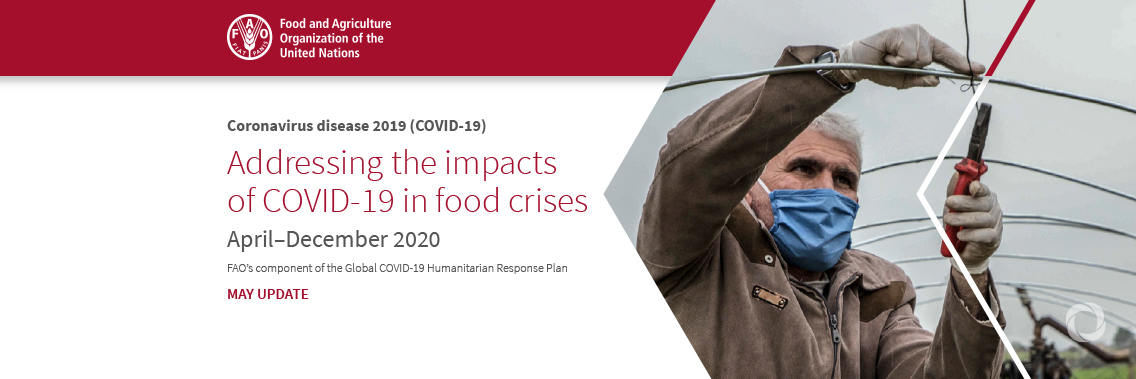
The UN’s Food and Agriculture Organization (FAO) is seeking $350 million to scale up hunger-fighting and livelihoods-boosting activities in food crisis contexts where COVID-19’s impact could be devastating.
Although the pandemic’s full-scale and long-term impact on food security is yet to be revealed, evidence shows that in countries already hit by acute hunger, people are increasingly struggling to have access to food as incomes fall and food prices rise.
If farmers do not have access to their fields or do not have the means or access to buy seeds and other inputs to plant or buy feed for their animals, planting seasons will be missed, cultivation will drop significantly and animals will be lost. This means that less food will become available too – in both rural and urban areas.
“We cannot wait until we finish dealing with the health impacts before we turn to food security. If we don’t start implementing livelihoods assistance now, we will face multiple food crises. And a bill many times greater,” warned FAO Director-General QU Dongyu at a briefing today on the UN agency’s revised humanitarian response to COVID-19.
FAO’s new funding request of $350 million is about three times more than in late March as COVID-19’s staggering socioeconomic impacts become more evident.
FAO’s humanitarian response to COVID-19 is part of the Global COVID-19 Humanitarian Response Plan.
Additional funding is urgently required to address new needs emerging from COVID-19. New activities will build upon critical livelihood-saving support currently being delivered, including:
- In South Sudan, FAO carried out its largest seed distribution so that farmers do not miss the main planting season. To date, FAO has distributed over 4 million kilograms of the procured and pre-positioned 8 million kilograms of crop and vegetable seeds, and over 100 000 agricultural hand tools to about 1,8 million people. This means that each family can grow enough food for at least 6 months and sell some surplus. In addition, nearly 50 000 people received fishing kits.
- In Somalia, FAO fully transitioned its cash assistance to mobile cash delivery, and, over the last 60 days, transferred over 4 million dollars in mobile money to help 200 000 Somalis access food and other basic needs. FAO has registered more than 2.1 million people on its Mobile Money Platform.
- In addition, 240 000 Somalis are receiving e-vouchers via SMS to get seeds, farm tools, irrigation service and storage bags from local traders. This way, FAO reinjects money into the local economy and avoids supply chain delays due to COVID-19.
- In Syria, FAO supported vegetable producers to set up nurseries, which are estimated to bring farmers an additional income of almost $2 000 per year.
- In Pakistan, FAO carried out an online campaign, engaging 160 000 people to learn about preventing food waste; and raised awareness, including through its farmer field schools, on how to stay safe of COVID-19 transmission.
- In Haiti, FAO distributed seeds and other inputs to nearly 50 000 people ahead of the main agricultural campaign.
Overall, FAO’s humanitarian response to COVID-19 impacts will focus on: improving hunger data collection and analysis so that organisations can respond more effectively; maintaining food production, including through scaling up activities so that farmers can take advantage of coming plating seasons; ramping up support to post-production activities, like harvesting, storage, small-scale food processing and conservation, and linking producers to markets to ensure food supply chains stay functional; and, awareness-raising so that people keeping food supply chains alive are not at risk of COVID-19 transmission.
Original source: FAO
Published on 18 May 2020