

Add us as your preferred source on Google to see more of our content in Search.
 Add to Preferred Sources
(June 4 – 10, 2020)
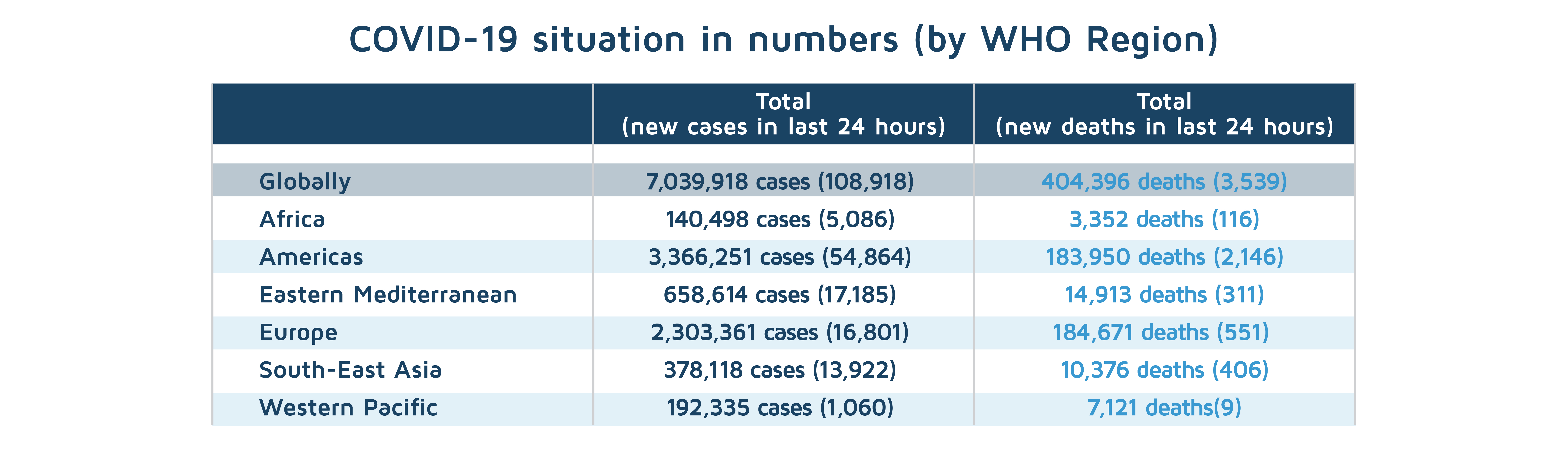
More than 7 million cases of COVID-19 and over 400,000 deaths have been reported to the World Health Organization (WHO) as of June 9, 2020. At the same time, more than 3.3 million people in the world have recovered from the coronavirus. Last week’s trends in the evolution of the disease show signs of the situation in Europe improving while globally it is worsening. Brazil, Iran, Chile, Mexico, Saudi Arabia and Pakistan recorded spikes of new COVID-19 cases last week, according to data provided by Johns Hopkins University Coronavirus Research Center.
The fact that COVID-19 has a major disproportionate impact on racial and ethnic minorities exposes the inequalities that exist within societies, according to the United Nations. In Sao Paulo, Brazil, people of color are 62% more likely to die from COVID-19 than white people. In France’s Seine Saint-Denis department, where many minorities live, higher mortality rates have also been reported.
The UN High Commissioner for Human Rights, Michelle Bachelet, said that the data reveals the devastating impact of COVID-19 on people of African descent, as well as ethnic minorities in certain countries including Brazil, France, the United Kingdom and the United States. “In many other places, we expect similar patterns are occurring, but we are unable to say for sure given that data by race and ethnicity is simply not being collected or reported”.
The number of African Americans who have died due to COVID-19 in the US is reported to be more than double that of other racial groups. In England and Wales, the death rate for black, Pakistani and Bangladeshi people is nearly double that of white people.
According to the UN, the disparities are the likely result of marginalization, discrimination and access to health, although more information is needed to fully understand and address the situation. Among the multiple factors that play a part in the disparities are:
-
-
- economic inequality
- overcrowded housing
- environmental risks
- limited availability of healthcare
- bias in provision of care
-
“People from racial and ethnic minorities are also found in higher numbers in certain jobs that carry increased risk, including the transport, health and cleaning sectors”, according to UN.
A particularly severe impact of COVID-19 is emerging for the world’s 476 million plus indigenous and tribal people. These people work in sectors hard-hit by the crisis, predominantly in the informal economy and are seriously affected by poverty. The International Labor Organization has released a short video that explains this trend.
Investing in innovation to combat COVID-19
The European Commission has announced the awarding of almost EUR 166 million to 36 companies in an effort to combat the pandemic.
The companies will work to expand production of bio-decontamination wipes, to develop ventilation monitoring systems that will provide first aiders with real-time feedback on the quality of the ventilation given to the patient and to develop an antibody platform to treat severe cases of the infection, among many projects.
On June 4, the UK hosted the Global Vaccine Summit. The summit raised US$8.8 billion from 32 donor governments and 12 foundations, corporations and organizations to immunize 300 million children and support the global fight against COVID-19. This amount pledged for Gavi, the Vaccine Alliance, exceeds by far the target of US$7.4 billion. Another US$567 million was also raised for a new innovative financing instrument to provide access to COVID-19 vaccines for low- and middle-income countries.
The largest donor to the Vaccine Alliance is the UK with the country promising support worth the equivalent of £330 million per year over the next five years. The Bill & Melinda Gates Foundation, Norway, Germany and the United States are among the top donors. Some developing countries have also joined the initiative and made their first ever pledge to Gavi – Bhutan, Burkina Faso, Cameroon, Finland, Greece, New Zealand, Portugal and Uganda.
Universal access to COVID-19 vaccines has also been mentioned. Dr Seth Berkley, CEO of Gavi, the Vaccine Alliance, said that support is needed to help to ensure the most vulnerable people in low- and middle-income countries – as well as those in high- and upper middle-income countries – have access to COVID-19 vaccines.
“As we celebrate a historic day we must also turn towards our next challenge: ensuring universal access to COVID-19 vaccines”, Dr Seth Berkley said.
More good news came from New Zealand where, on Monday June 8, the country’s Prime Minister, Jacinda Ardern, announced that her country had no active cases of the novel coronavirus.
New Zealand has now moved from alert Level 2 to alert Level 1 meaning that its residents can return to work, school, sports and domestic travel and can get together with as many people as they wish.
Not a single case of COVID-19 has been reported in this country since May 22. According to New Zealand officials, in total 1,504 people were diagnosed with the virus and 22 died.
The DevelopmentAid news team is working hard to keep you up to date with the most important headlines and events during the COVID-19 pandemic. Become a member and subscribe to our newsletter in order to remain fully informed about the latest news in the International Development Sector.
The next DevelopmentAid weekly coronavirus review will be released on June 17, 2020.
About COVID-2019

Coronaviruses are a large family of viruses that are common in many different species of animals including camels, cattle, cats and bats. Rarely, animal coronaviruses can infect people and then spread between them such as was the case with MERS (2012) and SARS (2003).The symptoms of the virus are very similar to those of a common cold – runny nose, headache, cough, sore throat, fever, a general feeling of being unwell. Blood tests are necessary in order to prove the presence of the virus in the organism.

Named by scientists as the “Wuhan seafood market pneumonia virus”,  COVID-19 is a coronavirus, like MERS and SARs, all of which have their origins in bats. Initial reports show that, in the early stages of the outbreak (early January 2020), many of those infected in Wuhan had some link to a large seafood and live animal market – the Huanan Seafood Wholesale Market, mainly its western wing where wildlife animals are traded. This suggests that the virus initially affected an animal and subsequently spread to a person in a what a CDC has called “the species barrier jump”.