
UNESCO report on inclusion in education shows 40% of poorest countries did not provide specific support to disadvantaged learners during COVID-19 crisis
Add us as your preferred source on Google to see more of our content in Search.
 Add to Preferred Sources
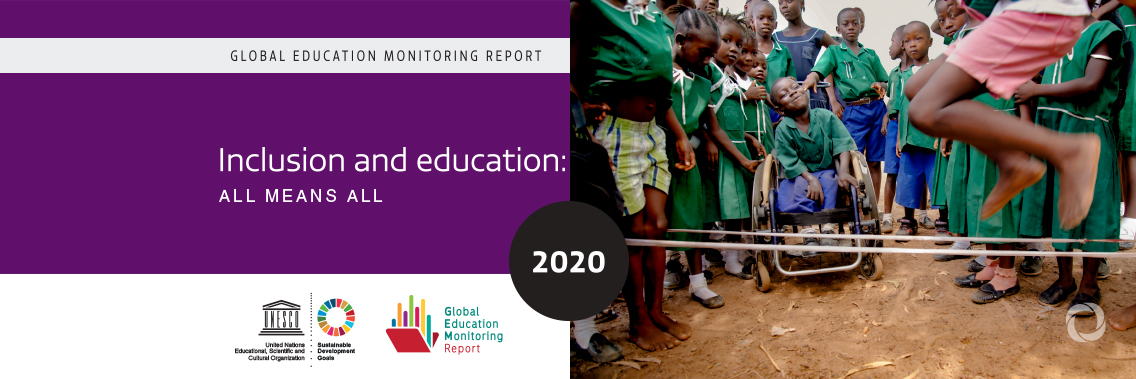
Fewer than 10% of countries have laws that help ensure full inclusion in education, according to UNESCO’s 2020 Global Education Monitoring Report: Inclusion and education – All means all.
The report provides an in-depth analysis of key factors that cause the exclusion of learners in education systems worldwide including background, identity, and ability (i.e. gender, age, location, poverty, disability, ethnicity, indigeneity, language, religion, migration or displacement status, sexual orientation or gender identity expression, incarceration, beliefs and attitudes). It identifies an exacerbation of exclusion during the COVID-19 pandemic and estimates that about 40% of low and lower-middle-income countries have not been able to supported disadvantaged learners during temporary school shutdown.
The 2020 Global Education Monitoring (GEM) Report urges countries to focus on those left behind as schools reopen so as to foster more resilient and equal societies.
“To rise to the challenges of our time, a move towards more inclusive education is imperative,” said the Director-General of UNESCO, Audrey Azoulay. “Rethinking the future of education is all the more important following the Covid-19 pandemic, which further widened and put the spotlight on inequalities. Failure to act will hinder the progress of societies.”
This year’s Report is the fourth annual UNESCO GEM Report to monitor progress across 209 countries in achieving the education targets adopted by UN Member States in the 2030 Agenda for Sustainable Development. It notes that 258 million children and youth were entirely excluded from education, with poverty as the main obstacle to access. In low- and middle-income countries, adolescents from the richest 20% of all households were three times as likely to complete lower secondary school as were as those from the poorest homes. Among those who did complete lower secondary education, students from the richest households were twice as likely to have basic reading and mathematics skills as those from the poorest households. Despite the proclaimed target of universal upper secondary completion by 2030, hardly any poor rural young women complete secondary school in at least 20 countries, most of them in sub-Saharan Africa.
“Covid-19 has given us a real opportunity to think afresh about our education systems,” said Manos Antoninis, Director of the Global Education Monitoring Report. “But moving to a world that values and welcomes diversity won’t happen overnight. There is an obvious tension between teaching all children under the same roof and creating an environment where students learn best. But, COVID-19 has showed us that there is scope to do things differently, if we put our minds to it.”
Parents’ discriminatory beliefs were found to form one barrier to inclusion: Some 15% of parents in Germany and 59% in Hong Kong, China, feared that children with disabilities disturbed others’ learning. Parents with vulnerable children also wished to send them to schools that ensure their well-being and respond to their needs. In Queensland, Australia, 37% of students in special schools had moved away from mainstream establishments.
The report shows that education systems often fail to take learners’ special needs into account. Just 41 countries worldwide officially recognized sign language and, globally, schools were more eager to get internet access than to cater for learners with disabilities. Some 335 million girls attended schools that did not provide them with the water, sanitation, and hygiene services they required to continue attending class during menstruation.
“Inadequate data means we are missing a huge part of the picture,” says Antoninis. “It is no wonder the inequalities suddenly exposed during COVID-19 took us by surprise.”
Read the 2020 Global Education Monitoring (GEM) Report.
Original source: UNESCO
Published on 23 June 2020