
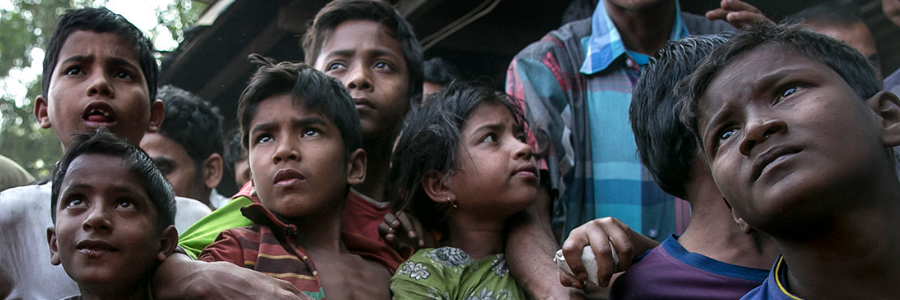
In the past few weeks, more than 370,000 Rohingya Muslims have fled a brutal military crackdown in the Buddhist majority country of Myanmar, where they are denied citizenship and reportedly face an array of human rights abuses, to seek refuge in Bangladesh.
Add us as your preferred source on Google to see more of our content in Search.
 Add to Preferred Sources
But many other Rohingya refugees have been turned away, leaving thousands stranded at sea. Almost 40 percent of all Rohingya villages are now empty, a Myanmar government spokesperson confirmed Thursday. Zeid Ra‘ad al-Hussein, the United Nations human rights chief, has called what’s happening to Rohingya in Myanmar “a textbook example of ethnic cleansing.”
Who are the Rohingya and where do they live?

The Rohingya are a Muslim ethnic group living primarily in the Buddhist nation of Myanmar (or Burma). There are approximately 1.1 million Rohingya living in the country.
According to Al Jazeera, the Rohingya have been described as the “world’s most persecuted minority,” and have faced systematic persecution since Myanmar’s independence in the late 1940s. Most Rohingya in Myanmar reside in the Rakhine State on the country’s western coast. Rakhine State is regarded as one of the country’s poorest states and lacks basic services in education and health care.
The Rohingya’s history in Myanmar
According to historians, the group has been residing in Arakan (now Rakhine State) since as early as the 12th century, Al Jazeera reported.
When the British ruled between 1824 and 1948, they administered Myanmar as a province of India and, thus, any migration of laborers between Myanmar and other South Asian countries (like Bangladesh) was considered internal. The majority of the native Myanmar population did not like that.
After gaining independence in 1948, the Burmese government still frowned upon any migration that occurred during the period of British rule, claiming it all to be illegal. In fact, many Buddhists in Myanmar consider the Ronhingya to be Bengali, or people from Bangladesh.

The discriminatory 1982 Citizenship Law officially prevented them from obtaining citizenship. And according to a Human Rights Watch report from 2000, this is the basis the Myanmar government uses to deny Rohingya citizenship in the country.
Over the years, military crackdowns on the Rohingya have forced hundreds of thousands to escape. According to the HRW report, Rohingya refugees reported that the Burmese army had forcibly evicted them. Many also alleged widespread army brutality, rape and murder. Between 1991 and 1992, more than 250,000 Rohingya refugees fled to southeastern Bangladesh. But with the influx of refugees, the Bangladeshi government insisted the refugees return to Arakan (Rakhine State).
By 1997, according to the HRW report, some 230,000 refugees returned. That same year, the Burmese government said it would not accept any more returning refugees after Aug. 15, 1997, leading to a series of disturbances in Bangladeshi refugee camps.
The Human Rights Watch has called the crisis a deadly game of “human ping-pong.”
What’s happening to the Rohingya now?
Myanmar, a Buddhist majority country, continues to deny the Rohingya citizenship, freedom to travel, access to education and the group still faces harsh systematic persecution.
In October 2016, the Burmese government blamed members of the Rohingya for the killings of nine border police, leading to a crackdown on Rakhine State villages in which troops were accused of rape, extrajudicial killing and other human rights abuses — all allegations they denied. And most recently in August, violence erupted after a Rohingya armed rebel group called the Arakan Rohingya Salvatian Army (ARSA) attacked police posts and an army base in Rakhine, Al Jazeera reported.
ARSA has reportedly killed a dozen Burmese security personnel in the past. And according to the Washington Post, it’s unclear how much support the rebel group, which seeks an autonomous Muslim state for the Rohingya, actually has among the Rohingya.
Following the August event, civilians began paying the price for ARSA’s small insurgency as Burma’s military launched a “clearance operation,” which U.N. commisioner for human rights Zeid Ra’ad al-Hussein has called “a textbook example of ethnic cleansing,” the Washington Post reported. At least 370,000 Rohingya Muslims fled to Bangladesh to escape the aforementioned allegations of human rights abuses such as rape, murder and arson, according to the Associated Press.
Women, children and the elderly made up the bulk of the that group. Over the past three years, hundreds of thousands of Rohingya have tried to escape by boat to neighboring countries that refuse to let them in. Approximately 8,000 migrants have been stranded at sea.
Why won’t other countries take them in?
Many of Myanmar’s neighboring countries, including Bangladesh and Thailand, refuse to take them in. The Thai navy has actually turned them away. Lex Rieffel, an expert on Southeast Asia at the Brookings Institution, told NPR in 2015 that the Buddhist-majority nation of Thailand has been battling an Islamist insurgency for decades and has “no stomach” for bringing in more Muslims.
“Where will the budget come from? That money will need to come from Thai people’s taxes, right?” Thai Prime Minister Prayuth Chan-ocha told reporters in 2015.
Malaysia and Indonesia, despite being Muslim-majority nations, have also prevented Rohingya from entering their countries, citing “social unrest.” And Indonesia worries about “an uncontrolled influx.”
“What do you expect us to do?” Malaysian Deputy Home Minister Wan Junaidi Jafaar told The Guardian in 2015. “We have been very nice to the people who broke into our border. We have treated them humanely, but they cannot be flooding our shores like this.”
How is the world reacting to the Rohingya crisis?
International aid to much of Myanmar’s Rakhine State have been suspended, leaving approximately 250,000 Rohingya Muslims without medical care, food and other vital humanitarian assistance, the Human Rights Watch reported Tuesday.
“The United Nations, ASEAN, and the Organization of Islamic Cooperation need to ramp up the pressure on Burma, and provide more assistance to Bangladesh, to promptly help Rohingya and other displaced people,” Philippe Bolopion, deputy diretor for global advocacy at Human Rights Watch said.
Earlier this year, the United Nations Human Rights Council approved an investigative mission, but was denied entry into Myanmar in June. And when an envoy entered in July, it was met with protests. On Monday, the White House released this statement: “We call on Burmese security authorities to respect the rule of law, stop the violence and end the displacement of civilians from all communities.”
Bangladesh, which is facing the largest influx of Rohingyas from Myanmar, has called on the international community to intervene. The Organization of Islamic Cooperation, the world’s largest Muslim body, has also issued a statement Tuesday urging Muslim countries to work together to help the Rohingya refugees.
Original source: AJC.
Posted on 14 September 2017