
Add us as your preferred source on Google to see more of our content in Search.
 Add to Preferred Sources
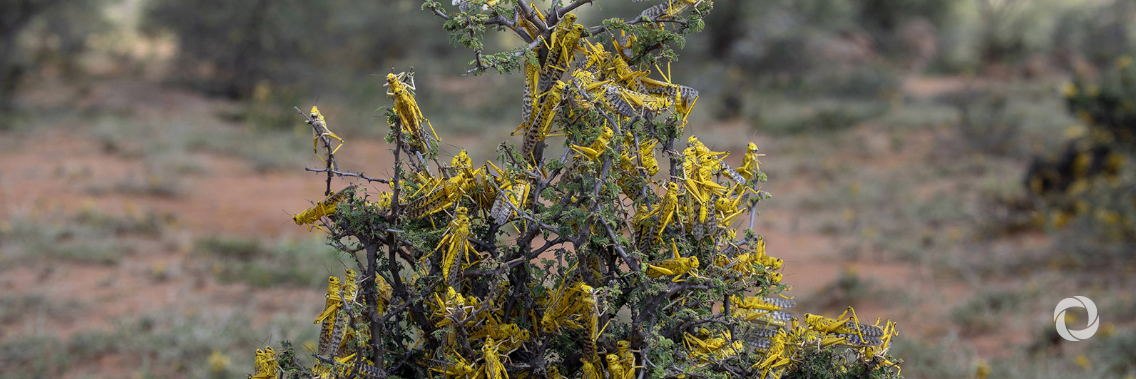
The Food and Agriculture Organization of the United Nations (FAO) welcomed a £ 17 million contribution from the United Kingdom to support efforts to combat the ongoing desert locust surge in East Africa and its potentially devastating impacts.
“We are once again grateful to the United Kingdom for their consistent support, which will go far helping to safeguard the food security and livelihoods of vulnerable farmers and their families in Africa and Asia threatened by desert locust,” said FAO Director-General QU Dongyu.
The funds come via the United Kingdom’s Department for International Development (DFID) and are in addition to a previous contribution of £ 8 million donated earlier this year for the desert locust appeal. The contribution from the United Kingdom will scale up ongoing efforts in East Africa, Yemen, and Southwest Asia. DFID also announced an additional £ 1 million which will be dedicated to supporting several institutions, including the University of Cambridge to establish tools, technologies, and partnerships needed for effective pest surveillance, forecasting, and early warning activities.
FAO is augmenting governments and other partners’ capacities in affected countries with surveillance and coordination, technical advice, supplies, and equipment. The UN agency is also providing farmers with livelihood packages, assuring veterinary care and feed for vegetation-starved livestock, and assisting families who have lost their crops with cash and farming inputs so they put food on the table.
With FAO’s support, 1.3 million tonnes of crops have been protected – enough to feed nearly 9 million people for an entire year. Yet the surge shows no sign of slowing across the Horn of Africa, and in fact, may be increasing in Southwest Asia.
According to the Organization’s desert locust hub, there is still a serious risk of swarms migrating from the Horn of Africa to West Africa, India, and Pakistan. Heavy spring rains across most of East Africa only led to better breeding conditions for the most destructive migratory pest in the world, with the next generation swarms potentially even larger than the ones we are grappling with now.
“Although substantial gains have been made in the fight against the desert locust, sustained support is critical to contain the threat. Capacity to detect Desert Locust early enough is crucial, including through the use of technologies and partnerships, and for that we must work together,” said Qu.
FAO’s latest desert locust appeal is for $ 311.6 million to deal with the expansion of the upsurge, covering the Greater Horn of Africa, Yemen, West Africa, the Sahel and Southwest Asia. So far, $ 182 million have been received or committed to the appeal. This leaves a gap of $ 129.6 million.
If the appeal is not fully funded, control efforts could slow or cease entirely by late September/October. This could lead to the numbers of the crop-devouring pest soaring again, further endangering millions of rural livelihoods. Vulnerable families need support, and to do so national capacities in monitoring and responding to desert locust must also be strengthened.
Original source: FAO
Published on 23 July 2020