
Add us as your preferred source on Google to see more of our content in Search.
 Add to Preferred Sources
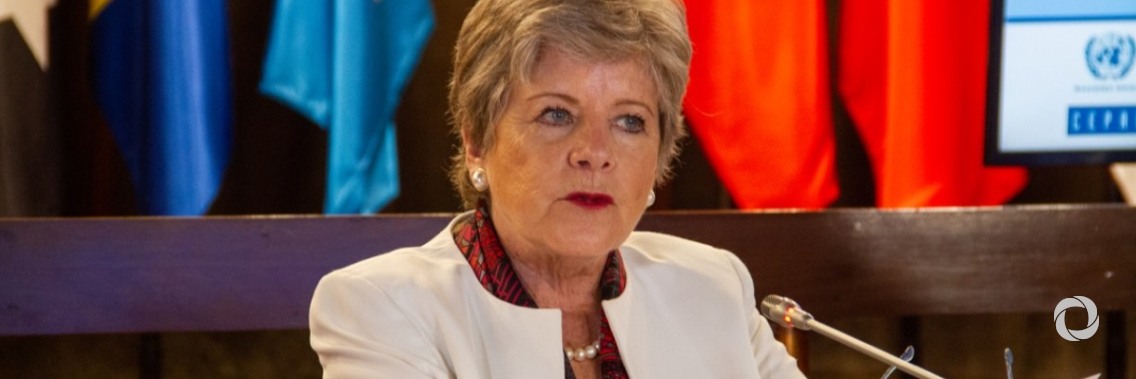
Faced with such an uncertain and regionalized global economy, Latin America and the Caribbean must deepen cooperation and bolster regional agreements, Alicia Bárcena, Executive Secretary of the Economic Commission for Latin America and the Caribbean (ECLAC), sustained in the framework of the XII session of the Inter-Parliamentary Monitoring Commission of the Pacific Alliance (CISAP).
In her remarks, Alicia Bárcena recalled that Latin America and the Caribbean is facing the worst crisis in a century: GDP is forecast to contract 9.1% in 2020; poverty will increase 37.3% to reach 231 million people; some 98 million people will live in extreme poverty (15.5%) and will run the risk of suffering hunger because they will not be able to cover their basic food intake needs, and unemployment will rise to around 13.5%.
She specified that the pandemic prompted by the coronavirus (COVID-19) has exposed the structural problems of the development model in the region, which include the commodification and fragmentation of health care systems, the great inequality affecting women and indigenous peoples, the high degree of urbanization that has facilitated contagion in the most vulnerable neighborhoods, high labor informality affecting 54% of workers, as well as fragile social protection systems and weak multilateralism with growing social tensions.
She explained that to confront the crisis, ECLAC proposes implementing an emergency basic income equivalent to one poverty line ($147 dollars) for six months, at a cost of 1.9% of GDP, along with an anti-hunger grant equivalent to 70% of one extreme poverty line ($57 dollars), which would cost 0.45% of GDP. The Commission also recommends longer repayment periods and grace periods for credits to Micro, Small and Medium-sized Enterprises (MSMEs) and partial co-financing of the payroll; expansionary fiscal and monetary policies that would sustain a longer period of spending; access to financing under favorable conditions for middle-income countries; and political and fiscal compacts for universal, progressive and redistributive social protection.
With regard to trade, ECLAC’s highest authority warned that the value of goods exports from Latin America and the Caribbean is seen falling by 23% in 2020 – marking the worst performance in 80 years – while the value of imports is expected to sink by 25%, notching the biggest drop in nearly 40 years.
Furthermore, intraregional trade has fallen among all the mechanisms for integration. In the first half of this year, trade within the Pacific Alliance plummeted. The hardest-hit sectors were manufactured goods, particularly vehicles; textiles, apparel and footwear; paper and cardboard; and machinery and equipment.
ECLAC supports the Pacific Alliance in 4 areas: promoting more trade in goods among its members, identifying possibilities for new production chains, improving statistics on trade in services, and developing a Common Digital Market.
Alicia Bárcena also emphasized the importance of convergence between the Pacific Alliance and the Southern Common Market (MERCOSUR), which is more necessary than ever today.
“The reduction of trade barriers and investments between the two would be an enormous step towards an integrated Latin American market,” she stated.
Finally, Alicia Bárcena highlighted that building back better will require a new global social compact, a better regional agreement, to move towards universal social protection. She added that the role of the State will be critical, and this will require greater external financing and more progressive, effective, and efficient taxation systems.
Original source: ECLAC
Published on 10 August 2020