
Stronger Together in Crises – Education Cannot Wait reaches 3.5 million children and youth in humanitarian crises worldwide
Add us as your preferred source on Google to see more of our content in Search.
 Add to Preferred Sources
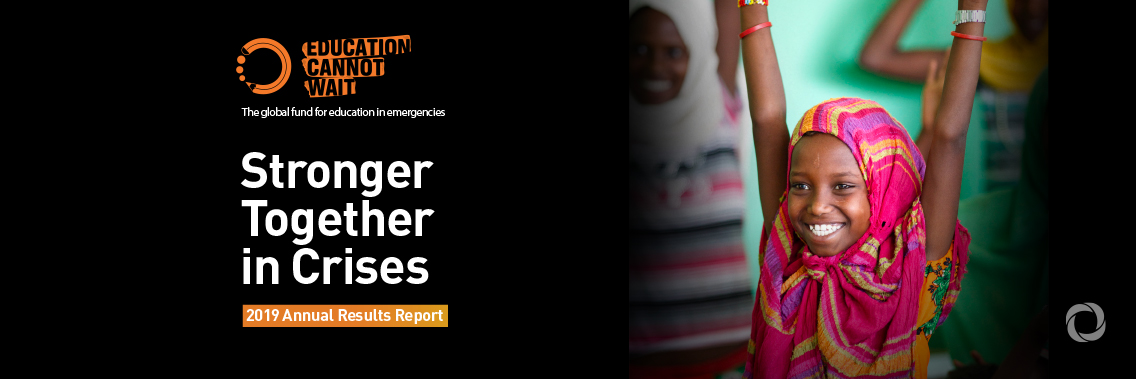
Education Cannot Wait launched its ‘Stronger Together in Crises – Annual Results Report 2019’, reaffirming itself as the global fund for education in emergencies and protracted crises. Since the Fund’s inception in 2016, its investments have reached nearly 3.5 million children and youth in many of the world’s worst humanitarian crises.
“Education Cannot Wait works to serve the 75 million children and youth – 39 million of whom are girls – whose education has been disrupted by armed conflicts, forced displacement, climate-change-induced disasters, and protracted crises. This new Annual Results Report shows ECW advancing from strength to strength, just three years into its operations,” said the Rt. Hon. Gordon Brown, UN Special Envoy for Global Education and Chair of the ECW High-Level Steering Group.
The report comes at an unprecedented time when the global education crisis is exacerbated by COVID-19. The pandemic has swept across the world, threatening decades of hard-won development gains: 90 percent of the world’s school-age children and youth have had their education disrupted. As an innovative fund, Education Cannot Wait is breaking new ground, but more needs to be done. Financing is absolutely essential.
The report provides evidence that ECW’s partnership model is spurring progress in delivering inclusive, equitable quality education for children and youth caught in emergencies and protracted crises. It shows growing political commitment for the emergency education sector and increased prioritization of education in humanitarian appeals: humanitarian funding for education grew five-fold from 2015 to 2019, with more than US$700 million committed in 2019. The share of funding dedicated to the education sector as part of the total sector-specific humanitarian aid globally also continued to rise, reaching 5.1 percent in 2019.
To date, ECW has mobilized $662.3 million, including $252.8 million from both public and private donors in 2019. The Fund substantially increased its operations in 2019, disbursing $130.7 million to 75 grantees to support education in emergencies and protracted crises responses in 29 countries. The report shows that ECW is providing the impetus for quicker education responses in the face of sudden-onset crises, and is strengthening coherence between humanitarian and development aid interventions. It also captures encouraging trends in terms of strengthening national and local capacities to respond, as well as improving data, evidence, and accountability for the sector.
ECW-financed education in emergency activities reached 2.6 million crisis-affected children and youth in 2019 alone. The Fund’s focus on the most vulnerable and marginalized children and youth is translating into real results: while girls often face additional barriers to access education in crisis settings, nearly half of ECW’s beneficiaries (48 percent) are girls. In all, 30 percent of the Fund’s beneficiaries are refugees, 15 percent are internally displaced children and youth, and 55 percent are other crises-affected children and youth, including those from host communities.
Indeed, more remains to be done. Funding appeals for education in emergencies and protracted crises remained significantly underfunded in 2019, with only 43.5 percent of the required funding secured; and, the gap risks widening further with the compounding effect of the COVID-19 pandemic and the stress it is exercising onto education and aid budgets worldwide.
In just the past four months of 2020, ECW’s total First Emergency Response investments span 33 countries and crisis-affected contexts, with a record amount of US$60.1 million rapidly allocated by ECW for vulnerable children and youth, who are now doubly impacted by COVID-19.
Read the Stronger Together in Crises – Annual Results Report 2019.
Original source: Education Cannot Wait
Published on 11 August 2020