
Add us as your preferred source on Google to see more of our content in Search.
 Add to Preferred Sources
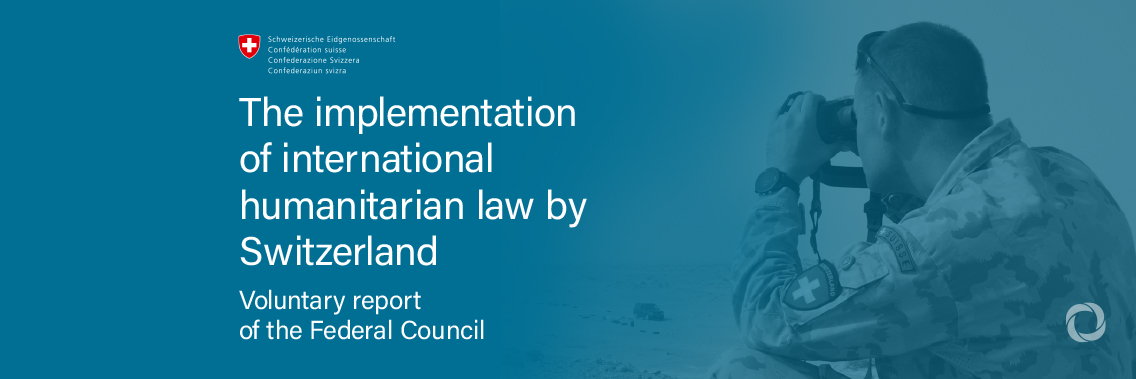
The Federal Council adopted a voluntary report on the implementation of international humanitarian law by Switzerland. Seventy-one years after the adoption on 12 August 1949 of the Geneva Conventions, Switzerland is one of the first states to do so. Respecting, strengthening, and promoting international humanitarian law are written into Switzerland’s DNA. Switzerland intends to set an example and encourage other states to take similar initiatives. This would foster dialogue among states in order to improve the protection of victims of conflicts worldwide.
The voluntary report assesses best practices and the main challenges Switzerland faces in implementing international humanitarian law. It also provides the Interdepartmental Committee for International Humanitarian Law with a blueprint for an action plan setting out concrete measures to strengthen efforts to promote international humanitarian law. Switzerland is one of the first countries to take this step. The action plan foresees for example that Switzerland will help clarify how IHL should be implemented in relation to new technologies. As it campaigns for a seat in the UN Security Council, Switzerland will also work towards ensuring that the Council takes due consideration of international humanitarian law.
Foreign policy and domestic policy are inextricably linked. Swiss foreign policy is based on democratic dialogue with national actors. The Federal Council is committed to maintaining a dialogue on international humanitarian law with Parliament, the media, academic circles, non-governmental organisations, and Swiss citizens. The Federal Council’s policy on international humanitarian law is a reflection of Swiss values.
International humanitarian law aims to save lives, alleviate suffering, and ensure that a minimum of humanity is upheld in armed conflicts. It protects people who are not, or are no longer, involved in hostilities. It also limits the means and methods of warfare in armed conflicts. While international humanitarian law is generally respected, exceptions are still too numerous: executions of civilians, bombing of hospitals, torture, starvation, etc. Violations of international humanitarian law have unacceptable humanitarian consequences. That is why promoting respect for international humanitarian law is all the more important.
Read the Voluntary report of the Federal Council.
Original source: SDC