
Add us as your preferred source on Google to see more of our content in Search.
 Add to Preferred Sources
The coronavirus pandemic has hit micro-enterprises in Serbia hardest and led to a decline in working hours during the second quarter of 2020 equivalent to the loss of 510,000 full-time jobs.
However, offering “the most generous and comprehensive economic package among the Western Balkan economies,” the Serbian government successfully contained “the expansion of poverty”, according to a new report by the European Bank for Reconstruction and Development (EBRD) and the International Labour Organization (ILO).
Following the introduction of strict public health measures and the subsequent slump in economic activity, working hours in Serbia declined by an estimated 14.8 percent during the second quarter of 2020. Shorter working hours and furlough schemes contributed significantly to this decrease. If the health crisis persists and employment retention programmes discontinue, however, people may be pushed into unemployment, the study warns.
The report identifies sectors in which over 700,000 workers are at immediate risk as the health crisis persists: wholesale trade, retail trade, accommodation, transport, services, forestry and logging, and crop and animal production. Of this workforce, almost 314,000 are self-employed and over 267,000 are informal workers.
To date, micro-enterprises, employing more than 735,000 workers, were hit hardest by the crisis with more than one in four having completely ceased operating. The government provided its “most generous and powerful financial assistance measure” in the form of employment retention subsidies, which for micro, small and medium-sized enterprises amounted to about 65 percent of total labour costs.
While the report welcomes the “near-universal support to both firms and citizens”, it also offers five preliminary policy recommendations:
- a more selective and targeted approach towards supporting the most vulnerable citizens,
- solutions to support a large number of circular and seasonal workers,
- mitigating the less visible social costs of the pandemic,
- optimising Serbia’s new youth employment programme, and
- using social dialogue more consistently and more effectively.
Barbara Rambousek, EBRD Director, Gender and Economic Inclusion, said: “This is an important report highlighting not only the impact of the coronavirus pandemic on the Serbian labour market and workforce but also providing concrete and valuable advice on how to tackle the challenges it identifies. We welcome the Serbian authorities’ commitment to engage in this process and make the best use of the study’s findings. For us, it is also encouraging to see how our rapid advisory support is already making a difference where it is being deployed.”
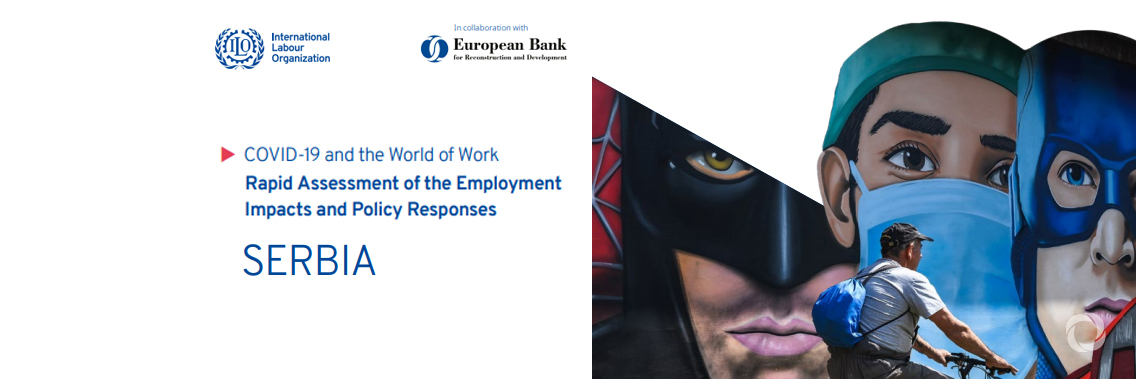
Read the report: COVID-19 and the World of Work: Rapid Assessment of the Employment Impacts and Policy Responses SERBIA.
Original source: EBRD