

Add us as your preferred source on Google to see more of our content in Search.
 Add to Preferred Sources
In the last decade, China has had a growing role in international development cooperation. It has taken a distinct path to achieve this, one that is different to the traditional Western approach towards development. The country has managed to become a major contributor to multilateral organizations, steadily increasing its development budget over the years, and is now on its way to becoming Africa’s main development partner. This article looks at China’s place in the global aid architecture by presenting numbers, key features and trends.
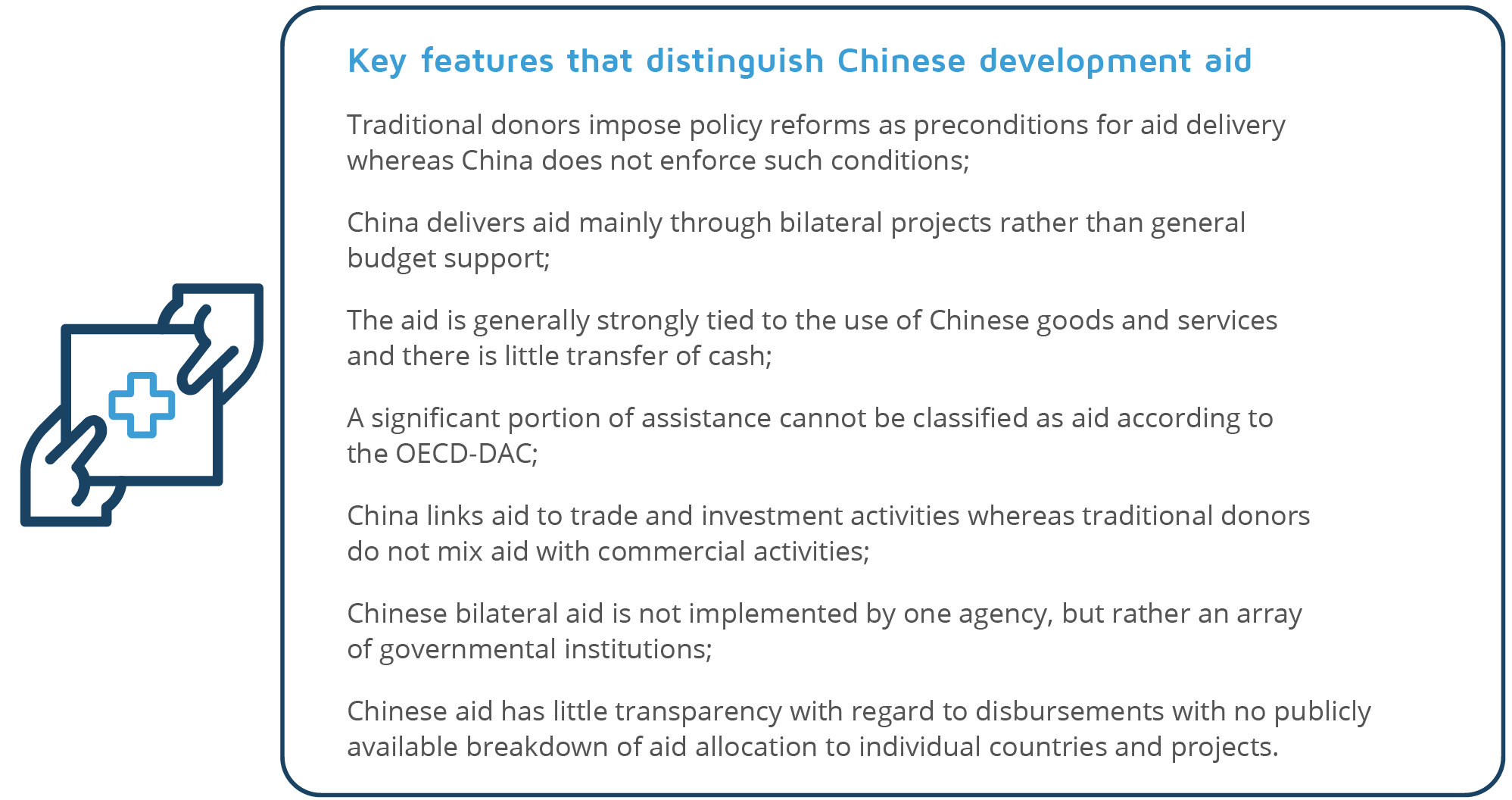
Key features of Chinese development aid
Unlike traditional Western aid donors, China has adopted a specific approach to development aid with certain key features and policies having been formulated over the years. China published its first white paper on development aid in 2011, with the second paper following three years later. These documents are the main Chinese policy documents on the issue of development aid to date. CIDCA, the Chinese International Development Cooperation Agency established in 2018, is currently preparing a new white paper on development aid, expected to be issued in 2020, which will further define China’s aid policy.
Source: UNCTAD Africa Economic Development Report \ Chr. Michelsen Institute Insight Publication.
China’s aid is primarily delivered as bilateral project aid with three main channels for aid flow. The bulk of Chinese development aid is represented by subsidized loans from the country’s policy banks, mainly the EXIM bank which is the export-import bank.
Loans for infrastructure development – for example, transport, communications and energy – seem to be a main priority of the Chinese aid policy, representing a little more than half of the total aid available.
Next in line comes aid provided for projects within health and agriculture – mainly for health clinics, towards agricultural growth and for training centers. Additionally, China provides support for higher education and training through scholarships and training programs.
The final channel is aid which is allocated as interest free loans, these being mainly directed to infrastructure projects , public buildings and facilities (state houses, parliaments, sport stadiums, etc).
China’s foreign aid expenditures
Chinese financing for international development has increased steadily from 2003 to 2015. According to official statistics from MOFCOM, the country’s Ministry of Commerce, Chinese development aid today amounts to around US$3 billion, a dramatic increase from US$631 million in 2003. Other estimates, that take into account relevant expenditure from other Chinese governmental institutions suggest that the total aid expenditure has increased from US$4.6 billion in 2011 to US$6.4 billion in 2018.
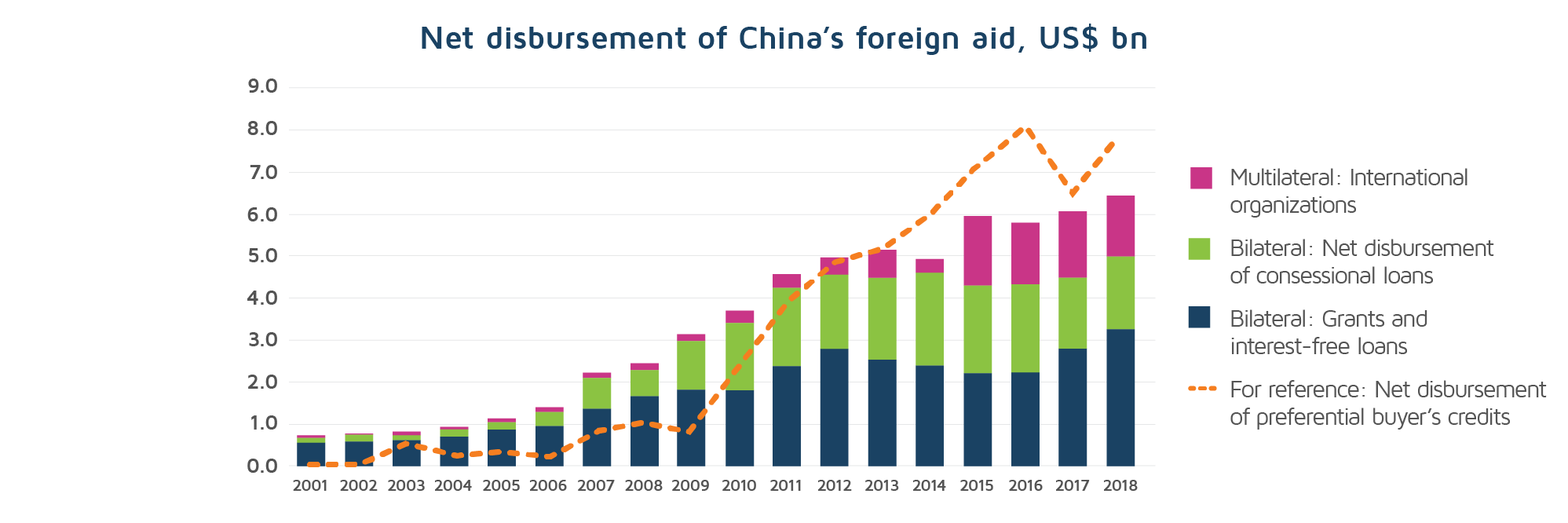
*Note: China’s foreign aid is defined as the sum of (1) grants and interest-free loans by the Ministry of Commerce (MOFCOM), (2) grants managed by other ministries responsible for foreign aid, (3) scholarships provided by the Ministry of Education (MOE) to students from other developing countries, (4) interest subsidies on concessional loans, which are deducted from the total amount of aid, (5) concessional loans managed by the Export-Import Bank of China (China Eximbank) as bilateral foreign aid, and (6) subscriptions and contributions to ODA-eligible international organizations as multilateral foreign aid. In addition to those items, (7) the administration cost of the China International Development Cooperation Agency (CIDCA), China’s new aid agency, is included in bilateral foreign aid.
Source: Estimating China’s Foreign Aid: 2017-2018 Preliminary Figures, JICA Research Institute
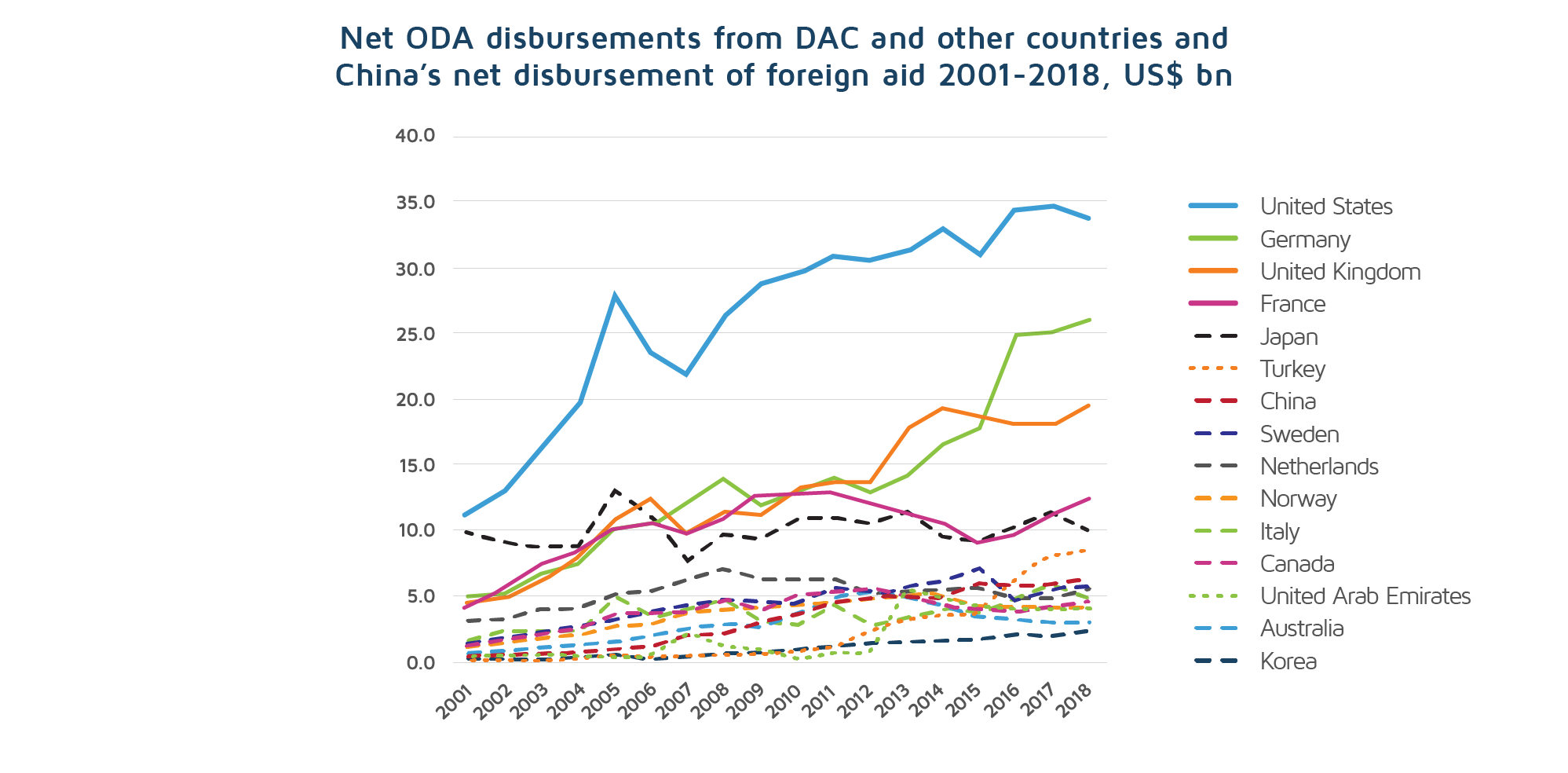
China defines “development cooperation” in a different way to its Western counterparts and does not report to the OECD in strict accordance with the organization’s ODA guidelines. Thus, the international development landscape has found it difficult to make an exact comparison of China’s aid with other donor countries. However, the OECD-DAC considers China to be a “key partner” while the country does foster exchanges with the OECD-DAC with regard to development policy matters.
China’s steady growth in the last decade has meant that its place in the development arena has also changed. Comparing the ODA flows of the top nine DAC member countries – as well as Korea as a member country in East Asia – the top two emerging providers that reported to the OECD-DAC in 2018 were Turkey and UAE with China being ranked at number 7 in terms of net disbursements.
Source: Estimating China’s Foreign Aid: 2017-2018 Preliminary Figures, JICA Research Institute
China’s aid to multilateral organizations
Historically, Chinese aid has been invested largely in bilateral projects and this is a trend that continues. China’s contributions to multilateral institutions have varied for the past ten years – representing about 10% of its bilateral aid. However, China increasingly emphasizes the importance of participating in such forums.
China makes multilateral contributions to the World Bank, the International Monetary Fund and UN agencies with those contributions having increased over the years. It contributed a total of US$12 million to the UN regular budget in 2000 – representing just 1% of the total contributions. By 2019, China’s contribution had increased to US$367.9 million or 12% of the total, making China currently the second-largest contributor after the US. The bulk of its UN contribution (over 46%) went to the World Food Programme followed by UNDP at just under 11%.
China’s contribution to the World Bank also illustrates the trend of increasing its contribution to multilateral organizations. At the 19th replenishment of the Bank’s IDA Fund in December 2019, China increased its contribution to US$1.2 billion. This means that China has now climbed to sixth position among the biggest contributors to the World Bank’s instrument to support the most vulnerable countries – the International Development Association.
China on the way to becoming Africa’s main development partner
Africa is the continent which receives the main bulk of Chinese aid. Its regional policy framework guides Chinese engagement in Africa through the Forum for China-Africa Cooperation and its three-year action plan.
China is currently a key player in the provision of funding for infrastructure development for African countries. The most recent report from the Infrastructure Consortium for Africa revealed that China has been the largest funding provider to African infrastructure in recent years including transport, energy and telecommunications development.
At the 2018 Summit of the Forum for China-Africa Cooperation in Beijing, China pledged US$50 billion for the coming three years (in addition to US$10 million from the Chinese business sector). Significantly, US$15 billion, or US$5 billion per year, of the total amount is assigned to foreign aid for Africa for the period between 2019 and 2021. This amount makes China a major bilateral donor for that continent and could potentially mean that this ambitious donor might overtake the US as the biggest aid donor to Africa.
DevelopmentAid is a membership organization providing comprehensive information for the international development sector. For more information on the China’s activity in the development sector, visit our News section.