
Add us as your preferred source on Google to see more of our content in Search.
 Add to Preferred Sources
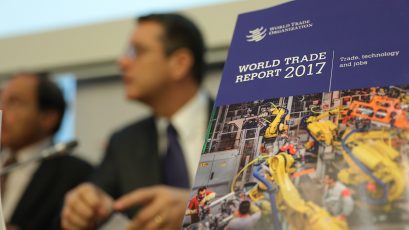
Technology and trade have propelled the global economy through a period of great dynamism over the past quarter of a century but – as with any economic advance – there has also been disruption. The 2017 edition of the WTO’s flagship publication, the World Trade Report, examines how technology and trade affect labour markets. The Report, launched yesterday, September 27, at the WTO Public Forum, notes that continued economic progress hinges on the ability of societies to remain open to trade and technological advance, while also being able to adjust, adapt and promote greater inclusiveness.
At the launch of the World Trade Report, a group of eminent panellists discussed the effects of globalization on labour markets and its implications for business strategies, governments’ macroeconomic policies, the evolution of labour markets and how societies might adjust to these changes.
“Trade and technology are two of the most powerful drivers of economic progress,” said Director-General Roberto Azevedo in his opening address. He underlined that while most individuals are benefitting considerably from trade and technology, it is important to acknowledge that others can lose out. “We need to ensure that the benefits of economic progress reach everybody,” he said.
WTO Chief Economist Robert Koopman outlined the main findings of the Report. He stressed that while trade is important in driving a decline in poverty in many countries, economic progress also requires adjustment.
 In the past decades, changes in labour market composition are largely due to technological progress, with increasing output produced by a steady amount of labour, Mr Koopman said. He noted that while the Report did not find any correlation between trade openness and unemployment or between trade openness and inequality, evidence suggests that trade supports jobs and particularly the participation of women in the workforce. He concluded that the right domestic policies tailored to the needs of each country play an important role in facilitating the necessary economic adjustment.
Anne Krueger, senior research professor of Johns Hopkins University, noted that trade “gets an unfair beating” in taking the blame for unemployment, while other reasons, such as shifts in demand, voluntary job change and poor management in a company can also result in job losses. She also underlined that trade contributes to economic growth which in turn leads to job creation.
Professor Krueger stressed the need to equip workers through education and vocational training. There is a great deal to be done in many countries to help people with job search, informing them of opportunities, supporting them in their training and further education, and even telling them what additional training they need to get their next job, she said.
Professor Dennis Snower of Kiel Institute for the World Economy observed that employment also fulfils human needs relating to the sense of empowerment and social solidarity while noting that the increased use of robots and artificial intelligence calls for a revolution in education and training.
“The skills that we already have – empathy, compassion, reading one another, shaping each other’s goals by influencing each other – these are the skills we will need in the future”, he said.
Noting that the transition from agricultural to industrial economies at the beginning of the 20th century resulted in great social tension, Professor Snower concluded by noting: “Now our challenge is to make this transition without the cost of world wars.”
Pankaj Ghemawat of IESE Business School and Stern School of Business pointed to an exaggerated perception of globalization and a general demand for economic benefits to stay at home. These factors have significant implications for our ability to win support for trade deals, he stressed.
Original source: WTO
Published on 27 September 2017