
Add us as your preferred source on Google to see more of our content in Search.
 Add to Preferred Sources
Remote monitoring has been around for quite some time and has become a necessary practice for development actors working in conflict or disease-stricken contexts where security and health risks are high. Although in the recent years the focus has been heavily on innovation and technology with regards to remote monitoring, many guidelines will nevertheless stress the following fact: there is no need to reinvent the wheel.
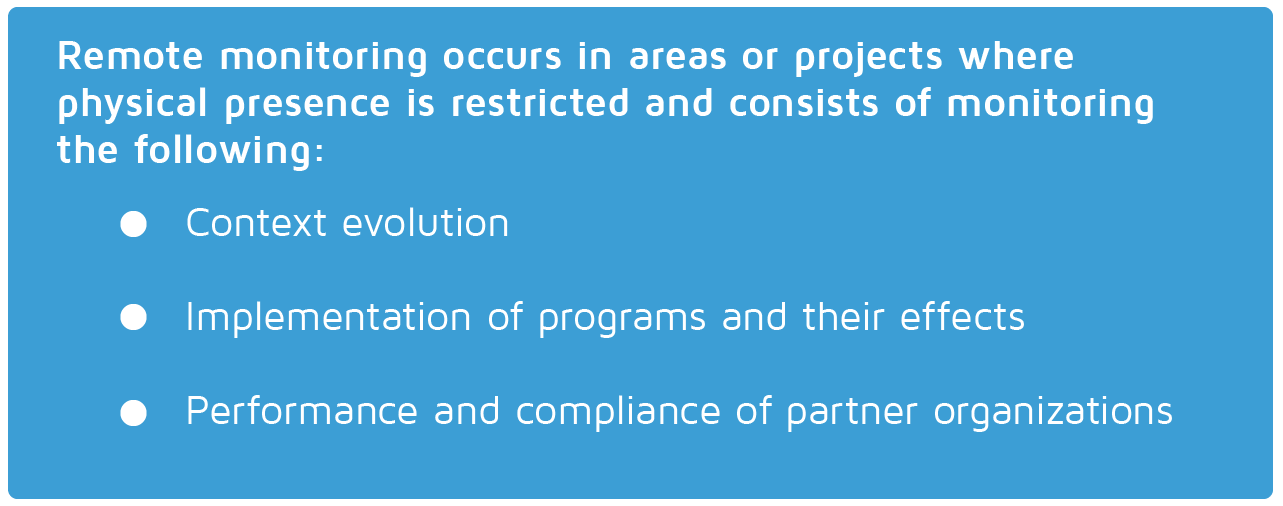
As development actors are faced with the challenge of adapting their M&E approach, there is a set of guiding questions to be asked that can help them to identify the appropriate remote monitoring approach to suit their needs and resources. Listed below are some of the major questions that development actors should consider before creating a remote monitoring tool or plan.
 What information do you want to collect?
Different methods of remote monitoring can yield different types of information. Knowing the type of information that you need and who you need it from will help to narrow down what kind of tool should be used. For continuous performance monitoring, implementing actors may want to discuss which key performance indicators can be collected remotely in order to evaluate progress. For remote context evaluation, implementing actors may want to identify changes in the general operating environment and find suitable actors to provide information, for example, the policies being enacted which could affect the progress of project implementation.
 What should you consider before adapting your monitoring approach?
When adapting your monitoring approach, you should consider whether other partners or external organizations are already collecting relevant data that might be of use to you. Providers of information could include third-party monitoring mechanisms, local institutions that could share data, organizations that specialize in the collection and analysis of big data sources or local marketing research firms that invest in regular market research.
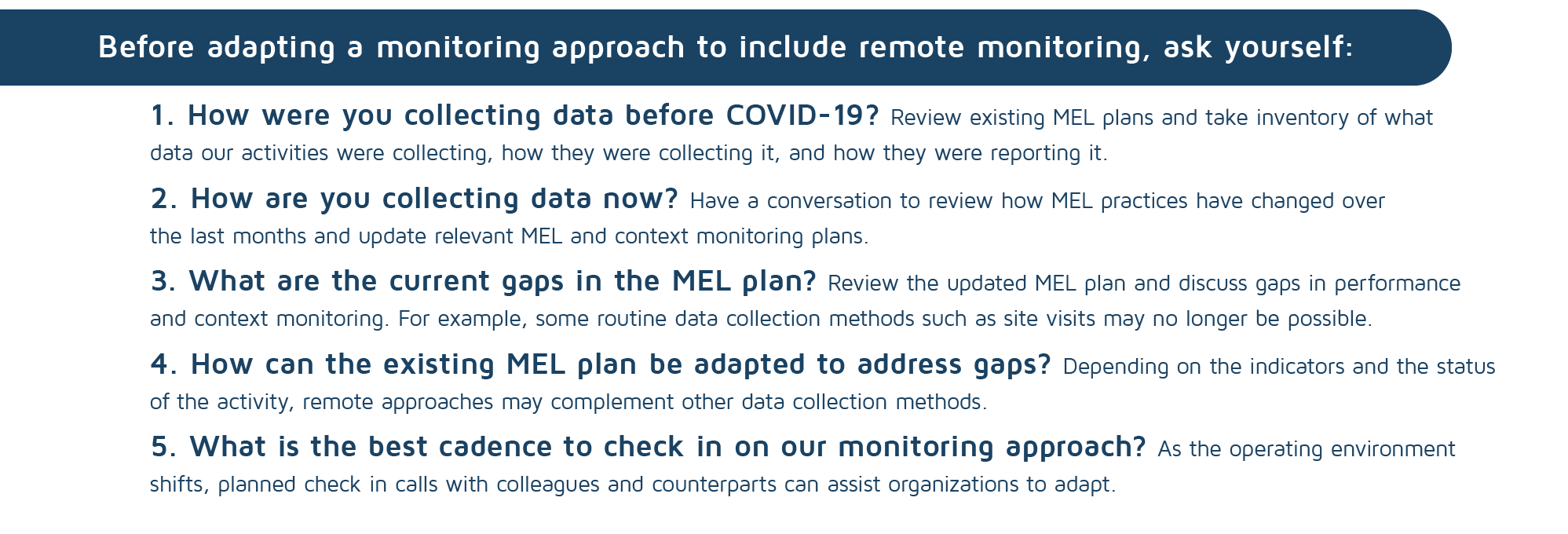
Source: USAID, Guide for Adopting Remote Monitoring Approaches
 Are you collecting data from beneficiaries?
You should consider what the level of connectivity is in the area of interest and what the mobile phone ownership demographics are. This could provide a complete picture of your database and identify whether certain elements have been omitted which could thus potentially offer a biased result. Considering such gaps can be a starting point to mitigating them.
The demographics of the target population could also trigger considerations regarding access to and the use of digital technology. For example, in some countries, mobile phone ownership and internet use is lower among women than men and this could affect any monitoring efforts. Age is another factor to consider, given that internet use is generally lower among older populations. The same applies to disability whereby hearing and visually individuals may face difficulties accessing and using mobile phones.
If you are working in a setting where the target population has a low literacy rate, you should consider using Interactive Voice Response (IVR) or voice calls instead of any written form of response.
 Which tools will allow you to collect data for remote monitoring?
A number of tools can be employed for remote monitoring, including phones, internet-enabled mobile phones and satellite images. To decide which tools are best suited to your need, check what the local resources are in terms of connectivity.
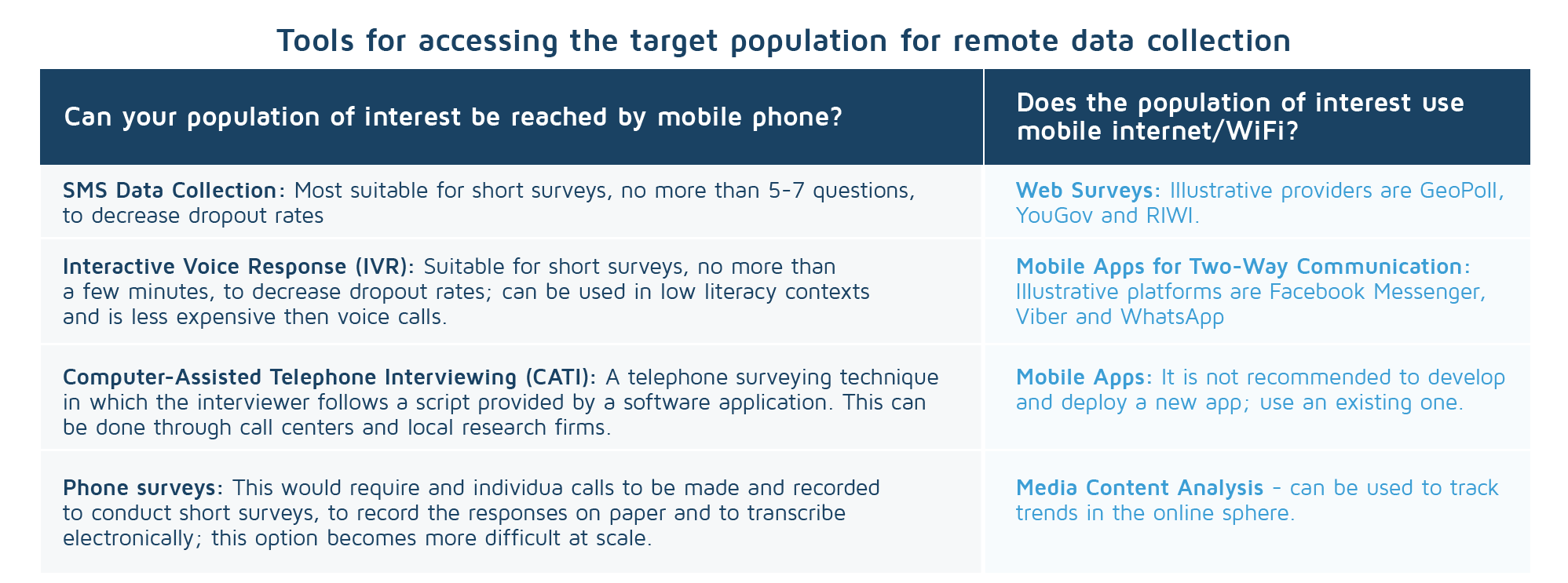
Source: USAID, Guide for Adopting Remote Monitoring Approaches
 What GEO-SPATIAL remote monitoring tools are available to help track activities?
Geospatial tools can support activity and context monitoring efforts, especially when project activity results in changes in the physical landscape of the project’s locations. By using satellite or aerial images, remote sensing can detect changes in infrastructure (i.e. buildings and roads), natural habitat (i.e. forests, savannas, etc.), agricultural land and even the movement of heavy equipment. If you know the location of your activities and are legally empowered to monitor projects through remote sensing, you can consult with your organization’s Geographic Information System (GIS) specialists or contract external GIS services for technical and logistical assistance.
DevelopmentAid is a membership organization providing comprehensive information for the international development sector. To search through more than 300 monitoring and evaluation jobs in the development sector posted on our platform, register and become a DevelopmentAid member.