

Add us as your preferred source on Google to see more of our content in Search.
 Add to Preferred Sources
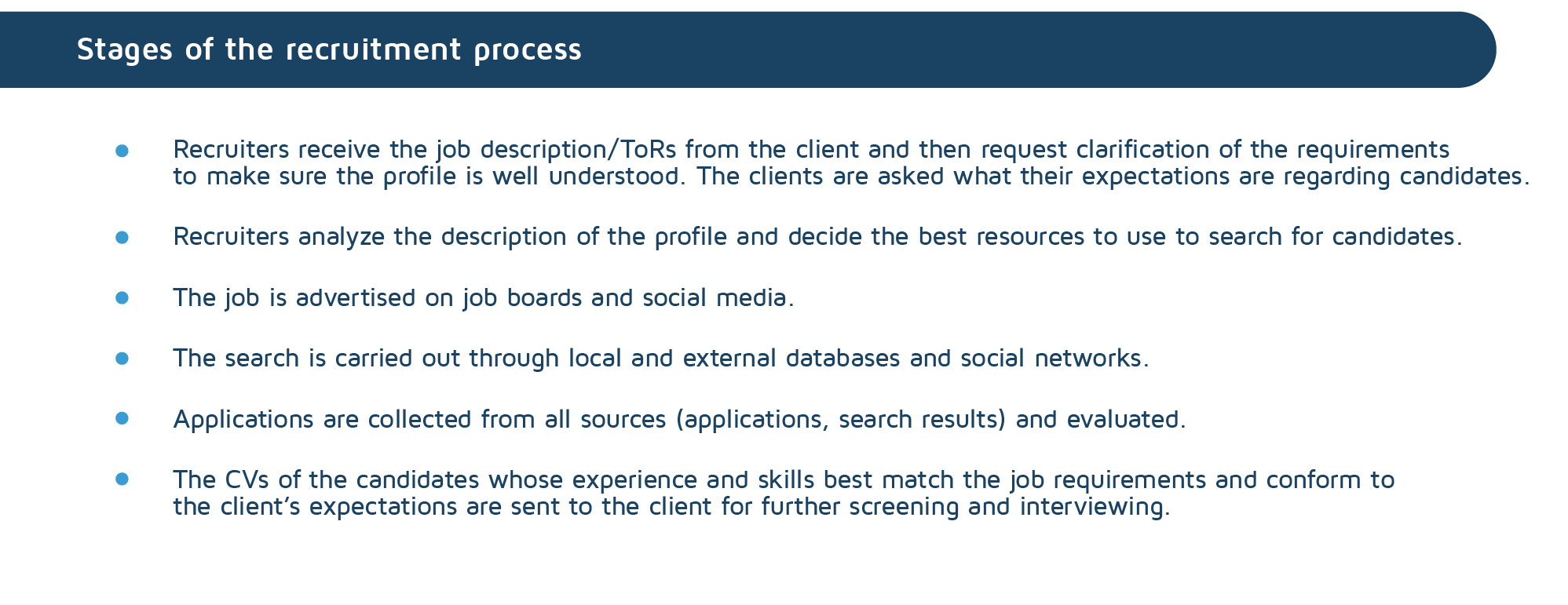
Finding the right candidate for a specific role is the main responsibility of a recruiter as well as the main challenge. This article presents the recruiter’s perspective on headhunting in the development sector, offering exclusive insights as to how DevelopmentAid recruiters operate to find the best candidates.
 More often than not, recruiters work in a competitive environment
For short-term projects in particular, generally several companies will be competing to find the best suited experts for the same bid. In such demanding circumstances, maximizing efficiency is key to finding the right candidate.
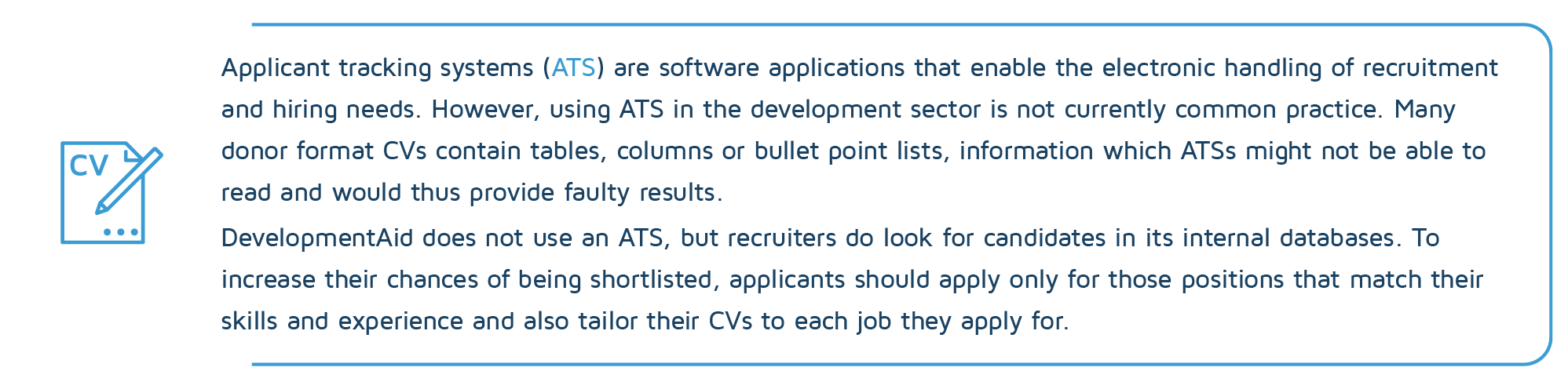
DevelopmentAid recruiters rely on the company’s internal database to identify the winning candidates since this contains the CVs of a large number of experts working in the development sector. Used in conjunction with DevelopmentAid’s own project management tool, this makes activities such as searching, storing information and contacting experts faster and leaner.
Furthermore, identifying and securing the right talent is a matter of expertise, ability and intuition that comes only with experience. Getting to know the ins and outs of recruiting in the development and humanitarian sectors is a major contributor to an efficient recruitment process.
Source: developmentaid.org
 Alignment with the job requirements is the main criteria that recruiters look for when analyzing a CV
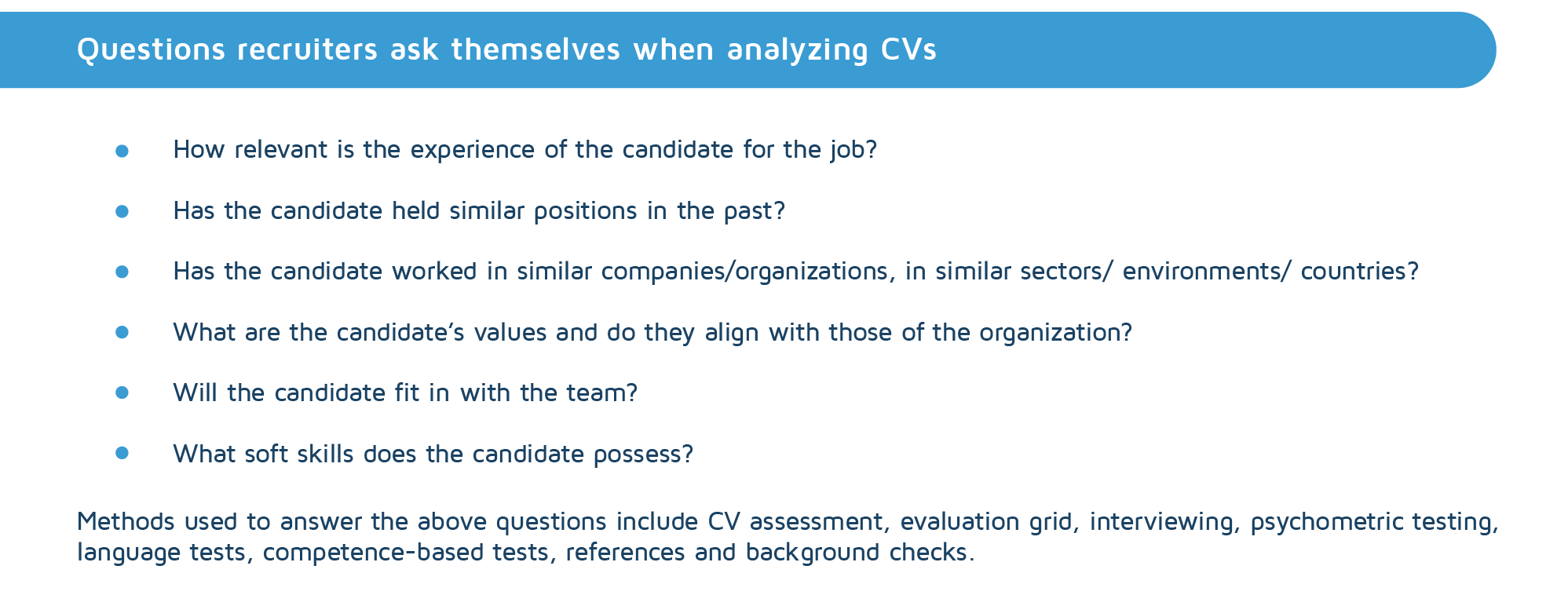
Usually, hundreds of people apply for the same position and only those who most closely match the job profile are shortlisted. For tender-based positions in particular, when applying for a key expert role for a project at the bid stage, recruiters insist that candidates prepare a well-tailored CVs that match the requirements of the role by a minimum of 90%. The DevelopmentAid recruiter’s strategy is therefore to narrow the focus down to a select number of candidates who are best for the job and then work to secure these experts.
“Assessing one’s chances, experience and qualifications against the job advertisement requirements is a very good practice,” advise DevelopmentAid recruiters.
Given this approach, potential candidates are encouraged to put themselves in the recruiter’s shoes and view at themselves with a critical eye to assess their compatibility with the job requirements. Such an ability to carefully refine one’s own career and profile is an important aspect that is taken into consideration by recruiters during the process of selecting candidates.
Meanwhile, candidates who apply for all sorts of positions in any sector or country that are advertised by DevelopmentAid are viewed with skepticism and provoke initial red flags whereby recruiters may choose to disregard their applications altogether. Such eagerness is seen as neglect by the applicant to properly consider the job requirements.
Source: developmentaid.org
 The most challenging aspect of the process for a recruiter is to identify the right candidate for the requirements of the job
The work of a recruiter is much like that of a forager’s hunt and finding the right candidate for a given position who is also both available and interested in applying for it is what recruiters struggle with most. Furthermore, tight deadlines make matters even more challenging.

Source: developmentaid.org
For short term projects, recruiters have a timeframe of three days to find applicants while for long term technical assistance projects, the timeframe is somewhat longer of up to five days. For permanent positions, a recruiter needs between two weeks to two months to identify the best candidates, depending on the difficulty of the position, its level of seniority, the location of the posting and the salary and benefits the client can offer.
The current pandemic has brought additional challenges to the recruitment process. Candidates are more reluctant to travel and to accept jobs abroad or disinclined to give up their current employment for a new position. Currently, stability has become a priority for candidates when it comes to searching for a job or taking on a new position.
Source: developmentaid.org
 Failure for a recruiter is when a selected candidate turns out to be a misfit for the position
Misfits can happen in donor-funded short-term projects where the selection process is less rigorous and is made solely on the basis of the applicant’s CV without any of the usual additional stages of evaluation such as interviews.
However, misfits for long-term project hires are a rare occurrence. Leading positions or positions in an international NGO as a staff member involve several stages of candidate shortlisting, where applicants are carefully evaluated against the job requirements and the client’s expectations of the candidate. Such a rigorous process ensures the recruitment of the best talent.
If you are looking fo increase the chance of being shortlisted and accepted for a job or a project apply for CV Tailoring service.