

Add us as your preferred source on Google to see more of our content in Search.
 Add to Preferred Sources
The latest UN report, “The Human Cost of Disasters 2000-2019”, indicates that in the last 20 years the number of natural disasters occurring as a result of climate change has doubled.
The cost to the world was almost US$3 trillion and the death of 1.2 million people with another 4 billion seriously affected. However, it is expected that these numbers could be even higher as some countries in Africa and Asia do not provide information about how climate disasters have affected their economies and population.
The report leaves no doubt that the vast majority of these disasters are exclusively related to climate change with the number increasing from 3,656 (1980-1999) to 6,681 (2000-2019). The UN warned that, if humanity fails to stop global warming, the situation will soon become worse.
The report calculates that during the last 20 years the number of floods has doubled from 1,389 to 3,254 while the incidence of storms grew from 1,457 to 2,034. Today, people experience heatwaves almost four times more than between 1980 and 1999. The UN warns that this natural hazard is potentially much more serious for humanity than other disasters because extreme heat catalyzes wildfires. For example, 20 years ago the world experienced 163 wildfires, today this figure has grown to 238.
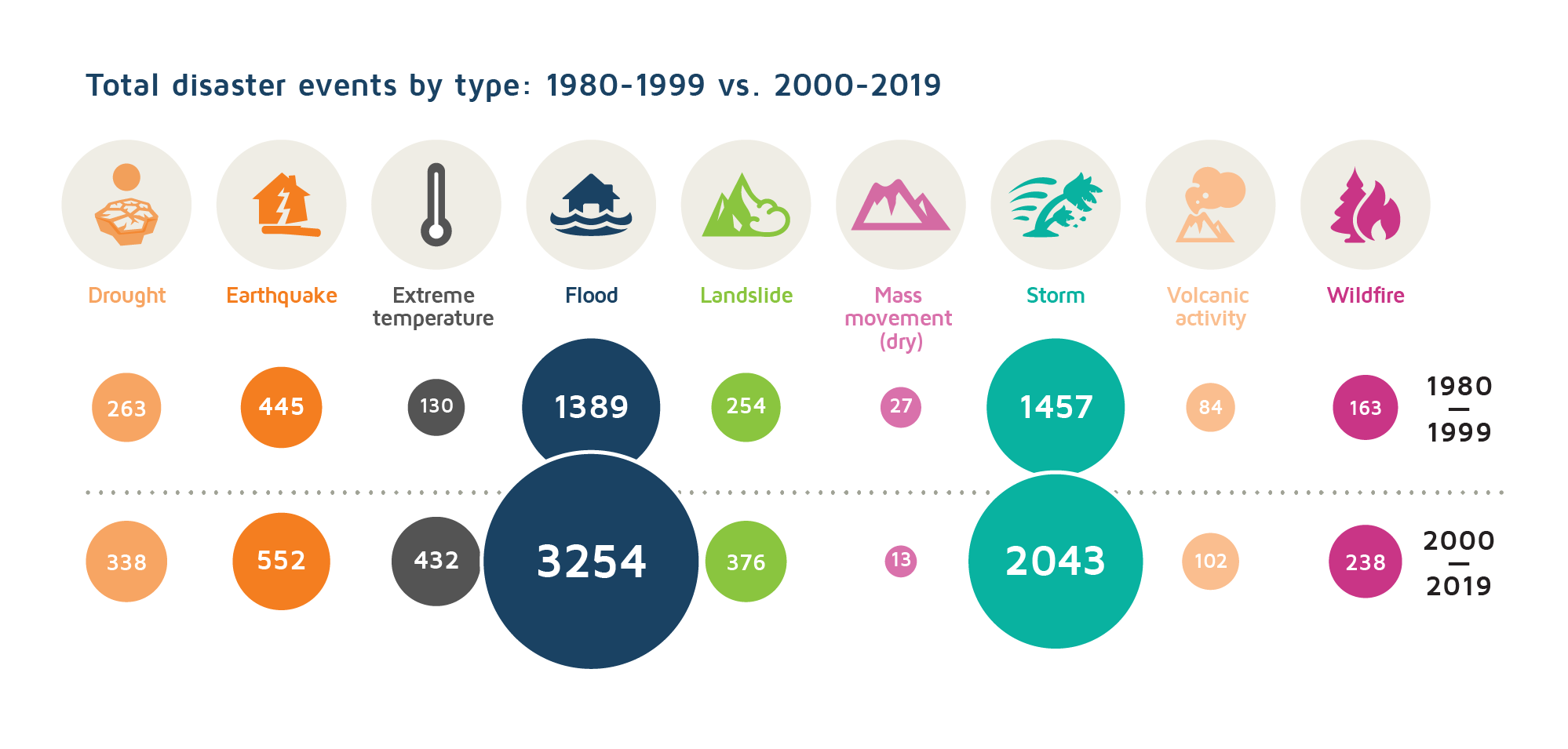
The region most affected by natural disasters is Asia followed by the Americas and Africa. The highest number of such events was reported in China (577) followed by the US (467), India (321), the Philippines (304), and Indonesia (278). Thus, it can be observed that those regions that already suffer because of poverty, such as countries in South-East Asia, are becoming even poorer as a result of the climate crisis.
“We are deliberately destructive. This is the only conclusion that can be reached when looking at the disasters that have occurred over the past 20 years,” said the UN Office for Disaster Risk Reduction representative, Mami Mizutori, who presented the report on Monday, October 12th.
Mizutori also stressed that, in her opinion, governments are not doing enough to counter climate change by failing to transform their economies to become renewable energy reliant. While the world has succeeded in decreasing the number of people dying because of natural disasters, thanks to the development of early warning systems, nevertheless “more people are being affected by the expanding climate emergency”, she added.
The report also found that, on the one hand, in high-income countries, less people are affected or killed as a result of natural disasters but, on the other, economic losses are much higher than is the case in low-income states. The costliest disasters are storms. Between 2000 and 2020 these generated US$1.39 trillion losses in the Americas while floods cost US$651 billion. The countries which have reported the highest level of losses in terms of GDP last year are Dominica (15%), Cayman Islands (9,1%), Haiti (8%), Grenada (7.8%), Turks and Caicos Islands (5.8%), Bahamas (4.3%), Guyana (3.6%), Puerto Rico (3.5%), Belize (3.4%), and Samoa (2.1%). Unfortunately, many of these are also struggling with hunger and extreme poverty and thus climate disasters make their situation even more complicated.
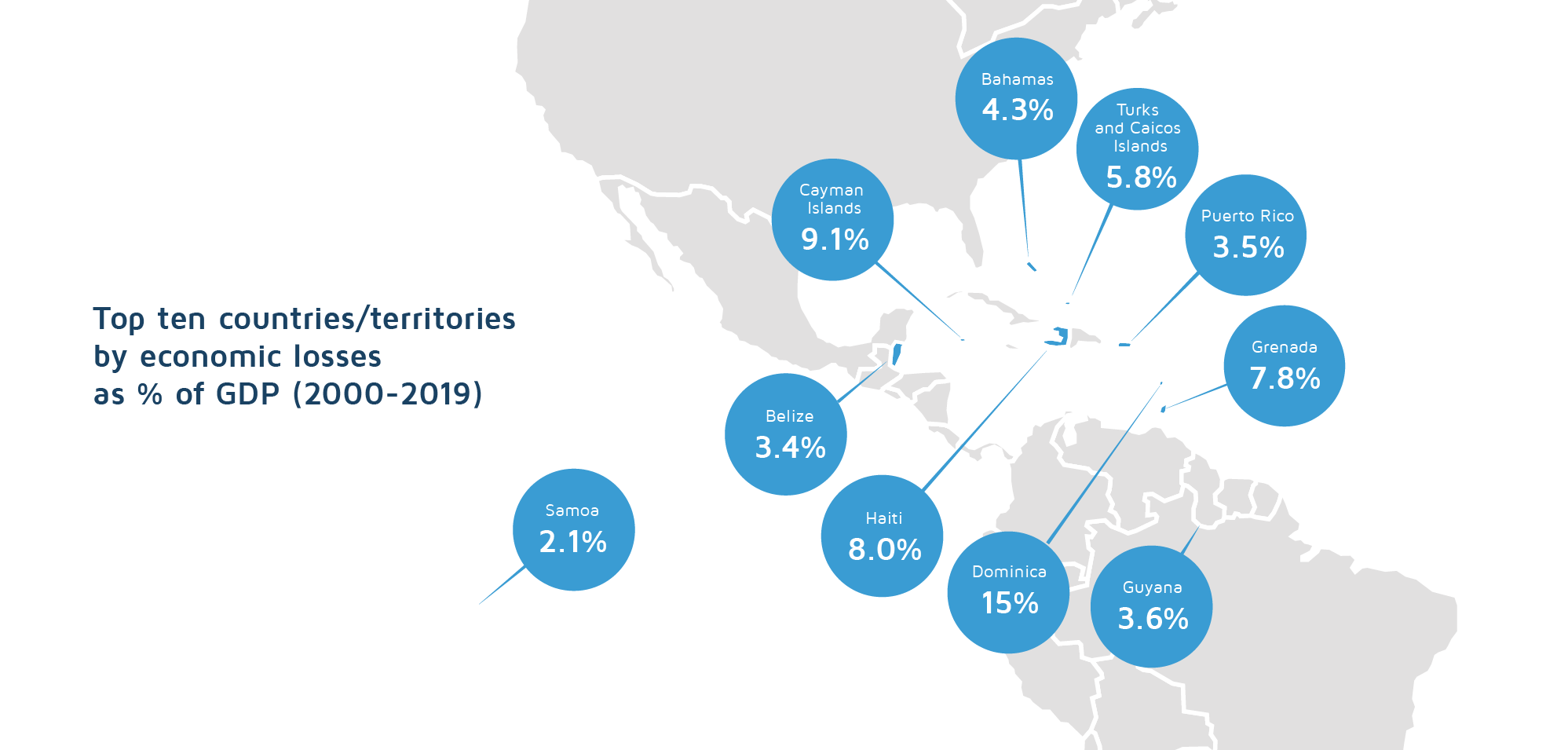
The UN indicates that the years 2004, 2008, and 2010 were the most devastating in terms of natural disasters causing more than 200,000 deaths in each of these years.