
Children in poorest countries lost nearly four months of schooling since start of pandemic – UNESCO, UNICEF and World Bank report finds
Add us as your preferred source on Google to see more of our content in Search.
 Add to Preferred Sources
Schoolchildren in low-and lower-middle-income countries have already lost nearly four months of schooling since the start of the pandemic, compared to six weeks of loss in high-income countries, according to a new report published today by UNESCO, UNICEF, and the World Bank.
“The pandemic will notch up the funding gap for education in low and middle-income countries. By making the right investment choices now, rather than waiting, this gap could be significantly reduced,” said Stefania Giannini, UNESCO Assistant Director-General for Education. “
At the Global Education Meeting convened by UNESCO with Ghana, Norway, and the UK on 22 October, some 15 heads of state and government, close to 70 education ministers and development partners committed to protect education funding and act to safely reopen schools, support all teachers as frontline workers and narrow the digital divide.
“We don’t need to look far to see the devastation the pandemic has caused to children’s learning across the world. In low- and lower middle-income countries, this devastation is magnified as limited access to remote learning, increased risks of budget cuts and delayed plans in reopening have thwarted any chance of normalcy for schoolchildren,” said Robert Jenkins UNICEF Chief of Education. “Prioritizing reopening schools and providing much-needed catch-up classes is critical.”
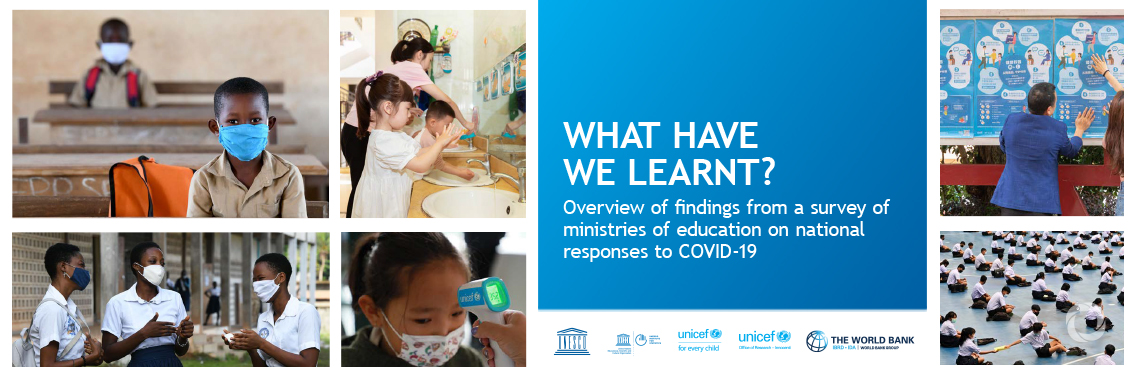
The report compiles findings from surveys on national education responses to COVID-19 collected by UNESCO and carried out in nearly 150 countries between June and October through funding provided by the Global Partnership for Education (GPE) as part of their accelerated funding response to the COVID-19 Pandemic. Schoolchildren in low- and lower-middle-income countries were the least likely to access remote learning, the least likely to be monitored on their learning loss, the most likely to have delays to their schools reopening and the most likely to attend schools with inadequate resources to ensure safe operations, the report finds.
Even before the pandemic, children’s learning was in crisis. Half of the 10-year-olds in middle- and low-income countries couldn’t understand a simple written sentence. According to UNESCO, more than a quarter of a billion children were already out of school, a number likely to increase by at least 24 million as a result of the pandemic. Schoolchildren today currently stand to lose $10 trillion in earnings over their working lifetime, equal to 10 percent of global GDP.
Read the report: What Have We Learnt?
Original source: UNESCO