
Add us as your preferred source on Google to see more of our content in Search.
 Add to Preferred Sources
COVID-19 is increasingly bringing education to a halt for many of Syria’s children after nearly ten years of conflict, displacement, and poverty, Save the Children has found, as an estimated half of the children that were going to school in north Syria before the COVID-19 outbreak have now dropped out.
Save the Children analyzed publicly available data, looked at its own programming, spoke to other organizations, and surveyed almost 500 teachers. It found that:
- An estimated 2.45 million children, or one in three, were already out of school by the end of 2019 in the whole of Syria.
- The COVID-19 crisis has pushed an additional 50 percent out of education in the north of the country, resulting in two-thirds of children being out of school in northern Syria.
- Between the first and second quarter of 2020, the number of students in Save the Children’s education programs dropped from more than 11,200 to around 7,775.
- In northwest Syria, Save the Children’s partners reported losing access to nearly 50 percent of students in some areas after the closure of schools in March.
- Teachers reported similar figures for Al Hol, Roj, and Areesha camps in the Northeast, where at least 5,500 children stopped going to school.
Teachers who responded to the survey overwhelmingly said that poverty is the biggest reason for children dropping out of school, pointing to the cost of education and reliance on child labor as a source of income. Child labor is a particularly grave concern in northeast Syria, where 79 percent of the teachers said students dropped out because they had to support their families financially.
Some 60 percent of teachers said the pandemic has had an impact on the continuity of education in classrooms. Loss of physical learning spaces due to COVID-19 restrictions has meant the only option for children to learn is remotely, which many children do not have the means to do.
When schools closed, Save the Children rolled out new ways of remote learning to keep as many children as possible in education, including mobile teachers that visit students in their homes, online education, and using text messaging services. This is despite several challenges, including children not having access to smartphones or the internet, making it difficult for NGOs and partners to follow up with children who drop out.
“A decade of conflict has dragged millions of Syrian families into poverty, forced children to work just to survive, and drove hundreds of thousands of them out of school, making education a pipe dream. Save the Children and other education actors have been doing what they can to ensure as many children as possible can learn in a safe space and realize their true potential. COVID-19 has further exacerbated existing challenges that prevented children from learning. We fear that children who dropped out of school this year will never return. Dropping out of school is a fatal blow to the immense efforts that children and their families have committed to education despite a decade of obstacles,” said Sonia Khush, Save the Children’s Syria Response Director.
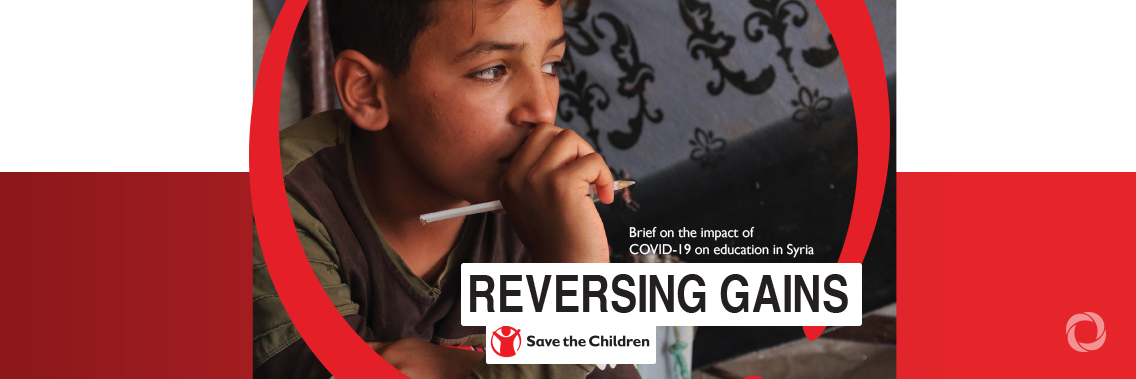
The report Reversing Gains, calls for the reopening of schools when it is safe to do so, with an approach that combines in-person learning where possible, and remote education.
Save the Children is gravely concerned about the impact the lack of education of Syria’s children will have on the country’s future. The education sector desperately needs resources to continue safely, and donors should also fund programs that help lift families out of poverty, so parents and caregivers can keep their children engaged in learning and don’t feel the need to resort to child labor and other negative coping mechanisms.
Original source: Save the Children