


Add us as your preferred source on Google to see more of our content in Search.
 Add to Preferred Sources
Peace Research Institute Oslo has recently released a report indicating that in 2019, over 2/3 (69%) or as many as 1.6 billion of the world’s children were living in countries affected by conflict, while only 725 million were living in peaceful states.
Furthermore, around 426 million children, i.e. one in six, were living in conflict zones including places impacted by hostilities. Those numbers indicate a constant growth since 2000. It also emerged that the recent increase has been significant when compared to 2018 when 1.52 billion children were living in conflict-affected states.
The Uppsala Conflict Data Program (UCDP) which was used to prepare the report assumes that armed conflict occurs when ‘armed force is used by an organized actor against another organized actor, or against civilians, resulting in at least 25 battle-related deaths in one calendar year’. Conflicts usually consist of several individual incidents or events involving lethal violence that occur at a certain given time and place.
African children are mostly affected by conflicts, with 180 million children from the continent living in conflict zones which represent 30% of all children impacted by conflicts globally. Asia, which occupied the first position a couple of years ago before being overtaken by Africa, is currently the second mostly affected. The least conflict impacted children live in Europe.
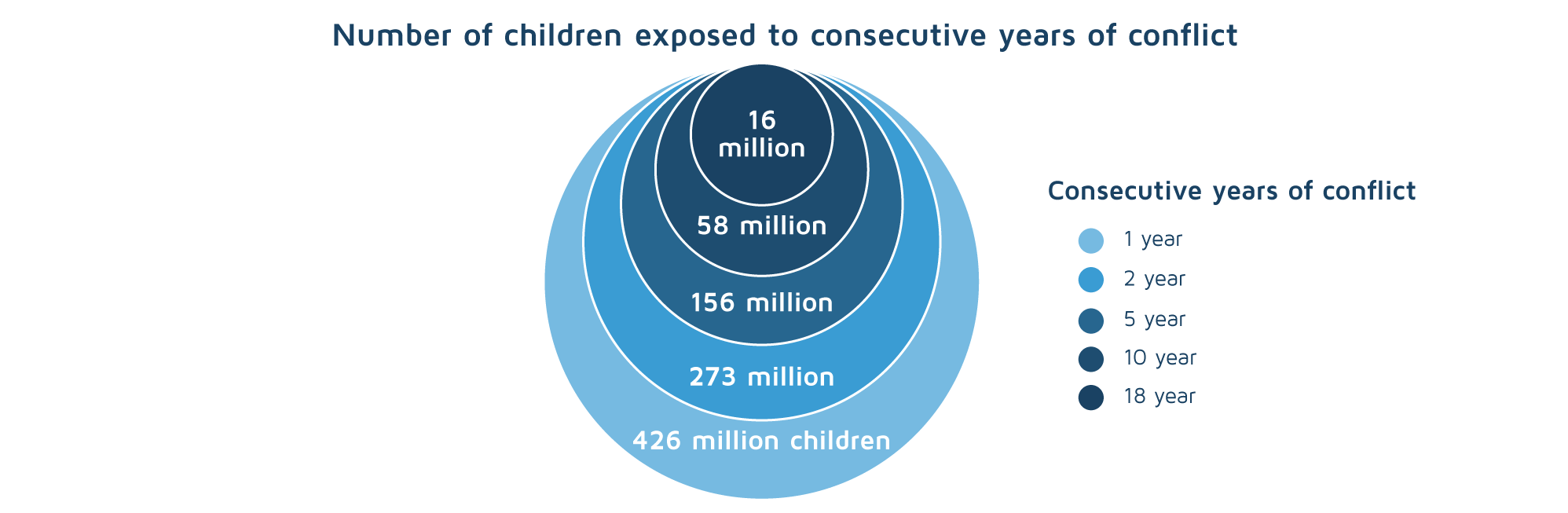
According to the report, more than 55 million children have been living in conflict zones for 10 consecutive years with 16 million for 18 consecutive years. It is also assessed that in 2019 over 71 million children between 0-5 years old were living in areas where conflicts had lasted all of their lifetime. The authors of the publication estimate that, worldwide, 800,000 18-years-olds have lived in conflict for their entire lives.
About 160 million children were living in countries where over 1000 battle deaths occurred in 2019 and 225 million of these were in areas affected by medium intensity conflicts (i.e. between 25 and 999 battle deaths) and the countries assessed as being impacted by the highest conflict intensity last year were Afghanistan, Syria, and Somalia.
The data presented in the report shows a very negative trend as, despite some fluctuations, it is clearly visible that the number of children living in conflict-affected areas has constantly increased since the end of the Cold War even though the number of states experiencing armed conflicts has not risen. While in the early and mid-1990s, about 200-250 million children were living in conflict-affected zones, this is now 426 million, representing a growth of 50%.
Apart from presenting the data, the authors of the report also prepared a list of recommendations to serve as guidance for decision-makers as to how to deal with this issue. They believe that, in order to reduce the number of children affected by conflicts, the international community should organize high-quality peacekeeping operations in conflict-affected areas, prepare and implement credible sanctions against armed groups during conflicts to limit violations against children and increase aid to conflict-affected countries to rebuild infrastructure and health care systems which children can benefit from.