
Add us as your preferred source on Google to see more of our content in Search.
 Add to Preferred Sources
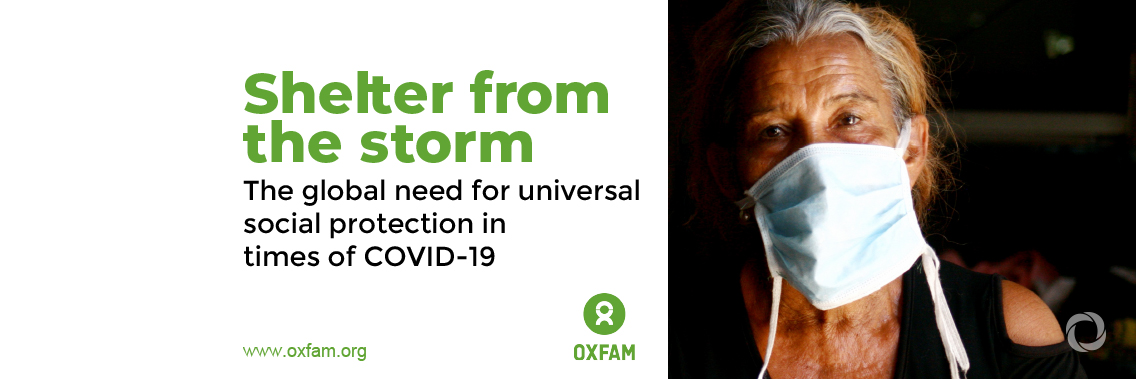
New Oxfam research shows that over a third of the world’s population has had no public money to cope with the effects of the pandemic.
A new report “Shelter from the Storm”, done in partnership with Development Pathways, reviewed government programs used to inject additional money to help people, such as disability, unemployment, child, and elderly benefits, for 126 low and middle-income countries. It found none of them were adequate to meet everyone’s needs.
Overall, the world has spent an additional $11.7 trillion this year to cope with the fallout from the coronavirus pandemic. Of this, $9.8 trillion (83%) was spent by 36 rich countries against just $42 billion (0.4%) in 59 low-income countries.
On additional cash poured specifically into social protection programs, 28 rich countries have spent at the rate of $695 per person. In contrast, low-income and emerging countries have spent at a per capita rate of between $28 to as low as $4.
To make matters worse, rich countries have only increased their aid to developing countries for social protection by $5.8 billion – the equivalent of less than five cents for every $100 raised to tackle Covid-19.
“The coronavirus united the world in fear but has divided it in response,” said Oxfam Executive Director Gabriela Bucher. “The pandemic sparked a laudable global effort that reached more than a billion more people with social protection support over 2020 but, as of today, more people still have been left behind entirely. That need not be so.”
The need for better social protection programs to help people is huge. Half a billion people are now under-employed or out of work, twice as many women affected as men. Workers in low-income countries have suffered most, losing 23% of their working hours. People are falling into debt, skipping meals, keeping children from school, and selling their assets. Remittance flows from migrants to reliant families back home have collapsed. Global poverty and hunger are rocketing.
However, the report finds:
- 41% of the 126 countries studied had social protection schemes consisting of one-off payments, now long exhausted; only 13% had programs that lasted longer than six months. Eight out of 10 countries have not reached even half their citizens.
- Some countries like South Africa, Namibia, and Bolivia were better prepared with near-universal social benefits in place prior to the pandemic. Oxfam says that most other countries could achieve this with better policies and more support.
- By 2030, Kenya and Indonesia, for example, could cut their poverty rate by 25% and 31% respectively by investing 1.7% of their GDP now into universal social protection schemes.
- Many developing countries have been able to mobilize non-financial help, like food aid, but this is often insufficient to make up the overall gap in formal social protection schemes.
Bucher said that social protection is both a lifeline and a human right, and one of the most powerful and affordable investments to reduce inequality, vulnerability, poverty, and need.
“The case for overseas aid, progressive taxation and international solidarity has never been stronger, precisely because of this desperate time in which we are living through”.
“All this because inequality is a hard-wired design feature rather than design fault of our global economic system. Millions of desperate people see precious little relief ahead without urgent action,” Bucher said.
Years of under-investment and often discredited advice – such as harsh and arbitrary means testing – have left most developing countries with shallow or broken social protection programs and exposed to the pandemic’s worst consequences.
“Oxfam has reached 11.3 million people through our Covid response programming around the world however, as much as civil society is mobilizing together strongly, with local partners and community leadership to the fore, the scale of people’s need is overwhelming and growing”.
Oxfam is calling for a Global Fund for Social Protection to avert a huge increase in global inequality and poverty, as a keystone toward a more equal and resilient post-Covid economy. Governments should commit an additional 2% of their GDP into social protection programs and ensure minimum income security for children, the elderly, mothers, and people living with disability.
Read the report: Shelter from the Storm.
Original source: Oxfam