

Add us as your preferred source on Google to see more of our content in Search.
 Add to Preferred Sources
The World Food Programme (WFP) has warned that many people in Madagascar, particularly in the southern part of the country, are under threat of starvation as a result of the COVID-19 outbreak combined with an acute drought that has occurred earlier than expected this year.
WFP estimates that 1.5 million people are in urgent need of food and nutrition assistance, which represents over half the inhabitants of southern Madagascar, with 75,000 pregnant and breastfeeding women amongst this number. Unfortunately, people are suffering not only because of the food insufficiency but also because of the lack of freshwater, caused by the intense dry season on the island.
Aina Andrianalizaha from WFP, who visited the most affected areas, said that “People dig into the sand to find water but they rarely find any. They have to walk several kilometers from their villages or hamlets to fetch water.”
Due to the lack of water, those living in southern Madagascar are also unable to grow plants and, furthermore, almost all the seeds and grains that should have been planted have instead been eaten because of the famine leaving people unable to produce food.
Food Phase Security Classification figures show that 100,000 children under 5 years old, may soon experience acute malnutrition and for 19,000 of these who are already affected by malnourishment, the situation is severe.
The WFP has assessed that US$35 million is needed to avoid a humanitarian catastrophe in the coming months and has called upon donors to deliver this funding as soon as possible. The agency launched emergency food aid action in September reaching out to over 100,000 people in the Amboasary District of Madagascar within a couple of days. It also delivered hot meals to 2,000 school children and elderly people.
Famine also has another side effect in that children stop attending school. It is estimated that 75% of children in the Amboasary District stopped participating in classes as a result of the famine because they had to work to help their parents get food instead and thus the level of child labor is also rising.
Media reports indicate that people are beginning to die from hunger. Some sources indicate that at the beginning of November at least 15 people died as a result of acute malnourishment with children being amongst them although experts claim that this number is definitely an underestimate.
Southern Madagascar has not seen rain for almost a year. The region, which is naturally very arid, is experiencing exceptional drought due to climate change and deforestation. Trees were a natural water reservoir but excessive logging has dramatically reduced their number. Apart from natural disasters, the famine is aggravated by poor governance and rural banditry. Local authorities informed the government of the dramatic situation in the south many months ago but there has been no reaction.
The WFP is planning to extend its reach and distribute food and cash in another nine districts – Toliara II, Betioky Sud, Ampanihy, Bekily, Beloha, Tsihombe, Ambovombe, and Taolagnaro.
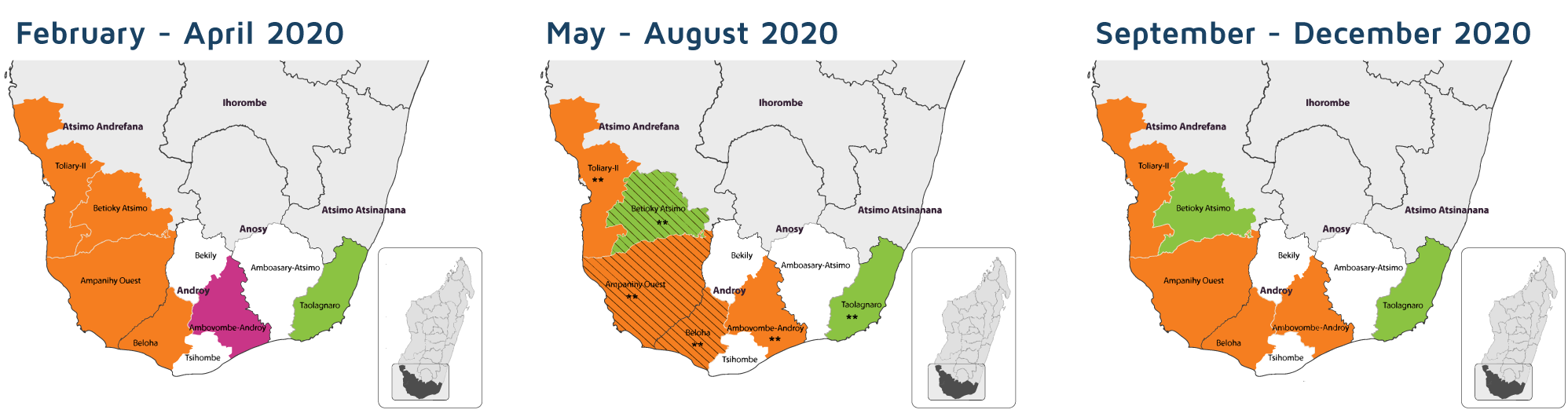
At the beginning of October, the World Bank, the European Union, the WFP, UNICEF, and USAID launched Operation Kéré (famine in Malgasy) which aims to send urgent water and food support to the Amboasary community.