
Add us as your preferred source on Google to see more of our content in Search.
 Add to Preferred Sources
Strict British and US counter-terrorism laws are discouraging humanitarian organisations from delivering vital emergency assistance to millions of people facing starvation and fatal diseases in drought-hit Somalia. Senior humanitarian officials say the laws, which target any individual or organisation found to have materially assisted a terrorist group, exert a “chilling effect” on vital assistance in areas of Somalia controlled by Islamic militants from al-Shabaab, an al-Qaida affiliate. The worst drought for 40 years in the unstable east African country threatens 6 million people with famine. Most of the worst hit – around 2 million people – live in areas run by al-Shabaab.
“US and UK terrorism financing laws are a significant discouragement to operating in al-Shabaab areas. At the very least, you could end up wasting a huge amount of time explaining yourself; at worst, if substantial amounts of aid were appropriated by al-Shabaab – as has happened to people in the past – you could end up in court with your organisation shut down,” said the country director of one major international NGO working in Somalia.
Moving any aid by land in Somalia involves paying “taxes” at road blocks run by different armed groups, including al-Shabaab. UN experts estimated that at the height of its power in 2010 al-Shabaab imposed fees and taxes that totalled on average $90,000 (£70,200) per aid agency every six months.
Also, any access to al-Shabaab controlled areas for NGOs would have to involve negotiations with local community and clan elders, of whom some are likely to be connected to the insurgents.
“Once you get past [the security issues], that becomes a consideration and you have to figure out how you can work there … It has a chilling effect. I’m sure in Washington or London it’s clear what [the laws] meant but here it is much more difficult,” Justin Brady.
Senior UN officials in Somalia recently sought clarification from the US and the UK about potential prosecution. Unofficial advice to NGOs, given via the UN, is that “a blind eye” is being turned to any humanitarian operations in al-Shabaab controlled zones following legal changes to allow a “humanitarian exception” to the counter-terrorist laws.
British officials last week said the NGOs’ anxiety is unfounded, and pointed out that no one has been prosecuted by the US or the UK under the legislation.
“The bottom line is that there is an emergency and the priority for everyone is getting aid to those who need it, wherever they are,” said David Concar, the British ambassador to Somalia.
Despite the reassurances, deep anxiety remains among aid planners, who say they need clear guidance from the US and UK. This would be politically difficult, as it could be seen as sanctioning negotiations with terrorist organisations.
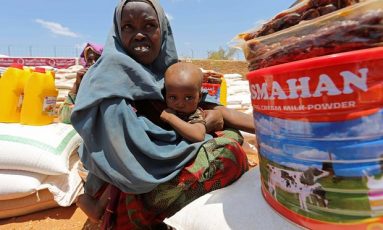 In 2011, during the last major famine, little aid made it into al-Shabaab held areas. One expert report, published after the emergency, listed “constraints on aid agencies related to counter-terrorism legislation” as important factors contributing to the death toll of more than 250,000.
The British government was forced to write off aid worth £480,000 following a series of thefts between November 2011 and February 2012 by al-Shabaab from the offices and warehouses of partner organisations.
In this new crisis, the Islamic militants have allowed women and children, and some men, to leave areas under their control to travel to government-held towns – such as Baidoa, 250km north-west of Mogadishu – where medical assistance, water and food is available.
Senior NGO officials said the laws forced them to “think twice” before undertaking such operations – even if security was guaranteed. Any humanitarian activity is therefore “under the radar”, thus ruling out major interventions.
The UN says it needs $4.4 bn (£3.4 bn) for humanitarian assistance to more than 20 million people facing famine in Somalia, South Sudan, Nigeria and Yemen in what officials have described as the biggest humanitarian emergency since the organisation was founded in 1945.
Source: The Guardian. Read full article here.
26 April, 2017