
Add us as your preferred source on Google to see more of our content in Search.
 Add to Preferred Sources
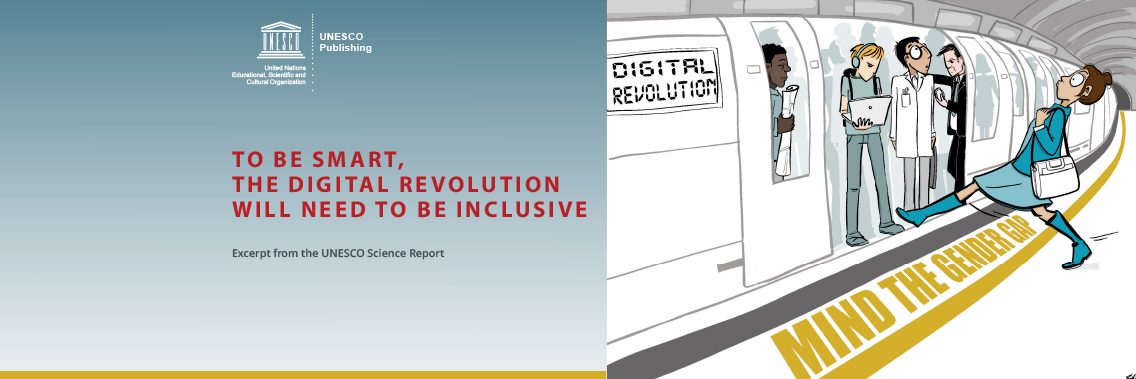
Despite a shortage of skills in most of the technological fields driving the Fourth Industrial Revolution, women still account for only 28% of engineering graduates and 40% of graduates in computer science and informatics, according to the forthcoming UNESCO Science Report, whose chapter on gender in science, entitled To be Smart the Digital Revolution will Need to be Inclusive, is published to mark International Day of Women and Girls in Science.
“Even today, in the 21st century, women and girls are being sidelined in science-related fields due to their gender. Women need to know that they have a place in science, technology, engineering, and mathematics and that they have a right to share in scientific progress,” said Audrey Azoulay, UNESCO Director-General.
The share of women among engineering graduates is lower than the global average for many members of the Organization for Economic Co-operation and Development (OECD). This is the case, for instance, in Australia (23.2%), Canada (19.7%), Chile (17.7%), France (26.1%), Japan (14.0%), the Republic of Korea (20.1%), Switzerland (16.1%), and the USA (20.4%).
There is no distinct regional pattern. Some of the highest proportions of female engineering graduates can be found in the Arab States, for example in Algeria (48.5%), Morocco (42.2%), Oman (43.2%), Syria (43.9%), and Tunisia (44.2%), and in Latin America where women account for 41.7% of engineering graduates in Cuba, 47.5% in Peru and 45.9% in Uruguay. Wide disparities are also to be found among countries of the same region.
The chapter also highlights the fact that women are not benefitting fully from employment opportunities open to highly educated and skilled experts in cutting edge fields such as artificial intelligence where only one in five professionals (22%) is a woman, according to a 2018 study by the World Economic Forum on the Global Gender Gap.
Likewise, women founders of start-ups still struggle to access finance and, in large tech companies, they remain underrepresented in both leadership and technical positions. They are also more likely than men to leave the tech field, often citing poor career prospects as a key motivation for their decision. Corporate attitudes towards women are evolving, however, as studies link investor confidence and greater profit margins to having a diverse workforce.
Women need to be part of the digital economy to prevent Industry 4.0 from perpetuating traditional gender biases. As the impact of artificial intelligence on societal priorities continues to grow, the underrepresentation of women’s contribution to research and development means that their needs and perspectives are likely to be overlooked in the design of products that impact our daily lives, such as smartphone applications.
The glass ceiling also remains an obstacle to women’s careers in academia, despite some progress. Globally, women have achieved numerical parity (45–55%) at the bachelor’s and master’s levels of study and are on the cusp at PhD level (44%), according to the UNESCO Institute for Statistics.
The gender gap widens as women progress in their academic careers, with lower participation at each successive rung of the ladder from doctoral student to assistant professor to director of research or full professor.
Overall, female researchers tend to have shorter, less well-paid careers. Their work is underrepresented in high-profile journals and they are often passed over for promotion. Women are typically given smaller research grants than their male colleagues and, while they represent 33.3% of all researchers, only 12% of members of national science academies are women.
The gender bias is also found in peer-review processes and at scientific conferences at which men are invited to speak on scientific panels twice as often as women.