
Add us as your preferred source on Google to see more of our content in Search.
 Add to Preferred Sources
On the eve of the tenth anniversary of the Syrian conflict and crisis, the Commission criticises the warring parties’ readiness to sacrifice fundamental rights for short-lived political gains or under the pretext of fighting terrorism, and the enabling selectivity shown by those supporting the Government of Syria or the different warring parties. It calls for a reinvigoration of international efforts to end the conflict and put the country on a path toward peace and justice.
In a 20-page (31 with annexed maps) report, the Commission of Inquiry on the Syrian Arab Republic recalls the most heinous of violations of international humanitarian and human rights law perpetrated against the civilian population in Syria since March 2011. Such acts are likely to constitute crimes against humanity, war crimes, and other international crimes, including genocide.
“Parties to this conflict, have benefitted from the selective intervention and woeful negligence of the international community, that has left no Syrian family unscathed,” said Commission Chair Paulo Pinheiro. “The children, women, and men of Syria have paid the price as a brutal authoritarian Government unleashed overwhelming violence to quell dissent. Opportunistic foreign funding, arms, and other support to the warring parties poured fuel on this fire that the world has been content to watch burn”, he continued. “It is far past time to finally put Syrians first – and expend every effort to support a peaceful, negotiated resolution to the conflict and to help place Syria on a path toward a stable, prosperous, and just future for all her people”, he concluded.
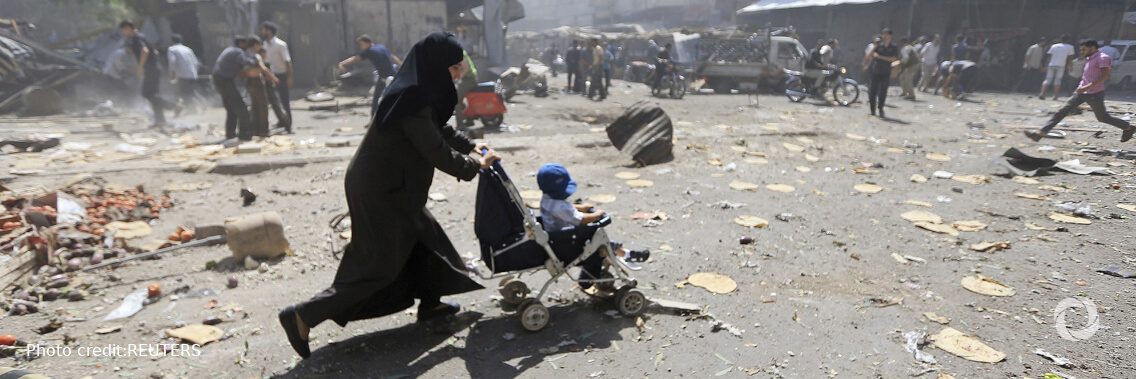
After ten years, more than half of the pre-conflict population is internally or externally displaced, cities have been reduced to rubble, and a constellation of armed actors continues to prey on the population. Syrians in population centres have suffered vast aerial and artillery bombardments; they have endured chemical weapons attacks, modern-day sieges leading to starvation, and shameful restrictions on humanitarian aid – both cross-line and cross-border, the latter even with the approval of the Security Council.
“As a significant refugee hosting country in past, it is unconscionable that for ten years, humanitarian aid has been consistently delayed, denied, and instrumentalised – despite the clear and consistent needs of so many Syrians, as well as Palestinian and other refugees,” observed Commissioner Karen Koning AbuZayd. “There are basic human rights and humanitarian needs – food, water, health care, and education – that must be met regardless of which group controls a given territory. With a medical sector vastly diminished by deliberate targeting, incidental damage, and the flight of medical workers, the COVID-19 pandemic that has wreaked havoc on medical systems in many high-income countries is the overwhelming remaining medical staff and other frontline workers in Syria –” she continued. “Principled and rights-based humanitarian access must be restored without further delay,” she concluded.
While all parties to the conflict remain largely unwilling to transparently investigate and make public findings in relation to alleged misconduct of their own forces, let alone prosecute perpetrators – the report outlines positive prosecutorial developments in third State national jurisdictions, and notes the Commission’s contribution to more than 60 such investigations, drawing on its nearly 8,000 interviews and initial information concerning more than 3,200 alleged individual perpetrators.
The report concludes that innovative solutions must be pursued to also address the broader justice needs of Syrians, inspired by creative approaches taken to address criminal prosecutions and the preservation of evidence in the Syrian conflict.